
If you are replacing your HVAC system in 2026 or getting quotes on a new heat pump or air conditioner, you are probably hearing new refrigerant names that did not matter much a few years ago.
The two biggest names homeowners are seeing now are:
- R-454B
- R-32
And naturally, people want to know:
“Which one is better?”
Here’s the plain answer:
For most homeowners, the refrigerant itself is less important than the quality of the installation, ductwork, airflow setup, and equipment design. But there are real differences between R-454B and R-32 that affect efficiency, availability, long-term servicing, and manufacturer choices.
And because the HVAC industry is transitioning away from older refrigerants like R-410A, understanding these changes matters more than it used to.
Especially if you are investing thousands into a new system.
Upgrade to the Right Refrigerant
Stay ahead of 2026 HVAC changes with expert advice, quality installation, and dependable service you can trust.
First: Why Refrigerants Are Changing at All
Older HVAC systems commonly used:
- R-22 (older systems)
- R-410A (most modern systems from the last 15–20 years)
But environmental regulations are pushing the industry toward refrigerants with lower Global Warming Potential (GWP).
That is why manufacturers are now shifting toward:
- R-454B
- R-32
These newer refrigerants are designed to reduce environmental impact while still delivering strong cooling performance.
But the transition has created confusion because homeowners assume:
- newer automatically means better
- all brands are using the same refrigerant
- refrigerants are interchangeable
None of those are fully true.
The Biggest Thing Homeowners Need to Understand
You cannot simply “swap” refrigerants between systems.
An R-410A system is engineered specifically for R-410A.
Likewise:
- R-454B systems are designed around R-454B
- R-32 systems are designed around R-32
The equipment, pressures, oil compatibility, controls, sensors, and safety standards are all engineered around the refrigerant being used.
This is where homeowners sometimes get into trouble.
They hear:
“We can just convert it later.”
Usually, that is not realistic or financially smart.
What Is R-454B?
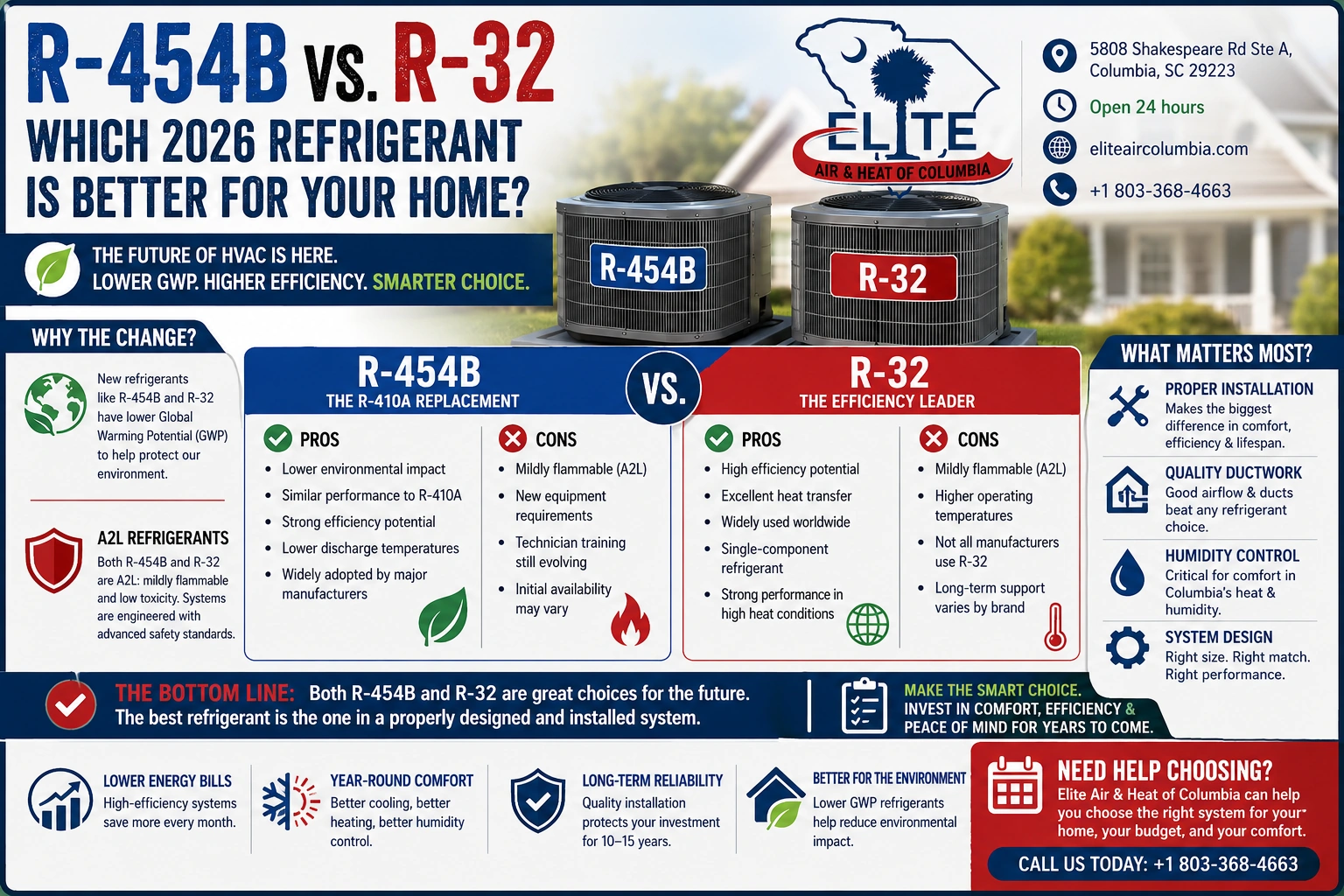
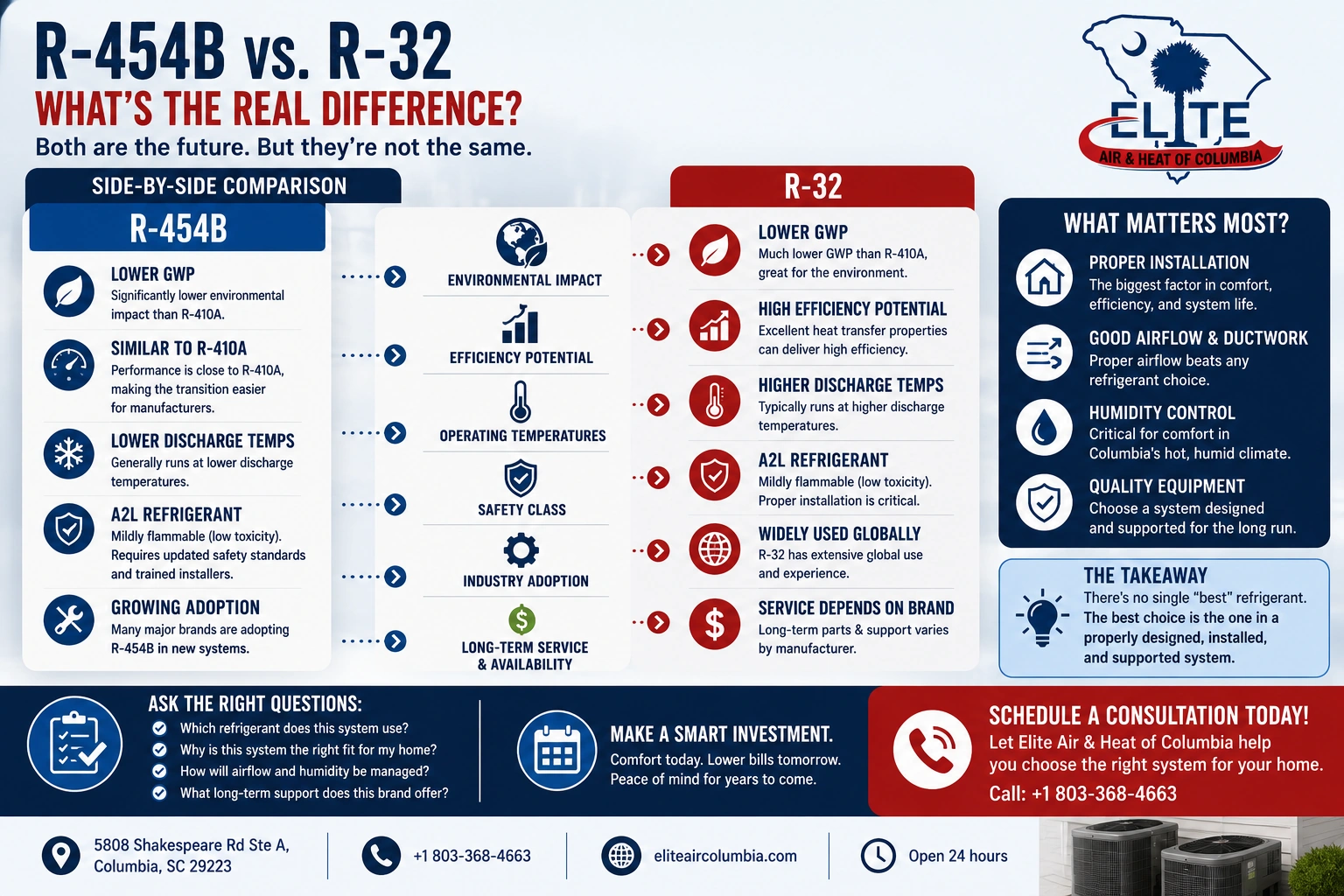
R-454B is one of the leading R-410A replacement refrigerants being adopted by many major HVAC manufacturers.
It was designed specifically as a lower-GWP alternative while maintaining performance characteristics similar to R-410A.
That matters because it allows manufacturers to adapt existing system designs more easily.
Pros of R-454B
Lower Environmental Impact
R-454B has significantly lower GWP than R-410A.
That is one of the primary reasons manufacturers are moving toward it.
Familiar Performance Characteristics
For many HVAC manufacturers, R-454B behaves similarly enough to R-410A that system redesigns are somewhat easier.
Strong Efficiency Potential
Many new high-efficiency systems are being developed around R-454B platforms.
Lower Discharge Temperatures
Compared to R-32, R-454B generally operates with somewhat lower discharge temperatures, which some manufacturers prefer for compressor longevity.
Cons of R-454B
Mild Flammability
Like R-32, R-454B falls into the A2L refrigerant category.
That means:
- low toxicity
- mildly flammable
This sounds alarming to homeowners, but the systems are engineered with safety standards specifically for these refrigerants.
Still, installation requirements matter more now.
New Equipment Requirements
A2L systems require:
- updated safety standards
- leak detection considerations
- proper ventilation rules
- trained technicians
This is not a DIY transition.
Availability and Technician Familiarity
Because the transition is still relatively new, some areas may initially experience:
- equipment shortages
- technician learning curves
- supply inconsistencies
What Is R-32?
R-32 is another major lower-GWP refrigerant gaining traction worldwide.
In fact, R-32 has already been used extensively in many countries for years.
Some manufacturers strongly prefer it because of its efficiency characteristics and simpler refrigerant composition.
Pros of R-32
Higher Efficiency Potential
R-32 can offer excellent heat transfer and efficiency performance.
In properly designed systems, this can help lower operating costs.
Widely Used Globally
R-32 already has significant worldwide adoption, which may help long-term familiarity and support.
Simpler Refrigerant Composition
Unlike blended refrigerants, R-32 is a single-component refrigerant.
That can simplify certain servicing considerations.
Strong Performance in Heat
R-32 systems can perform very well in demanding cooling conditions like Columbia summers.
Cons of R-32
Higher Operating Temperatures
R-32 tends to operate with higher discharge temperatures than R-454B.
That does not automatically mean it is bad, but system engineering becomes very important.
Mild Flammability
Like R-454B, R-32 is also classified as A2L mildly flammable.
Again, proper installation matters.
Manufacturer Differences
Not every manufacturer is committing to R-32.
That means:
- parts availability
- long-term service familiarity
- dealer support
may vary depending on the brand you choose.

The Cost of a 15-SEER2 vs. 20-SEER2 System: When Is the “Break-Even” Point?
When homeowners in Columbia, SC compare a 15-SEER2 HVAC system with a 20-SEER2 system, one of the first questions we…
Which Refrigerant Is More Efficient?
This is where online discussions often become oversimplified.
Homeowners sometimes assume:
“R-32 is more efficient.”
or
“R-454B is better.”
The reality is more complicated.
Efficiency depends far more on:
- equipment engineering
- installation quality
- airflow design
- ductwork
- humidity control
- system sizing
than refrigerant choice alone.
A poorly installed high-efficiency system with the “better” refrigerant can still perform terribly.
Meanwhile, a properly installed system with excellent airflow and duct design can dramatically outperform expectations.
A good technician should explain the entire system design, not just sell the refrigerant name.
What About Safety?
This is one of the biggest homeowner concerns.
Both R-454B and R-32 are A2L refrigerants.
That means they are:
- low toxicity
- mildly flammable under certain conditions
Important:
This does not mean your house becomes dangerous.
Gas furnaces, natural gas appliances, propane systems, and many common household products already involve combustible materials.
The HVAC industry has developed updated:
- safety codes
- installation standards
- ventilation requirements
- leak mitigation procedures
for these newer refrigerants.
The bigger issue is making sure:
- the installation is done correctly
- the contractor is trained on A2L systems
- the equipment matches code requirements
Which Refrigerant Will Be Easier to Service?
This is still evolving.
Some manufacturers are heavily committing to R-454B.
Others are favoring R-32.
Right now, the more important question is often:
“Which refrigerant does my preferred manufacturer support long-term?”
Because service availability often follows manufacturer adoption.
If a contractor strongly recommends one system over another, ask:
- why they prefer it
- what refrigerant it uses
- what long-term parts support looks like
- whether technicians are trained for it
What Homeowners Should Actually Focus On
Most homeowners are focusing on the wrong thing entirely.
The refrigerant matters.
But these matter more:
Proper System Sizing
Oversized systems create humidity problems in Columbia homes.
Ductwork Quality
Bad ductwork can destroy efficiency no matter what refrigerant is used.
Humidity Control
In Columbia’s heat and humidity, moisture removal matters just as much as cooling.
Installation Quality
Poor brazing, airflow setup, refrigerant charging, or commissioning can shorten system life dramatically.
Static Pressure and Airflow
This is one of the most overlooked parts of HVAC replacement.
Should You Wait to Buy Because of Refrigerant Changes?
Some homeowners are delaying replacement because they are nervous about the transition.
That is understandable.
But waiting only makes sense if:
- your current system is stable
- repair costs are reasonable
- efficiency is acceptable
If your current system:
- keeps breaking down
- struggles with humidity
- uses expensive R-22 refrigerant
- runs constantly
- creates huge utility bills
then delaying may cost more than moving forward.
What About Existing R-410A Systems?
R-410A systems are not suddenly illegal.
Existing systems can still be:
- serviced
- repaired
- maintained
But over time:
- refrigerant costs may rise
- equipment availability will shrink
- replacement parts may become more expensive
That does not automatically mean replacing a functioning system today is necessary.
The Bottom Line
For most homeowners, the “better” refrigerant is the one inside a properly designed, properly installed HVAC system backed by good long-term support.
Both R-454B and R-32 are major parts of the HVAC industry’s future.
R-454B tends to appeal to manufacturers wanting performance characteristics closer to R-410A.
R-32 offers strong efficiency potential and already has broad global use.
But neither refrigerant can overcome:
- bad ductwork
- poor airflow
- improper sizing
- weak humidity control
- low-quality installation
If you are replacing your HVAC system in 2026, the most important thing is not memorizing refrigerant names.
It is making sure the contractor can explain:
- why the system was selected
- how airflow will be managed
- how humidity will be controlled
- what refrigerant the manufacturer supports long-term
- and how the installation will affect comfort and operating costs over the next 10–15 years
If you are comparing HVAC replacement options in the Columbia area, Elite Air & Heat of Columbia can help you understand the real-world differences between equipment choices, refrigerants, efficiency claims, and installation quality before you make a long-term decision.
Need Help Choosing a New AC?
Our HVAC professionals can explain your refrigerant options and recommend the best system for long-term comfort and efficiency.