
If you are replacing your HVAC system in South Carolina, there is a good chance the conversation eventually turns into:
“Should I go with Carrier or Trane?”
And honestly, that is a fair question.
Both brands have strong reputations.
Both build premium HVAC equipment.
Both are common throughout Columbia and the Midlands.
And both can cool a house effectively during brutal South Carolina summers.
But here’s the plain answer:
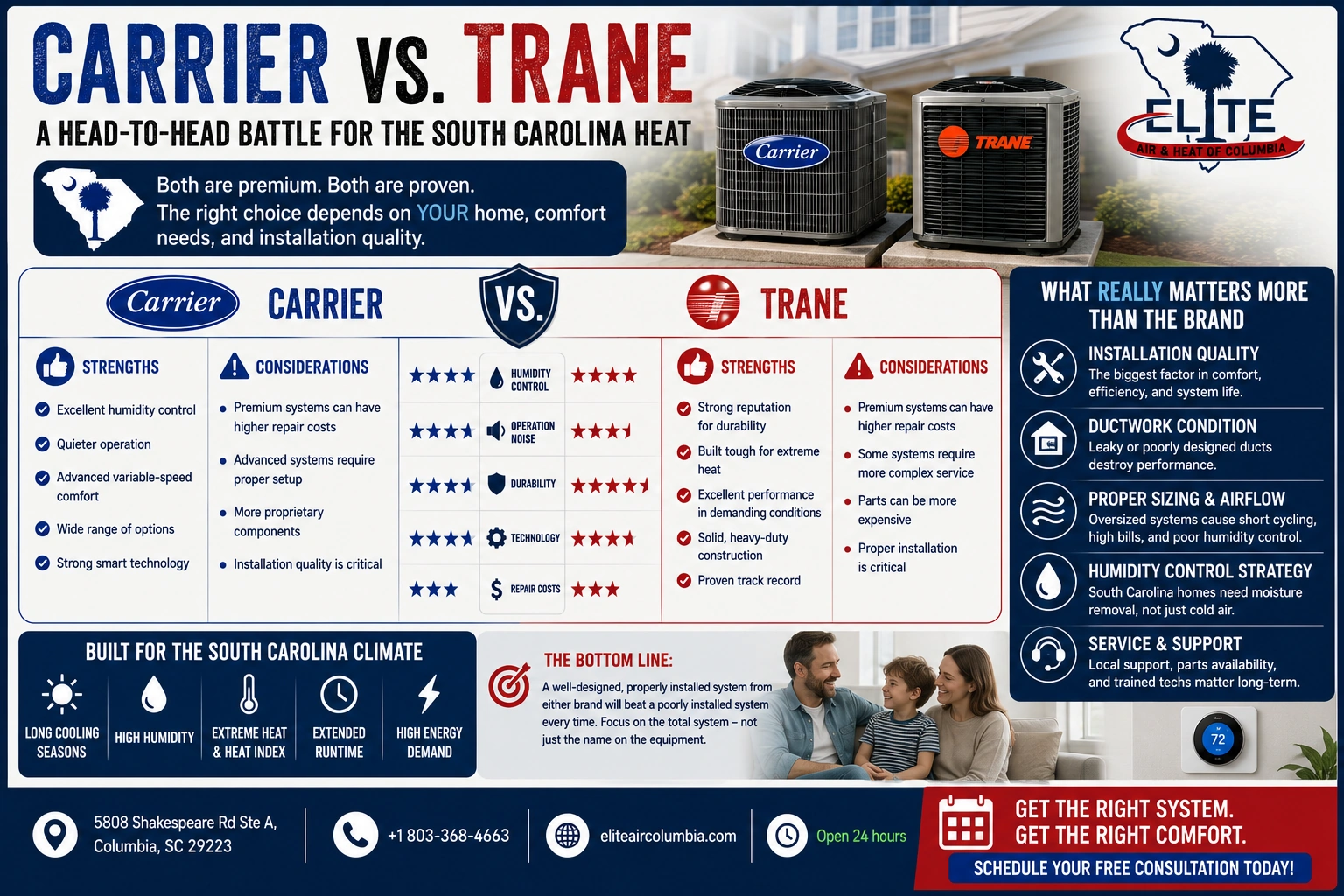
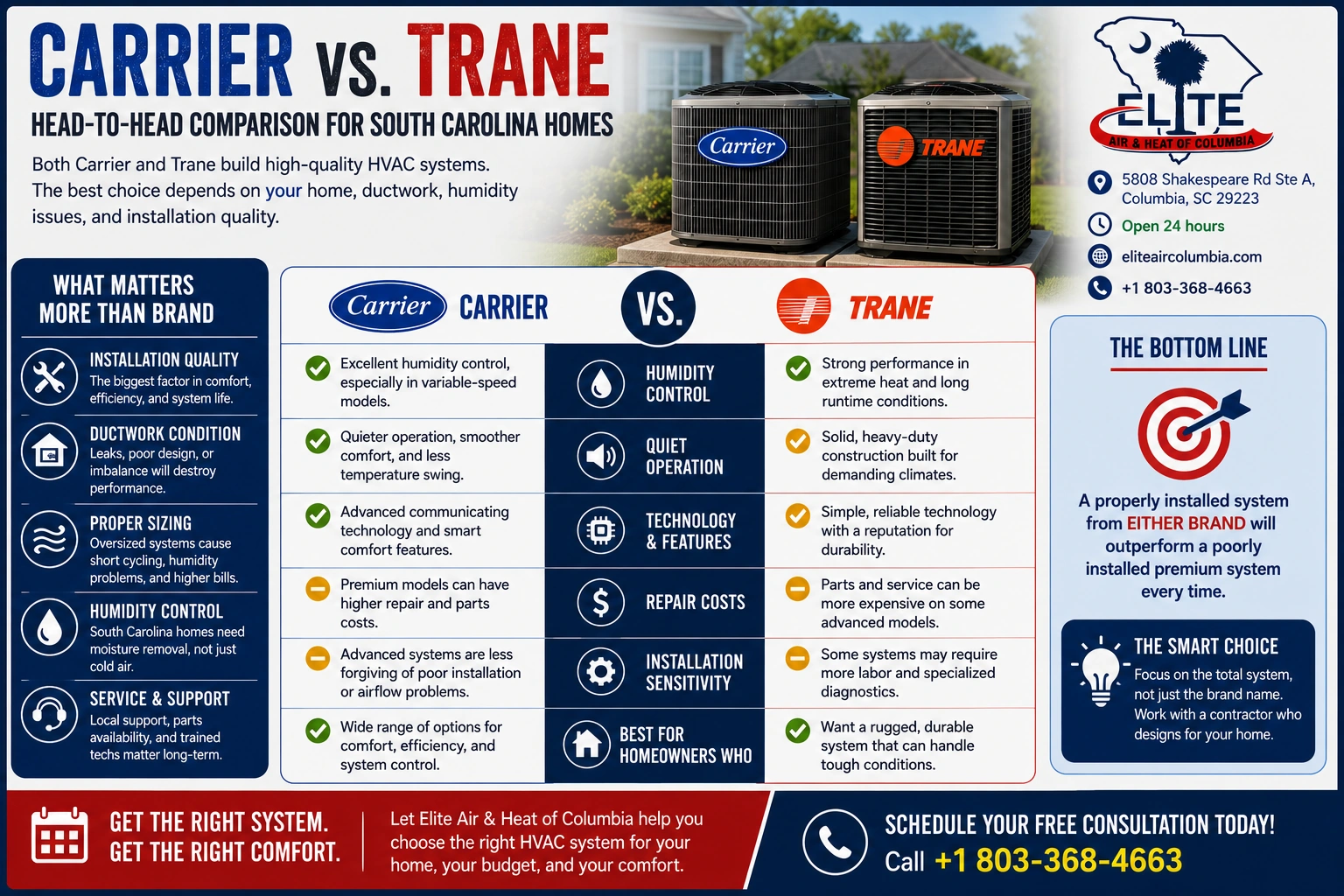
Neither Carrier nor Trane is automatically “better” for every home. The right choice depends more on your house, ductwork, humidity issues, installation quality, repair priorities, and long-term goals than the logo on the equipment.
That may sound like a dodge, but experienced HVAC technicians know it is true.
A perfectly installed mid-tier system will usually outperform a poorly installed premium system.
Still, there are meaningful differences between Carrier and Trane that homeowners should understand before spending thousands on a replacement.
Upgrade to the Right Cooling System
Compare Carrier and Trane with help from experienced HVAC professionals. Schedule your consultation today.
First: Why South Carolina Is Hard on HVAC Systems
Before comparing brands, it helps to understand what HVAC systems are up against here.
South Carolina cooling is demanding because systems deal with:
- long cooling seasons
- heavy humidity
- extended runtime
- high attic temperatures
- moisture removal demands
- sudden weather swings
- high summer electrical usage
In Columbia’s heat and humidity, comfort is not just about lowering temperature.
The system also has to:
- control moisture
- maintain airflow
- cycle correctly
- avoid oversized short-cycling
- handle long afternoon runtime
That means the “best” system is often the one that manages humidity and airflow consistently, not necessarily the one with the flashiest efficiency number.
Carrier: What Homeowners Like
Carrier has been one of the biggest names in HVAC for decades, and many homeowners like Carrier because the systems are often known for:
- quieter operation
- strong humidity control
- wide product variety
- advanced communicating technology
- efficient variable-speed performance
Carrier systems are especially popular in homes where:
- comfort consistency matters
- humidity control is a major concern
- homeowners want quieter indoor operation
Carrier Strengths
Excellent Humidity Control
Carrier’s higher-end variable-speed systems often perform very well in humid climates because they can run at lower capacities for longer periods.
That matters in South Carolina.
Longer, slower cooling cycles usually remove humidity more effectively than oversized systems blasting cold air quickly and shutting off.
A house that is technically “72 degrees” can still feel uncomfortable if humidity stays high.
Carrier tends to do well here when installed correctly.
Quiet Operation
Many Carrier systems are extremely quiet, especially premium models.
Homeowners upgrading from older single-stage systems often notice:
- smoother airflow
- less temperature swing
- less startup noise
- quieter outdoor units
Strong Smart Technology
Carrier offers advanced communicating systems that can optimize:
- airflow
- staging
- humidity management
- efficiency performance
But this also creates tradeoffs.
More advanced systems can mean:
- more proprietary parts
- higher repair costs
- greater dependence on proper setup
Carrier Weaknesses
Repair Costs Can Be Higher
Advanced communicating equipment can sometimes mean:
- more expensive control boards
- proprietary components
- specialized diagnostics
That does not make Carrier unreliable.
It just means repairs on premium systems may cost more than homeowners expect.
Installation Quality Matters Immensely
Carrier’s advanced systems are less forgiving of poor installation.
Bad airflow design or improper setup can create:
- humidity problems
- efficiency loss
- comfort complaints
- airflow imbalance
A good technician should commission the system properly, not simply install equipment and leave.
Trane: What Homeowners Like
Trane has built a reputation around durability and heavy-duty construction.
Many homeowners and contractors view Trane as:
- rugged
- reliable
- mechanically solid
- built for demanding climates
Trane systems are common throughout the Southeast because they are often viewed as capable of handling long, punishing cooling seasons.
Trane Strengths
Strong Reputation for Durability
Trane has long marketed itself around toughness.
And many technicians will tell you older Trane systems often develop reputations for surviving difficult conditions well.
That matters in South Carolina, where systems can run hard for months.
Excellent Build Quality
Trane equipment often feels mechanically substantial.
Homeowners sometimes notice:
- sturdy cabinet construction
- solid compressor performance
- durable system design
This contributes to Trane’s long-standing reputation.
Good Performance in Extreme Heat
Trane systems are often praised for maintaining cooling performance during extreme summer temperatures.
That matters during:
- July heat waves
- high humidity afternoons
- nonstop runtime periods
Trane Weaknesses
Parts and Repair Costs
Like Carrier, Trane premium systems can also involve:
- expensive parts
- proprietary components
- higher repair costs
Especially on communicating or variable-speed equipment.
Some Repairs Can Be More Complex
Certain Trane designs may require:
- more labor-intensive service
- brand-specific expertise
- specialized diagnostics
Again, this does not make them bad systems.
But homeowners should understand that premium equipment usually comes with premium repair economics.

The Cost of a 15-SEER2 vs. 20-SEER2 System: When Is the “Break-Even” Point?
When homeowners in Columbia, SC compare a 15-SEER2 HVAC system with a 20-SEER2 system, one of the first questions we…
The Bigger Question: Single-Stage vs. Variable-Speed
This is where the conversation becomes more important than the brand itself.
Many homeowners focus heavily on:
- Carrier vs. Trane
But ignore:
- system type
- staging
- airflow
- humidity management
A properly installed variable-speed system from either brand can dramatically outperform an oversized single-stage system in South Carolina humidity.
Why?
Because variable-speed systems:
- run longer at lower output
- remove humidity better
- maintain steadier temperatures
- avoid large temperature swings
- often reduce noise levels
But they also:
- cost more upfront
- contain more electronics
- can involve more expensive repairs later
The cheaper option is not always wrong, but it should make sense for your home and budget.
What Actually Matters More Than Brand
This is where homeowners sometimes get into trouble.
They spend weeks researching brand rankings online while ignoring the factors that affect comfort far more.
1. Installation Quality
This is the biggest factor.
A poorly installed premium system can:
- short cycle
- struggle with humidity
- develop airflow problems
- consume excess energy
- fail early
Meanwhile, a properly installed system with correct airflow can perform beautifully for years.
2. Ductwork Condition
Bad ductwork ruins HVAC performance.
Period.
You can install the best Carrier or Trane system available, but if the duct system has:
- leakage
- undersized returns
- crushed flex ducts
- airflow imbalance
the house may still feel uncomfortable.
A good contractor should inspect the duct system, not just quote equipment.
3. Proper Sizing
Oversized systems are extremely common in the South.
And oversized equipment creates:
- humidity problems
- short cycling
- uneven temperatures
- poor comfort
Bigger is not automatically better.
A load calculation matters.
4. Humidity Control Strategy
South Carolina homes need humidity management.
A system that cools quickly but leaves the home damp can still feel miserable.
This is especially important in:
- older homes
- homes with crawlspaces
- shaded homes
- large two-story homes
5. Service Support
Ask yourself:
- Which contractor services the brand well locally?
- Which company stocks parts?
- Which technicians actually know the equipment?
The quality of long-term support often matters more than online brand arguments.
Which Brand Is Better for Older Homes?
Older homes in Columbia often have:
- airflow limitations
- undersized returns
- uneven temperatures
- humidity imbalance
- aging ductwork
In these situations, the installation strategy matters far more than the logo.
Sometimes a simpler two-stage system may outperform an ultra-complex variable-speed setup if the house itself has airflow limitations.
A good technician should explain:
- what your home can realistically support
- whether duct upgrades are needed
- whether zoning makes sense
- whether humidity control should be prioritized
Which One Lasts Longer?
Homeowners love asking this question.
But lifespan depends heavily on:
- maintenance
- airflow
- installation quality
- humidity management
- duct condition
- runtime stress
Both Carrier and Trane can last a very long time when:
- installed correctly
- maintained properly
- matched to the home
And both can develop problems early if airflow and installation are poor.
So Which Should You Choose?
Carrier May Be Better If:
- humidity control is your top priority
- you want quieter operation
- you value comfort consistency
- you prefer advanced comfort features
Trane May Be Better If:
- durability reputation matters most to you
- you want robust mechanical performance
- your home experiences heavy runtime demands
- you prefer a more rugged system feel
But honestly?
The contractor matters more than the sticker.
If you only remember one thing, remember this:
A high-end HVAC system installed poorly is still a poor HVAC system.
The Bottom Line
Carrier and Trane both build strong HVAC systems capable of handling South Carolina heat.
Neither brand is universally superior.
The real difference usually comes down to:
- installation quality
- airflow design
- humidity management
- ductwork condition
- proper sizing
- long-term service support
A good HVAC contractor should be able to explain:
- why a particular system fits your home
- how humidity will be controlled
- whether the ductwork can support the equipment
- what repair costs may look like long-term
- and whether premium features are actually worth paying for
If you are comparing Carrier vs. Trane for your Columbia-area home, Elite Air & Heat of Columbia can help you evaluate the real-world differences in comfort, humidity control, efficiency, repair considerations, and installation quality before making a long-term HVAC investment.
Still Deciding Between Carrier & Trane?
Get expert guidance to choose the right HVAC system for your South Carolina home. Call today for trusted advice and installation.