

When your air conditioner quits in the middle of a South Carolina summer or your heat pump fails during a cold snap, financing may not have been part of your plan.
Most homeowners do not wake up expecting to spend thousands of dollars on an HVAC system. Yet when a major repair or replacement becomes necessary, the decision often comes down to two questions:
- How quickly can the problem be fixed?
- How can we pay for it without creating financial stress?
Here’s the plain answer: low-interest HVAC financing can make a necessary repair or replacement more manageable, but not every financing option is created equal. The best choice depends on your budget, your system’s condition, and how long you expect to stay in your home.
The goal is not simply to find a loan. The goal is to understand the total cost, the monthly payment, and whether financing helps you solve the problem without creating a bigger one later.
Affordable HVAC Payments Start Today
Find flexible financing options that fit your budget. Call now to explore low-interest HVAC loans and schedule your replacement.
Why HVAC Financing Has Become More Common
A decade ago, many homeowners could replace a system using savings alone.
Today, HVAC equipment costs have increased due to:
- Higher manufacturing costs
- Efficiency requirements
- Supply chain pressures
- Refrigerant changes
- Labor costs
- Material costs
In Columbia and throughout the Midlands, homeowners often rely heavily on cooling systems for much of the year. When an aging system finally fails, replacing it can be a significant investment.
Typical HVAC replacement costs may range from:
| HVAC Project | Typical Range |
| Minor Repair | $150 – $800 |
| Major Repair | $800 – $3,000+ |
| Heat Pump Replacement | $6,000 – $15,000+ |
| Central HVAC Replacement | $7,000 – $18,000+ |
| High-Efficiency System Installation | $10,000 – $20,000+ |
The exact cost depends on equipment size, efficiency ratings, ductwork conditions, installation complexity, and home layout.
For many families, financing bridges the gap between what is needed now and what can comfortably fit into the monthly budget.
When Financing Makes Sense
Financing is not always the right answer.
If you have sufficient emergency savings and the expense will not significantly affect your financial stability, paying cash may be the simplest option.
However, financing often makes sense when:
Your System Has Completely Failed
A failed air conditioner during a Columbia summer is more than an inconvenience.
Extended indoor heat can become uncomfortable and potentially unsafe for:
- Young children
- Older adults
- Individuals with medical conditions
- Pets
Waiting months to save enough cash may not be practical.
The Repair Cost Is Approaching Replacement Cost
This is where homeowners sometimes get into trouble.
Suppose a technician recommends a $2,500 repair on a 15-year-old system.
If replacement costs $9,000 and financing allows manageable monthly payments, replacing the system may provide greater long-term value.
That does not automatically mean you need a replacement.
A good technician should be able to explain:
- Remaining equipment life
- Repair likelihood
- Efficiency losses
- Future repair risks
The decision should be based on facts, not pressure.
You Want Predictable Monthly Payments
Many homeowners prefer a fixed monthly payment rather than depleting emergency savings.
Financing can preserve cash reserves for:
- Medical emergencies
- Home repairs
- Vehicle expenses
- Family needs
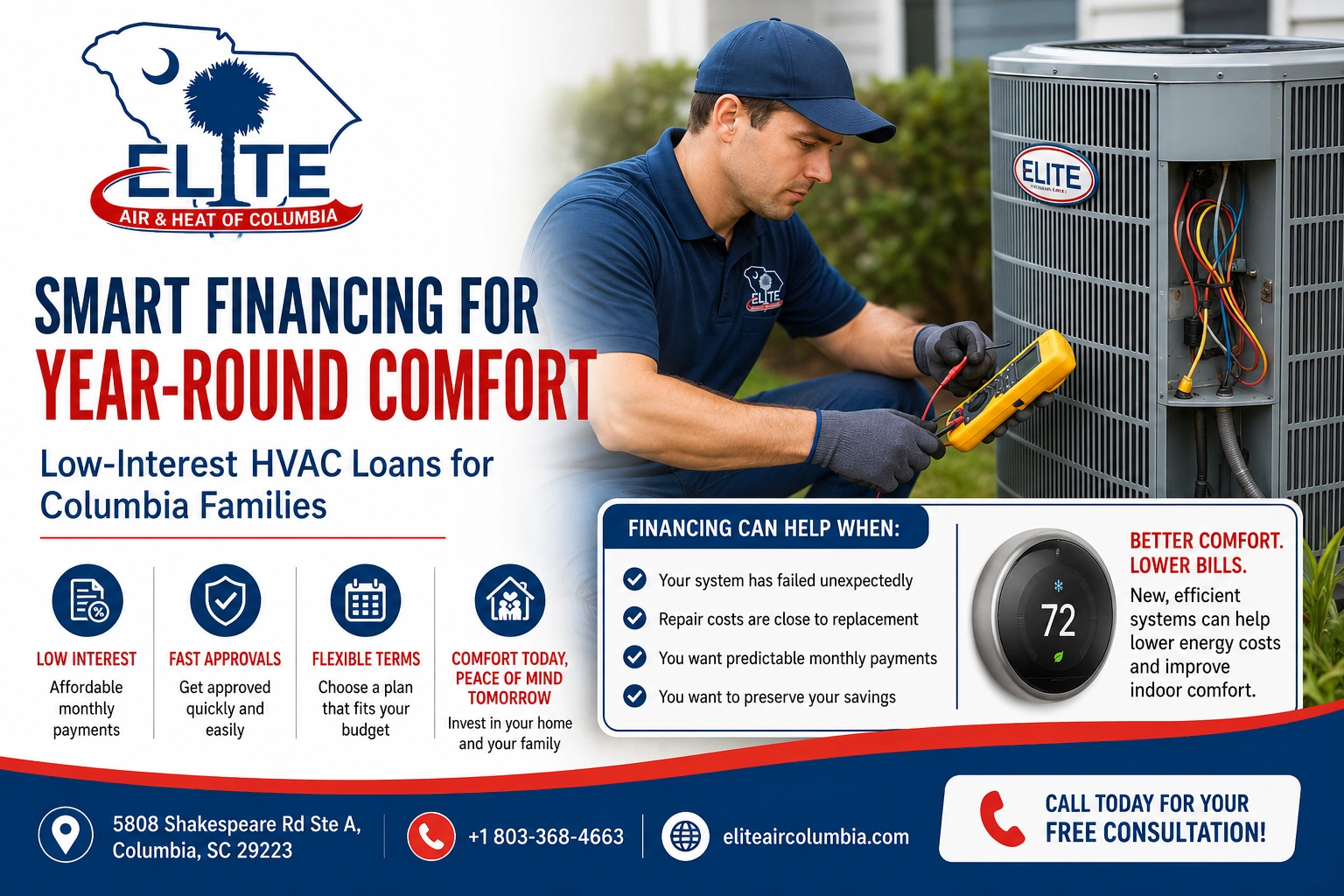
Understanding Low-Interest HVAC Loans
Not all HVAC financing programs are the same.
You may encounter:
Traditional Personal Loans
These loans come through banks, credit unions, or lending institutions.
Advantages:
- Fixed interest rates
- Fixed payments
- No home equity required
Potential drawbacks:
- Credit score requirements
- Interest charges over time
Promotional HVAC Financing
Many HVAC contractors partner with financing providers that offer:
- Deferred interest promotions
- Reduced-interest plans
- Fixed monthly payments
These programs can be attractive, but homeowners should read the details carefully.
A 0% promotional offer can be valuable if paid off within the required timeframe.
However, some deferred-interest plans may apply accumulated interest if the balance remains unpaid after the promotional period.
Always ask:
- Is it truly 0% interest?
- Is interest deferred?
- What happens if I miss a payment?
- What is the interest rate after the promotion ends?
Home Equity Financing
Some homeowners use:
- Home equity loans
- Home equity lines of credit (HELOCs)
Advantages may include:
- Lower interest rates
- Longer repayment periods
Potential drawbacks include using home equity as collateral.
For many HVAC projects, homeowners prefer financing options that do not require leveraging their home.
What Credit Score Do You Need?
The answer varies by lender.
Generally:
| Credit Range | Financing Options |
| Excellent (740+) | Best rates and terms |
| Good (670–739) | Competitive financing |
| Fair (580–669) | Limited options available |
| Below 580 | May require alternative programs |
Some HVAC financing providers offer programs designed for a wider range of credit situations.
If your credit is less than ideal, it is still worth exploring available options before assuming you cannot qualify.
What are the Signs You Need Emergency HVAC Repair?
When your heating or cooling system suddenly stops working, it’s not always clear whether it’s a minor issue or something…
How Much Does Financing Actually Cost?
Monthly payments depend on:
- Total project cost
- Interest rate
- Loan term
- Down payment amount
For example:
| Project Cost | Loan Term | Estimated Monthly Payment* |
| $8,000 | 60 Months | $150–$180 |
| $10,000 | 60 Months | $190–$225 |
| $15,000 | 72 Months | $250–$320 |
*Examples only. Actual terms vary by lender.
A lower monthly payment may sound attractive, but extending repayment typically increases total interest paid.
The cheapest monthly payment is not always the cheapest overall option.
Questions to Ask Before Accepting HVAC Financing
A good contractor should be comfortable answering financing questions.
Ask:
What Is the Total Cost of the Project?
Focus on the full installed price, not just the payment.
What Interest Rate Applies?
Request the exact annual percentage rate (APR).
Are There Prepayment Penalties?
Many homeowners choose to pay loans off early.
Make sure there are no penalties for doing so.
Is the Financing Promotional or Permanent?
Understand when promotional periods end and what happens afterward.
What Warranties Are Included?
Financing should not distract from evaluating the actual installation.
A good estimate should clearly explain:
- Equipment warranties
- Labor warranties
- Maintenance requirements
- Installation scope
What a Good HVAC Financing Conversation Should Sound Like
An honest contractor should never lead with financing.
They should first explain:
- The actual problem
- Repair options
- Replacement options
- Expected lifespan
- Cost differences
Only after those discussions should financing become part of the conversation.
If the first thing you hear is:
“How much can you afford per month?”
before anyone properly diagnoses the system, that is a warning sign.
The goal is not to buy the biggest system or the largest loan.
The goal is to solve the actual comfort problem.
Financing vs. Repairing: Which Is Better?
Many homeowners face this choice.
Repair May Make Sense When:
- Equipment is under 10 years old
- Repairs are relatively minor
- Efficiency remains acceptable
- Breakdown history is limited
Replacement May Make Sense When:
- Equipment is 12–15+ years old
- Repairs are becoming frequent
- Utility bills continue rising
- Major components have failed
- Comfort issues persist
If the issue keeps coming back, replacing parts blindly usually is not the answer.
A good technician should be able to show you why the recommendation makes sense.
Can Financing Help Lower Energy Costs?
Potentially.
Newer HVAC systems often operate more efficiently than aging equipment.
Benefits may include:
- Reduced cooling costs
- Better humidity control
- Improved airflow
- More consistent temperatures
- Fewer repair expenses
In Columbia’s heat and humidity, comfort is not just about temperature.
Humidity management plays a major role in how comfortable your home feels.
For some homeowners, energy savings offset a portion of the monthly financing payment.
However, those savings vary significantly depending on:
- Existing equipment condition
- Home insulation
- Ductwork performance
- Thermostat settings
- Usage habits
A contractor should be careful about promising exact savings.
Red Flags to Watch For
Be cautious if you encounter:
- Pressure to sign immediately
- Financing discussed before diagnosis
- Missing warranty details
- Unclear loan terms
- Extremely low monthly payment focus
- No explanation of repair alternatives
The cheaper option is not always wrong, but it should make sense.
Likewise, the most expensive option is not automatically the best.
If You Only Remember One Thing
Financing should make a necessary HVAC investment manageable—not confusing.
Before agreeing to any loan, make sure you understand:
- The actual HVAC problem
- Whether repair or replacement is appropriate
- Total project cost
- Interest rate
- Monthly payment
- Warranty coverage
- Long-term value
When homeowners understand those pieces, financing becomes a tool rather than a risk.
If your current system is struggling through Columbia’s long cooling season, the next step is a professional evaluation rather than guessing. A good technician should be able to explain the problem, the available options, and whether financing truly makes sense for your situation before asking you to approve the work.
Need a New HVAC but Worried About the Cost?
Flexible financing can make your new system more affordable than you think. Call now to learn about your payment options.