
Mini-splits solve one of the biggest problems in HVAC: how do you heat and cool a room without installing a full network of ductwork?
Then homeowners discover the next question.
Where do you put the indoor unit?
Wall-mounted mini-splits are the most familiar option. They are relatively simple to install, work well in bedrooms and smaller rooms, and put the equipment where it can be easily accessed. The downside is obvious: you can see them.
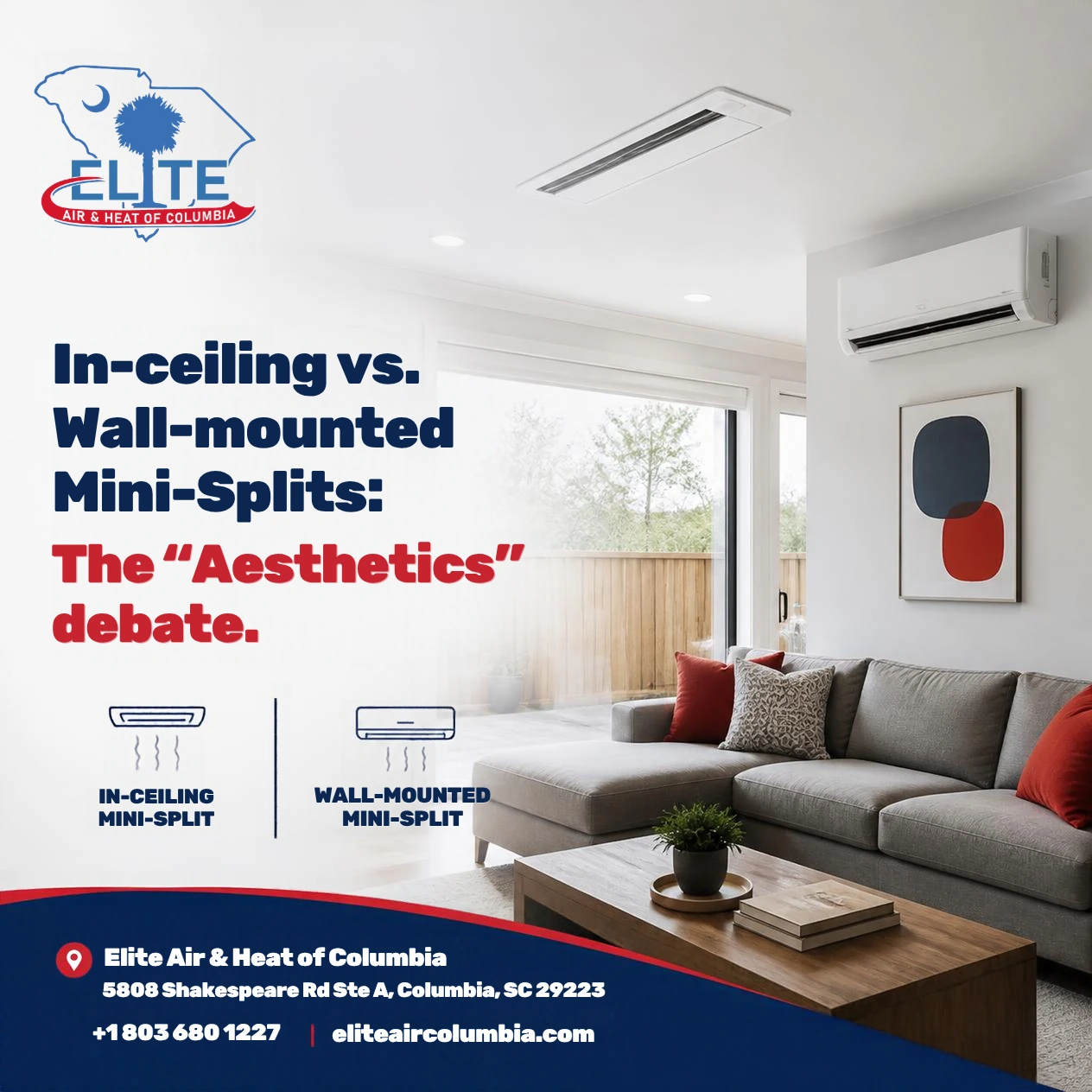
In-ceiling cassette mini-splits take a different approach. Most of the indoor unit is recessed above the ceiling, leaving mainly the grille visible. For homeowners who care about clean walls, architectural details, artwork, or a more built-in appearance, that can make a major difference.
At Elite Air & Heat of Columbia, we install and service ductless mini-split systems for Columbia-area homeowners who need an alternative to conventional ductwork. The best indoor-unit style is not automatically the one that looks the sleekest. Ceiling space, room layout, installation cost, airflow, service access, and the home’s construction all matter.
Here is how wall-mounted and in-ceiling mini-splits compare when appearance is part of the decision.
Want a Mini-Split That Blends In?
Get expert help choosing between in-ceiling and wall-mounted mini-splits. Call now for professional installation!
What Is a Wall-Mounted Mini-Split?
A wall-mounted mini-split uses an indoor air handler installed high on a wall, usually not far below the ceiling.
It connects to an outdoor condenser through refrigerant lines, electrical wiring, and a condensate drain.
These high-wall units are the most common style of ductless indoor equipment. Carrier describes them as the standard high-wall configuration and notes that their elevated placement helps conditioned air move effectively through the room.
The indoor unit contains the evaporator coil, fan, filter, controls, and airflow louvers.
From a practical standpoint, wall-mounted systems have a lot going for them.
They are:
- Straightforward to install in many homes
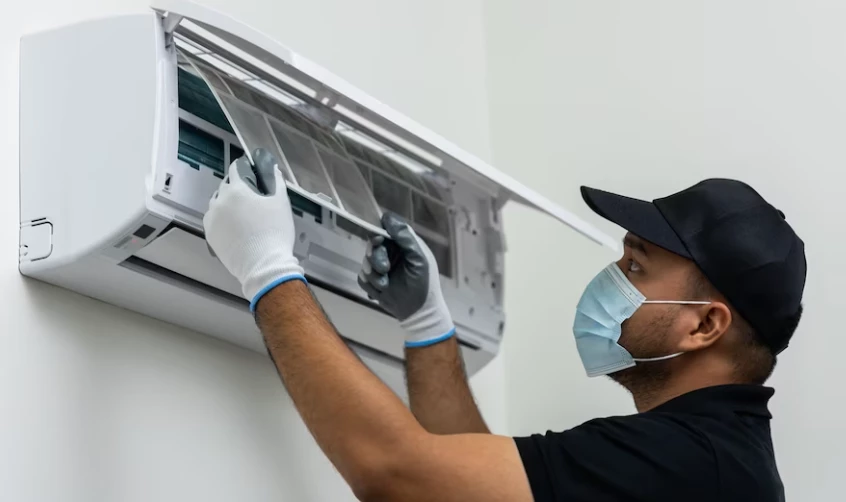
- Easy to access for filter cleaning
- Available in many capacities
- Suitable for single-zone and multi-zone systems
- Effective for bedrooms, offices, bonus rooms, and additions
The biggest objection is usually not performance.
It is appearance.
What Is an In-Ceiling Mini-Split?
An in-ceiling cassette mini-split places most of the indoor air handler above the finished ceiling.
Instead of seeing a rectangular unit mounted on the wall, you generally see a flat grille in the ceiling.
Depending on the cassette design, conditioned air may discharge in one, two, or multiple directions.
Carrier describes ceiling cassettes as recessed indoor units designed so that most of the mechanical equipment is concealed above the ceiling while the visible grille remains relatively unobtrusive.
This makes ceiling cassettes attractive in rooms where interior design is a major consideration.
They can work particularly well in:
- Open living rooms
- Kitchens
- Dining rooms
- Offices
- Large bedrooms
- Renovated older homes
- Rooms with limited wall space
But hiding the unit above the ceiling introduces a different set of installation requirements.
Which One Looks Better?
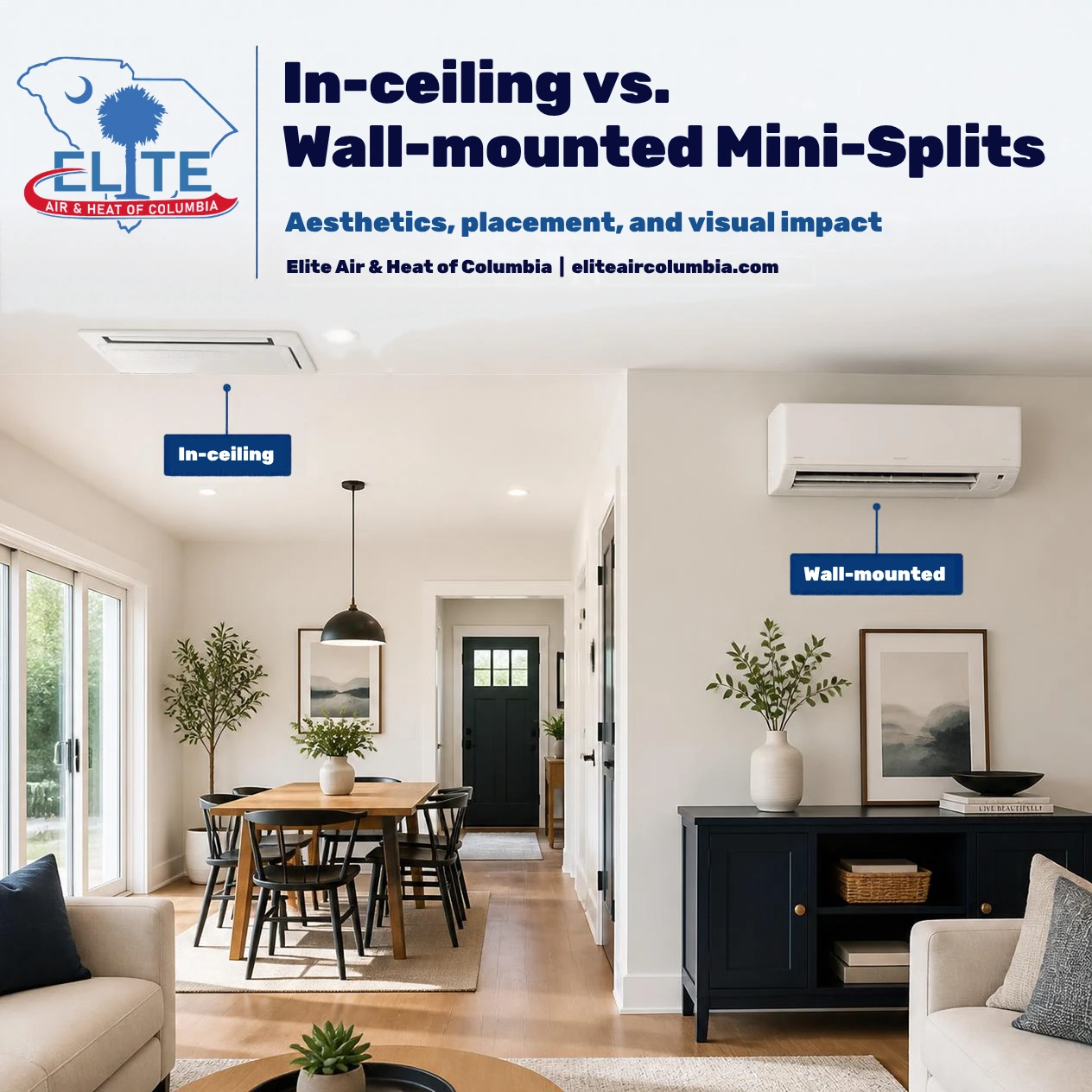
If the goal is minimizing visible HVAC equipment, the ceiling cassette usually has the advantage.
A wall-mounted mini-split is intentionally visible.
Even the most attractive high-wall unit still occupies a noticeable amount of wall space.
A cassette blends more closely with the architecture.
You see a grille in the ceiling instead of a large rectangular housing on the wall.
That distinction can matter in rooms where homeowners have carefully planned:
- Artwork
- Built-in cabinetry
- Tall windows
- Decorative molding
- Accent walls
- Shelving
- Lighting layouts
- Furniture placement
Carrier specifically lists aesthetics as one of the main reasons homeowners consider cassettes, since most of the unit is hidden and wall space remains free.
For some homeowners, that alone settles the debate.
For others, appearance is only one factor.
Why Some Homeowners Do Not Mind Wall-Mounted Units
The appearance issue is subjective.
Some homeowners see a mini-split on the wall and immediately dislike it.
Others stop noticing it after a week.
Modern wall-mounted units are generally much cleaner and more streamlined than older window air conditioners or through-the-wall units. Many use simple white housings with few visible controls.
They can also be positioned strategically.
For example, a wall unit placed:
- Above a doorway
- Over a television
- On a secondary wall
- Near a corner
- Away from the room’s main sightline
may have relatively little visual impact.
Carrier notes that while visible indoor units are a common concern with ductless systems, many homeowners ultimately find the appearance acceptable once the system becomes part of the room.
The question becomes whether hiding the equipment is worth the added installation complexity.
Ceiling Cassettes Preserve Valuable Wall Space
This is one of the strongest arguments for an in-ceiling system.
Wall space can be surprisingly valuable.
A mini-split installed high on a wall can interfere with:
- Tall bookcases
- Built-in cabinets
- Large artwork
- Architectural paneling
- Full-height curtains
- Windows
- Storage
- Interior-design focal points
A ceiling cassette keeps those walls available.
That makes cassettes particularly useful in open-plan rooms where there may already be limited uninterrupted wall space.
Imagine a living room with three walls occupied by windows, sliding doors, cabinetry, or openings into adjacent rooms.
Finding the right wall for a conventional mini-split head can become difficult.
A centrally located ceiling cassette may solve that problem.
But Do You Actually Have Room Above the Ceiling?
This is where aesthetics meets reality.
A recessed cassette cannot simply be attached to any ceiling.
The equipment body needs space above the finished surface.
That means installers must consider:
- Ceiling depth
- Joist spacing
- Roof framing
- Plumbing
- Electrical wiring
- Existing ducts
- Insulation
- Drainage
- Service clearance
Carrier specifically notes that ceiling cassettes require adequate clearance above the ceiling to house the indoor equipment.
That can make installation easy in one house and difficult in another.
A first-floor room beneath an unfinished attic may offer excellent access.
The same room beneath a finished second story may have very limited ceiling space.
A beautiful cassette design is irrelevant if there is nowhere to put the equipment.
Wall Units Usually Win on Installation Simplicity
One reason wall-mounted mini-splits are so common is that installation can be relatively direct.
The indoor unit is mounted on the wall, and a small opening is created for the line set, wiring, and drain.
That does not mean every wall-mounted installation is simple.
Installers still need to consider:
- Exterior access
- Line-set routing
- Condensate drainage
- Electrical connections
- Stud locations
- Outdoor-unit placement
- Proper equipment sizing
But compared with recessing an air handler into a ceiling, wall mounting often involves fewer structural complications.
Carrier describes wall-mounted units as a practical option when ceiling access is limited, while cassettes generally involve a more complex installation.
That often translates into a lower installation cost.
Are Ceiling Cassettes More Expensive?
They often can be.
The equipment itself may cost more, but labor and building modifications are also part of the equation.
A cassette installation may involve:
- Cutting a ceiling opening
- Working between framing members
- Routing a condensate drain
- Relocating obstructions
- Adding framing support
- Creating service access
- Repairing or refinishing portions of the ceiling
Carrier notes that ceiling cassette installations are generally more complex than wall-mounted installations and can carry higher upfront costs as a result.
That does not make them poor value.
If appearance is important enough, the additional cost may be completely justified.
The mistake is assuming the two styles are interchangeable except for how they look.
They are different installation projects.
Which One Distributes Air Better?
This depends heavily on room design.
Wall-mounted systems usually direct conditioned air outward from one side of the room.
Their adjustable louvers allow airflow to be directed horizontally and vertically.
That works extremely well in many standard bedrooms, offices, additions, and bonus rooms.
Ceiling cassettes can distribute air in multiple directions.
A four-way cassette installed near the center of a room can send conditioned air toward several areas at once.
Carrier identifies multi-directional airflow as one of the key advantages of ceiling cassettes, particularly in open rooms and larger spaces.
That can make a cassette particularly attractive for:
- Open kitchens
- Great rooms
- Large primary bedrooms
- Finished basements
- Studios
- Larger offices
But multi-directional airflow does not automatically mean better comfort.
Placement and sizing still matter.
Can a Wall-Mounted Unit Cool a Large Room?
Absolutely, provided it is properly sized and placed.
Homeowners sometimes assume a ceiling cassette must be more powerful because it looks more substantial.
Capacity is determined by the equipment, not simply by the mounting style.
Both wall-mounted and cassette systems are available in different BTU capacities.
Carrier currently offers cassette configurations across a wide range of capacities, while wall-mounted units are also available in numerous sizes for different room loads.
What matters is calculating how much heating and cooling the room actually needs.
That depends on much more than square footage.
An HVAC contractor should also consider:
- Windows
- Insulation
- Ceiling height
- Sun exposure
- Occupancy
- Air leakage
- Room orientation
- Local climate
- Adjacent spaces
Oversizing a mini-split because “more BTUs must be better” can create comfort and humidity issues.
Which One Is Quieter?
Both can be very quiet.
Modern ductless systems are known for relatively low indoor sound levels.
Carrier lists some wall-mounted units with sound ratings as low as approximately 16 decibels and some ceiling cassette models around 23.5 decibels, depending on model and operating conditions.
Those numbers should not be used to declare one entire category quieter than the other.
Different models operate at different sound levels.
Fan speed also matters.
What homeowners generally notice with mini-splits is that the indoor fan operates differently from the large bursts of air associated with some conventional central systems.
For a bedroom or home office, ask to compare the published sound ratings of the specific units you are considering.
Which Looks Better in a Bedroom?
This is where personal preference becomes important.
Some homeowners strongly prefer a ceiling cassette because nothing interrupts the bedroom walls.
That can be especially appealing if the room has:
- A decorative headboard wall
- Artwork
- Large windows
- Crown molding
- Built-in storage
Others prefer the simplicity of a wall unit because it is easier to service and does not require ceiling modifications.
A high-wall unit above a doorway or on a secondary wall may also be barely noticeable.
For bedrooms, we would not recommend choosing solely from a catalog photograph.
Think about where you will actually see the indoor unit from the bed.
A unit that looks prominent on an empty elevation drawing may disappear visually once furniture, curtains, artwork, and lighting are installed.
Which Is Better for an Open-Concept Living Space?
This is one area where ceiling cassettes often deserve serious consideration.
Open-concept rooms can have very little available wall space.
Kitchens may have cabinets.
Dining areas may have windows.
Living-room walls may contain televisions, shelving, artwork, or large openings into other rooms.
A ceiling cassette can avoid those conflicts and distribute air from a more central position.
Carrier specifically identifies larger rooms and open spaces as situations where ceiling cassette airflow can be advantageous.
However, room geometry still matters.
One centrally located cassette may not necessarily serve multiple separated areas equally well.
The system still has to be designed for the actual load.

How Do I Choose the Right HVAC Contractor Near Me?
Looking for an HVAC contractor near you? It can be tricky to know who to trust with your home’s comfort,…
Which Unit Is Easier to Maintain?
Wall-mounted systems usually have the advantage when it comes to everyday access.
Filters are located inside the indoor unit and can typically be accessed from the front.
That makes routine cleaning relatively simple.
Ceiling cassettes also use filters that require cleaning, but they are overhead.
That may mean:
- Using a step ladder
- Removing the grille
- Working above furniture
- Reaching a high ceiling
For a standard eight- or nine-foot ceiling, that may not be a major inconvenience.
For a vaulted or very high ceiling, it becomes more significant.
You should think about maintenance access before choosing a cassette location.
The best-looking position is not always the easiest position to service for the next 10 or 15 years.
What About Condensate Drainage?
Both styles remove moisture from indoor air while cooling.
That moisture has to go somewhere.
Wall-mounted units are often positioned so condensate can drain by gravity through a line routed outdoors.
Ceiling cassettes may require more complex drainage arrangements depending on where they are installed.
Some cassette units incorporate condensate pumps, but the drain still needs a properly designed route.
This is particularly important in Columbia’s humid climate.
A poorly installed condensate system can cause:
- Ceiling stains
- Water damage
- Mold growth
- Drain overflows
- Equipment shutdowns
A hidden indoor unit only looks better when the ceiling around it stays dry.
Which Is Better for Columbia Humidity?
Neither style automatically controls humidity better simply because it is mounted on the wall or ceiling.
Humidity control depends much more on:
- Correct equipment sizing
- Runtime
- Variable-speed operation
- Indoor load
- Air infiltration
- Building insulation
- System controls
Mini-splits remove moisture while cooling in the same basic way other air-conditioning systems do.
If the equipment is oversized, it may lower the room temperature too quickly and reduce the amount of time available for moisture removal.
That matters in Columbia, where summer comfort is not only about temperature.
Proper sizing should come before aesthetics.
Do Ceiling Cassettes Completely Disappear?
No.
They are discreet, not invisible.
You still see the ceiling grille.
Depending on the model, that grille may be fairly large.
That surprises some homeowners who expect something the size of a conventional supply register.
The advantage is that the grille usually looks more integrated with the ceiling than a wall-mounted indoor unit looks with a wall.
But whether that is visually preferable depends on the room.
A designer may prefer a ceiling cassette in a minimalist space.
Another homeowner may prefer to keep the ceiling completely clean and accept a wall-mounted unit instead.
There is no universally correct aesthetic answer.
What If You Want the Mini-Split Completely Hidden?
There is another option worth discussing.
Some mini-split systems use concealed ducted indoor units.
The air handler sits above a ceiling, inside an attic, or in another hidden location and connects to short runs of ductwork.
Only supply and return grilles remain visible.
Carrier describes this arrangement as combining mini-split technology with the more concealed appearance of traditional ducted HVAC.
This can be attractive for homeowners who want:
- Zoned mini-split performance
- Minimal visible mechanical equipment
- Traditional ceiling or wall registers
However, concealed ducted systems require more space and ductwork than a true ductless wall unit or cassette.
They are another option, not automatically the best option.
Wall-Mounted vs. Ceiling Cassette: Which Costs Less to Own?
Installation cost usually favors the wall-mounted unit.
Long-term operating cost is harder to generalize.
Energy use depends primarily on:
- Equipment efficiency
- System sizing
- Room load
- Thermostat settings
- Outdoor temperature
- Operating hours
- Installation quality
The mounting style alone does not determine your electric bill.
That is why homeowners should avoid paying more for a cassette because someone claims it is inherently more efficient.
Compare the actual equipment ratings and system configuration.
Where Do Mini-Splits Make the Most Sense?
Elite Air & Heat of Columbia currently recommends ductless systems particularly for areas such as:
- Bonus rooms
- Finished garages
- Sunrooms
- Additions
- Upstairs bedrooms
- Detached offices
- Older homes with limited duct access
Elite’s current Columbia HVAC guidance also specifically notes the aesthetic tradeoff: indoor mini-split heads are visible, and some homeowners care about that more than others.
We provide ductless mini-split installation, repair, replacement, and maintenance throughout the Columbia area.
That means the conversation does not need to begin with “Which mini-split should I buy?”
It should begin with:
What are we trying to accomplish in this room?
Questions to Ask Before Choosing an Indoor Mini-Split Style
Before making the decision based on appearance, ask:
- Is there enough space above the ceiling for a cassette?
- Will ceiling framing interfere with placement?
- Where can the condensate drain go?
- Will the unit remain accessible for service?
- Is a wall-mounted unit visible from the main seating area?
- Which option distributes air better in this room?
- Is one installation substantially more expensive?
- How loud are the specific models being considered?
- Where will the refrigerant lines run?
- Does the room need one zone or multiple zones?
- Would a concealed ducted mini-split be another option?
Good HVAC design should solve the mechanical and visual problems together.
When a Wall-Mounted Mini-Split Makes More Sense
We would generally lean toward a wall-mounted configuration when:
Installation Simplicity Matters
There is an obvious wall location and no reason to open the ceiling.
Budget Is a Priority
Wall units are generally less expensive and less complicated to install.
Easy Maintenance Matters
Homeowners want convenient access to filters and equipment.
It Is a Bedroom or Small Enclosed Room
A properly positioned wall unit can provide excellent coverage without requiring a central ceiling location.
Ceiling Space Is Limited
There is not enough depth or access for a cassette.
A high-wall unit may not disappear into the architecture, but it can be a very practical solution.
When an In-Ceiling Cassette Makes More Sense
A cassette becomes particularly attractive when:
Appearance Is a Major Priority
The homeowner wants clear walls and less-visible HVAC equipment.
Wall Space Is Limited
Windows, cabinetry, artwork, or architectural details leave few mounting locations.
The Room Is Open and Centralized Airflow Helps
Multi-directional airflow may suit a larger open area.
The Ceiling Is Already Accessible
New construction, renovation work, or an unfinished attic above can make installation much easier.
The Homeowner Accepts the Higher Installation Complexity
The cleaner look is worth additional work and expense.
That is when the aesthetic advantage becomes meaningful rather than purely cosmetic.
So Which Mini-Split Looks Better?
If the only consideration is visibility, most homeowners would probably consider the ceiling cassette more discreet.
But HVAC choices do not happen in an empty design studio.
Your home has framing, ceilings, electrical wiring, plumbing, furniture, windows, insulation, drainage requirements, and a budget.
A wall-mounted mini-split that fits the room correctly can be a much better decision than an expensive cassette forced into an impractical ceiling.
Likewise, putting a large wall unit directly above a carefully designed fireplace or gallery wall simply because installation is easier may leave the homeowner unhappy every time they enter the room.
The best system balances both sides.
It needs to work well, and you need to be comfortable looking at it.
Let Elite Air & Heat Help You Choose a Mini-Split That Fits the Room
A ductless mini-split can solve comfort problems that would otherwise require expensive ductwork, particularly in additions, bonus rooms, older homes, upstairs spaces, and rooms that never seem comfortable with the central HVAC system.
But the indoor unit becomes part of the room.
At Elite Air & Heat of Columbia, we can evaluate the space before recommending where the equipment should go. We currently provide ductless mini-split installation, repair, and replacement services throughout Columbia and surrounding communities, and our installation process considers the number of indoor air handlers, system efficiency, home layout, and individual cooling requirements.
If you are deciding between a traditional wall-mounted mini-split, an in-ceiling cassette, or another ductless configuration, we can help you compare the practical tradeoffs before equipment goes on the wall or into the ceiling.
Call Elite Air & Heat of Columbia at (803) 368-4663 or schedule a ductless HVAC estimate online. We can help you choose a system that fits the room, delivers the comfort you need, and looks right in your home.
Which Mini-Split Fits Your Home Best?
Not sure which design to choose? Our HVAC experts can help you find the perfect fit. Call now!