

Mitsubishi Hyper-Heat has built its reputation around something traditional heat pumps used to struggle with: producing reliable heat when outdoor temperatures fall well below freezing.
That makes perfect sense in places with long, harsh winters.
But what about South Carolina?
Here in Columbia, winter is considerably milder. We certainly get freezing nights and occasional sharp cold snaps, but we do not spend months dealing with subzero temperatures. That raises a reasonable question for homeowners considering a premium heat pump:
Are you paying for cold-weather performance you will rarely use?
At Elite Air & Heat of Columbia, we believe that is the right question to ask. Mitsubishi Hyper-Heat is impressive equipment, but the most capable system on paper is not automatically the best value for every house.
For some South Carolina homeowners, Hyper-Heat can be an excellent fit. For others, a conventional variable-speed heat pump may provide nearly everything they need at a lower upfront cost.
Here is how we look at it.
Is Mitsubishi Hyper-Heat Worth It for SC Winters?
Get expert advice on efficient heating from Elite Air & Heat Columbia Call today to find the right system for your home!
What Is Mitsubishi Hyper-Heat?
Hyper-Heat is Mitsubishi Electric’s name for its Hyper-Heating INVERTER, or H2i, heat-pump technology.
Like other heat pumps, these systems move heat rather than creating it primarily through electric resistance or combustion.
During winter, refrigerant absorbs heat from outdoor air and transfers it inside.
The important difference is what happens as outdoor temperatures drop.
Traditional heat pumps historically lost a significant amount of heating capacity in very cold weather. That often meant relying more heavily on electric resistance backup heat or another heat source.
Mitsubishi developed Hyper-Heat systems specifically to maintain more capacity in those conditions.
Current Mitsubishi residential Hyper-Heating models commonly provide 100% of rated heating capacity at 5°F, with several product lines continuing to provide heating at temperatures as low as -13°F. Mitsubishi’s newer GX Premier Hyper-Heat models advertise guaranteed heating operation as low as -22°F.
Those are impressive numbers.
They are also far colder than a typical Columbia winter.
How Cold Does Columbia Actually Get?
This matters because HVAC equipment should be matched to the climate where it will actually operate.
National Weather Service 1991-2020 climate normals show Columbia’s average January temperature at approximately 45.7°F. A January climate report lists the normal average maximum at about 56.8°F and the normal average minimum around 34.6°F.
That does not mean temperatures never drop much lower.
They do.
For example, Columbia Metro Airport reached 17°F during January 2026, and the lowest temperature recorded during 2025 was 16°F.
So South Carolina homeowners do occasionally need serious heating capacity.
The difference is duration.
We generally experience short cold snaps rather than months of temperatures near zero.
That distinction is important when deciding whether premium cold-climate heat-pump technology is worth paying for.
Does Hyper-Heat Work Better Than a Regular Heat Pump in Cold Weather?
Generally, yes.
That is exactly what it is designed to do.
Mitsubishi says its Hyper-Heating systems can maintain full rated heating capacity at outdoor temperatures around 5°F on many current models while continuing to operate below zero.
A conventional heat pump may still operate well below freezing, especially if it uses modern inverter technology, but its available heating capacity can fall as outdoor temperatures decline.
As capacity drops, one of several things may happen:
- The system runs longer.
- Indoor temperature starts falling behind the thermostat setting.
- Electric auxiliary heat operates more frequently.
- A dual-fuel system switches to furnace heat.
- The homeowner notices cooler supply air.
Hyper-Heat is designed to delay or reduce those problems.
In a northern climate, that can be a major advantage.
In Columbia, the benefit is primarily seen during our coldest periods rather than throughout the entire winter.
Does That Mean Hyper-Heat Is Overkill in South Carolina?
Not necessarily.
This is where the answer becomes more nuanced.
If a homeowner’s only goal is:
“I want enough heat to get through a normal Columbia winter.”
Then no, you do not generally need a system capable of maintaining full capacity at 5°F just because that technology exists.
A properly sized modern heat pump can make a lot of sense for Columbia’s relatively mild winter climate.
Elite’s own comparison of heat pumps and gas furnaces reaches a similar conclusion. For many Columbia homes, a modern heat pump matches the climate well, although gas heat and dual-fuel systems still make sense in some situations.
But homeowners do not always buy HVAC equipment based on the minimum requirement.
Hyper-Heat may still offer benefits that matter to a particular household.
Reason #1: You Want to Minimize Electric Backup Heat
This is probably the strongest argument for Hyper-Heat in South Carolina.
Many conventional central heat pumps use electric resistance heat strips as supplemental heat.
Those strips can provide a lot of heat quickly, but electric resistance heating typically uses considerably more electricity than moving heat with a heat pump.
During a major cold snap, a conventional heat pump may increasingly depend on those strips.
A cold-climate system that maintains greater heating capacity at lower outdoor temperatures may reduce how often supplemental resistance heat is needed, depending on the home’s load and system design.
That can matter even if temperatures only fall into the teens several nights per winter.
The question is whether those savings justify the higher equipment cost.
That requires looking at your actual home, not just comparing equipment brochures.
Reason #2: You Want an All-Electric Home
Hyper-Heat becomes especially interesting for homeowners trying to eliminate or avoid natural gas.
Maybe the home does not already have gas service.
Maybe replacing a gas furnace would require expensive venting or other work.
Or perhaps the homeowner simply prefers using electricity for both heating and cooling.
In that situation, strong low-temperature heat-pump performance becomes more important.
A standard heat pump may still work perfectly well.
But Hyper-Heat gives the homeowner more heating capacity during the unusual cold weather when ordinary systems are most likely to need supplemental assistance.
For an all-electric HVAC strategy, that additional margin can be valuable.
Reason #3: You Are Heating an Addition, Bonus Room, or Older Home
Not every Hyper-Heat installation needs to be a whole-house central HVAC replacement.
Mitsubishi offers both single-zone and multi-zone systems.
One outdoor unit can serve one indoor unit, or certain multi-zone configurations can serve multiple areas independently. Mitsubishi currently offers multi-zone systems capable of serving several individual indoor units, while single-zone systems can handle anything from a bedroom to a larger portion of a home depending on equipment selection.
That makes Hyper-Heat particularly interesting for:
- Bonus rooms
- Home additions
- Finished garages
- Upstairs rooms
- Historic homes
- Spaces without ductwork
- Detached offices
- Converted attics
Elite already installs and services mini-split systems throughout Columbia for exactly these types of applications.
If the system is already being chosen for ductless zoning, the incremental cost of Hyper-Heat may be easier to justify.
Reason #4: You Want More Consistent Winter Comfort
One characteristic of inverter-driven heat pumps is their ability to adjust output rather than simply running fully on or fully off.
That can create longer, steadier operating cycles.
Instead of waiting for the room to cool substantially and then blasting it with heat, the equipment can modulate to maintain temperature more consistently.
This is not unique to Mitsubishi.
Many modern variable-speed and inverter heat pumps operate this way.
But Hyper-Heat combines modulation with stronger low-temperature heating capacity.
For homeowners who dislike temperature swings, that combination can be attractive.
Reason #5: You Do Not Like How Traditional Heat Pumps Feel
Some homeowners who grew up with gas furnaces complain that heat-pump supply air feels cool.
A furnace can produce very hot supply air.
Heat pumps generally deliver warmer-than-room-temperature air, but it often does not feel as hot against your hand.
That does not mean the system is failing.
It is simply heating the house differently.
A higher-capacity cold-climate heat pump can sometimes maintain comfort better through colder outdoor conditions because it has more heating capability available before supplemental heat becomes necessary.
It still will not feel exactly like a gas furnace.
If the sensation of very hot supply air is important to you, a furnace or dual-fuel system may remain the better fit.
How Efficient Is Mitsubishi Hyper-Heat?
Efficiency varies by the exact indoor and outdoor equipment combination.
That is important.
“Hyper-Heat” is a technology family, not one single model with one efficiency rating.
Different systems have different:
- SEER2 ratings
- HSPF2 ratings
- Capacities
- Indoor-unit combinations
- Low-temperature output
- Electrical requirements
Homeowners should compare the actual matched system being proposed rather than relying on a general claim that Mitsubishi is “more efficient.”
High published efficiency is valuable only when the equipment is properly sized and installed.
A poorly selected premium heat pump can still produce disappointing results.
Does Hyper-Heat Eliminate the Need for Backup Heat?
Not automatically.
This is one of the biggest misconceptions around cold-climate heat pumps.
A system being capable of operating at a very low outdoor temperature does not necessarily mean it can satisfy the heating load of every house at that temperature.
Those are different things.
Suppose a heat pump can produce 30,000 BTUs per hour during a cold snap.
If the house needs 40,000 BTUs per hour to maintain temperature under those conditions, you still have a shortfall.
That is why HVAC sizing matters.
A technician needs to consider:
- Home size
- Insulation
- Window area
- Air leakage
- Ceiling height
- Orientation
- Duct losses
- Outdoor design temperature
- Actual equipment performance
Then the contractor can determine whether supplemental heat is necessary.
Simply buying Hyper-Heat does not eliminate the need for proper load calculations.
Could a Standard Variable-Speed Heat Pump Be Enough?
For many Columbia homes, yes.
This is probably the most important comparison.
Modern conventional heat pumps are much better than the basic heat pumps many homeowners remember from decades ago.
A properly sized variable-speed heat pump can handle the majority of a South Carolina winter very effectively.
Elite currently identifies variable-speed heat pumps as a strong option for Columbia because they can provide both heating and cooling while also helping with comfort and humidity control.
If temperatures are generally in the 30s, 40s, and 50s, Hyper-Heat’s extreme-cold capability may rarely be tested.
That does not make it useless.
It simply means you should compare the price premium with the number of hours each year when that capability is actually providing a major advantage.

What About Dual Fuel?
Dual fuel is another strong option for Columbia homeowners.
A dual-fuel system pairs a heat pump with a gas furnace.
The heat pump handles milder weather efficiently.
When temperatures fall or the system determines gas heat makes more sense, the furnace takes over.
Elite’s current Columbia heating guidance specifically identifies dual fuel as a useful option for some homeowners who want heat-pump efficiency combined with strong cold-weather furnace performance.
That creates an interesting comparison.
Hyper-Heat
- All-electric
- Strong low-temperature heat-pump performance
- May reduce supplemental resistance heating
- No gas combustion required
- Often higher equipment cost
Dual Fuel
- Uses both electricity and gas
- Heat pump handles mild weather
- Furnace handles colder periods
- Provides hotter supply air
- Requires gas availability
Neither is universally superior.
Your utilities, existing equipment, energy prices, and comfort preferences all matter.
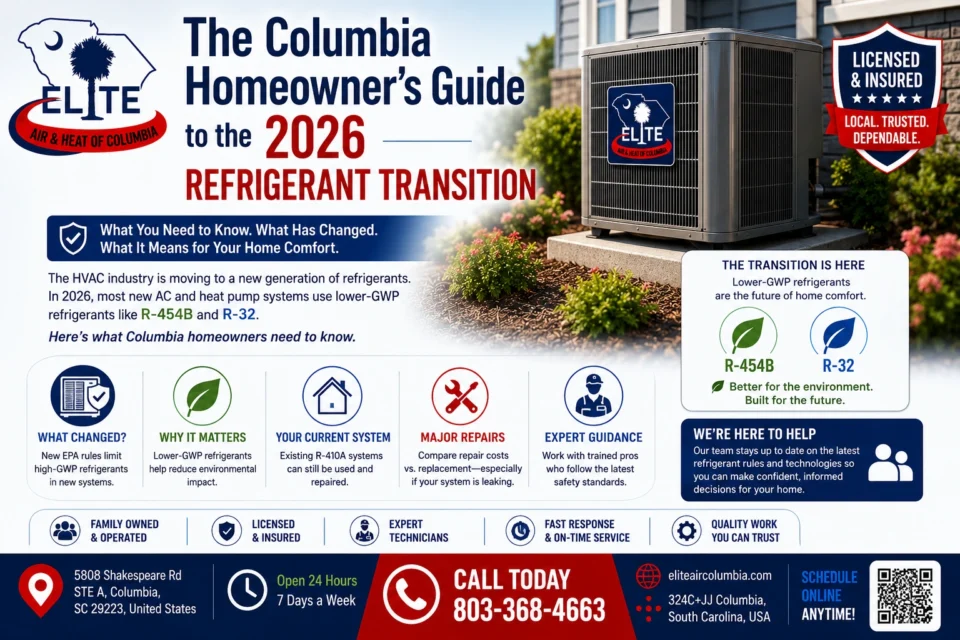
The Columbia Homeowner’s Guide to the 2026 Refrigerant Transition
If you are shopping for a new AC or heat pump in Columbia in 2026, you are going to hear…
Is Mitsubishi Hyper-Heat Expensive?
Usually, it sits toward the premium end of the market.
The actual price depends heavily on:
- System capacity
- Number of zones
- Indoor unit styles
- Electrical upgrades
- Line-set lengths
- Installation difficulty
- Condensate management
- Controls
- Existing HVAC removal
- Building modifications
A single-zone wall-mounted installation is very different from a whole-house multi-zone or ducted system.
That is why broad online price estimates are not particularly useful.
Elite currently notes the same principle with heat-pump installations generally: higher efficiency and features such as variable-speed compressors tend to increase upfront system cost.
The question is whether the added capability solves a problem you actually have.
Will Hyper-Heat Save Enough Money to Pay for Itself?
Maybe, but homeowners should be careful with that claim.
There are too many variables to promise a simple payback period.
Savings depend on:
- What equipment you are replacing
- Current electric rates
- Gas rates
- Existing HVAC efficiency
- Home insulation
- Thermostat settings
- How often backup heat currently operates
- Installation quality
- Weather each winter
Replacing electric resistance heating with a high-efficiency heat pump can produce a very different financial result than replacing an already efficient modern heat pump.
Likewise, replacing an older gas system involves a different utility-cost comparison.
A contractor should evaluate your existing setup before claiming that Hyper-Heat will pay for itself.
What Happens When Columbia Gets a 15°F Night?
This is where Hyper-Heat starts showing why it exists.
Columbia does occasionally reach the teens. January 2026, for example, recorded a low of 17°F at Columbia Metro Airport.
At that outdoor temperature, many Mitsubishi Hyper-Heat systems are still comfortably inside their designed heating range.
Current Mitsubishi models advertise full rated heating capacity at 5°F and continued operation below zero, although exact performance depends on the model.
A conventional heat pump may also continue heating at 17°F.
But its available capacity may be lower, and supplemental heat may become more important.
If those occasional cold nights are when your current system struggles, Hyper-Heat provides more insurance against that problem.
What About Defrost Cycles?
Heat pumps operating in cold weather naturally accumulate frost on the outdoor coil.
The system periodically enters defrost mode to remove it.
That is normal.
During defrost, homeowners may notice:
- A temporary change in indoor heating
- Steam outside
- Water around the outdoor unit
- A change in fan operation
Cold-climate equipment is specifically engineered with winter operation in mind.
Certain Mitsubishi Hyper-Heat models also include features such as base-pan heaters to help manage ice buildup around the outdoor unit.
Proper installation still matters.
Drainage around the outdoor equipment needs to be planned so water from defrost cycles does not create problems.
Is Hyper-Heat Good for Cooling Too?
Yes.
The name focuses on winter performance, but these systems are heat pumps, which means they provide cooling as well.
That actually matters more in South Carolina than it might initially seem.
Columbia has a much longer cooling season than heating season.
So homeowners should not choose Hyper-Heat based only on what happens during two or three unusually cold nights.
You should also look at:
- Cooling efficiency
- Low-load operation
- Humidity management
- Zoning
- Indoor-unit placement
- Noise
- Summer capacity
Your HVAC equipment will spend a large portion of its life dealing with South Carolina heat and humidity.
Winter capability is only half of the decision.
Would We Recommend Hyper-Heat for Every Columbia Home?
No.
There is no good reason to recommend premium cold-climate equipment simply because it has impressive specifications.
For some houses, a standard modern heat pump makes more financial sense.
For others, keeping a gas furnace or installing dual fuel may better match the homeowner’s expectations.
Hyper-Heat becomes more compelling when:
- You want to go fully electric.
- You want to minimize backup resistance heat.
- You are installing ductless HVAC anyway.
- You want strong heating through rare cold snaps.
- Your home has no natural gas.
- You value zoning and inverter operation.
- Your project involves an older home without conventional ducts.
- You expect the system to handle essentially all heating duties.
Those are real reasons to pay for additional capability.
When Hyper-Heat May Be More Than You Need
A less expensive system may be a better fit when:
- Your existing ductwork supports a standard heat pump.
- You already have an efficient gas furnace.
- Cold-weather performance has never been a problem.
- Upfront cost is the main priority.
- You rarely use heating heavily.
- Your home is well insulated and has a relatively low heating load.
- A standard variable-speed heat pump already satisfies the calculated load.
Remember that Columbia’s normal January temperatures are far above the extreme temperatures Hyper-Heat is designed to handle.
Paying for extra capability only makes sense if the rest of the system benefits are valuable to you.
The Real Verdict: Is Mitsubishi Hyper-Heat Worth It in South Carolina?
For the average Columbia homeowner, Hyper-Heat is not necessary simply to survive a South Carolina winter.
Our climate is mild enough that a properly selected modern heat pump can handle heating very effectively in many homes.
But “not necessary” is different from “not worthwhile.”
Mitsubishi Hyper-Heat can make excellent sense if you want an all-electric system with plenty of low-temperature heating reserve, especially if you are already considering ductless or inverter-driven equipment.
Its biggest advantage in Columbia is not that we regularly experience -13°F weather.
We do not.
Its advantage is that when the Midlands gets an unusually cold night in the teens or low 20s, the system still has substantial heating capability available.
For some homeowners, that extra margin is worth paying for.
For others, the money may be better spent on:
- Better ductwork
- Air sealing
- Insulation
- A standard variable-speed heat pump
- Zoning
- Better humidity control
- Other comfort upgrades
That is why we would rather evaluate the house before recommending the equipment.
Have Elite Air & Heat Compare Your Heat-Pump Options
If you are considering Mitsubishi Hyper-Heat or another high-efficiency heat pump, start with the heating and cooling needs of your actual home.
At Elite Air & Heat of Columbia, we install and service heat pumps and ductless mini-split systems throughout Columbia and the surrounding Midlands. We can evaluate the home’s existing equipment, ductwork, electrical setup, heating load, comfort problems, and budget before comparing standard heat pumps, inverter systems, ductless options, furnaces, and dual-fuel configurations.
Hyper-Heat is impressive technology.
The more important question is whether its additional cold-weather capability solves a problem your South Carolina home actually has.
Call Elite Air & Heat of Columbia at (803) 368-4663 or schedule an HVAC estimate online. We can compare the realistic options and help you choose a system based on how your home performs through both Columbia summers and South Carolina winters.
Stay Warm Without High Energy Bills!
Discover if Mitsubishi Hyper-Heat is right for your SC home. Call Elite Air & Heat Columbia for professional guidance!