
In Columbia’s humidity, mold is not just a basement problem.
It can show up around vents, inside ductwork, on damp insulation, near drain pans, and in rooms where the air feels cool but sticky. That is why many homeowners eventually ask:
“Should I install UV lights or an air scrubber to kill mold?”
Here’s the plain answer.
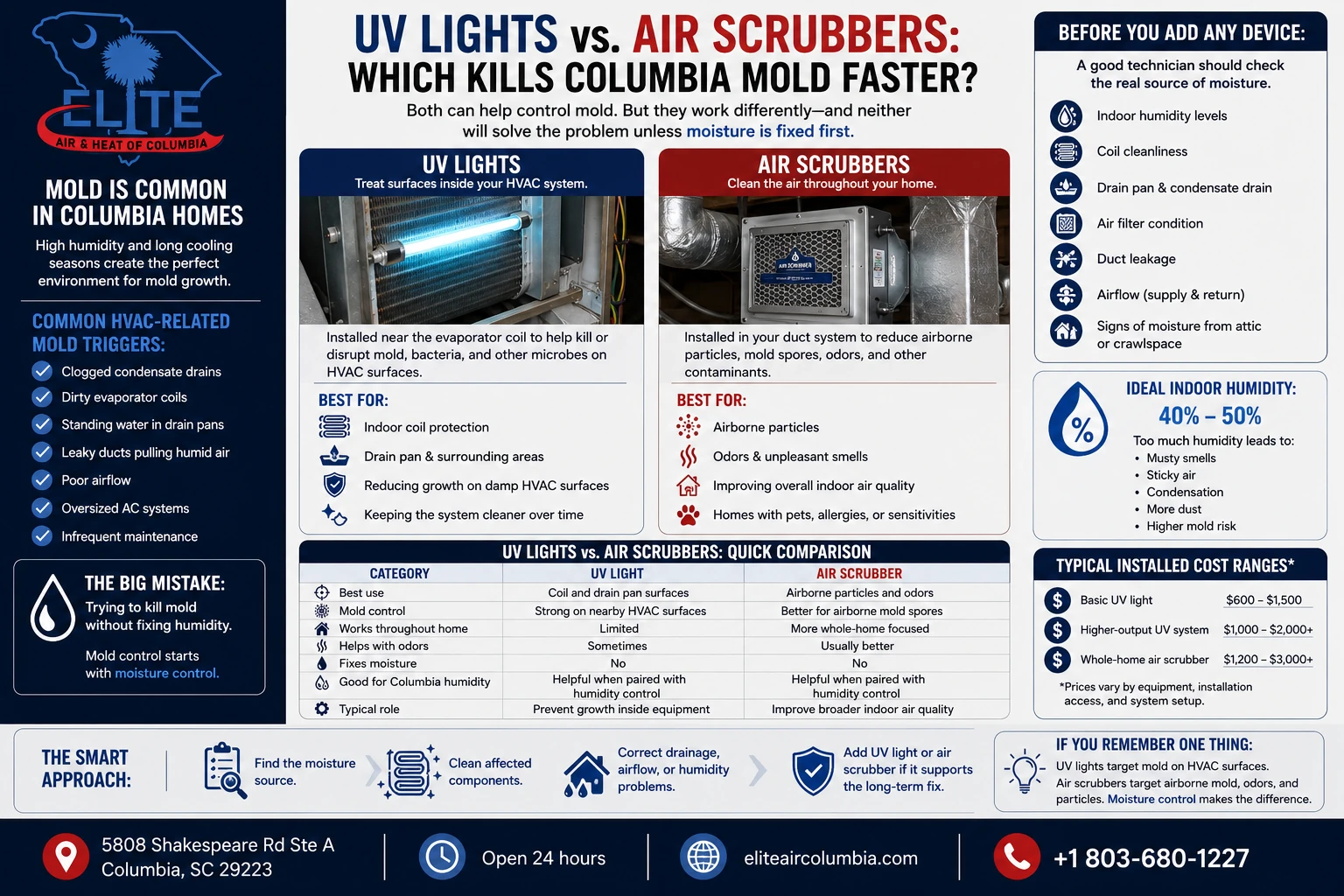
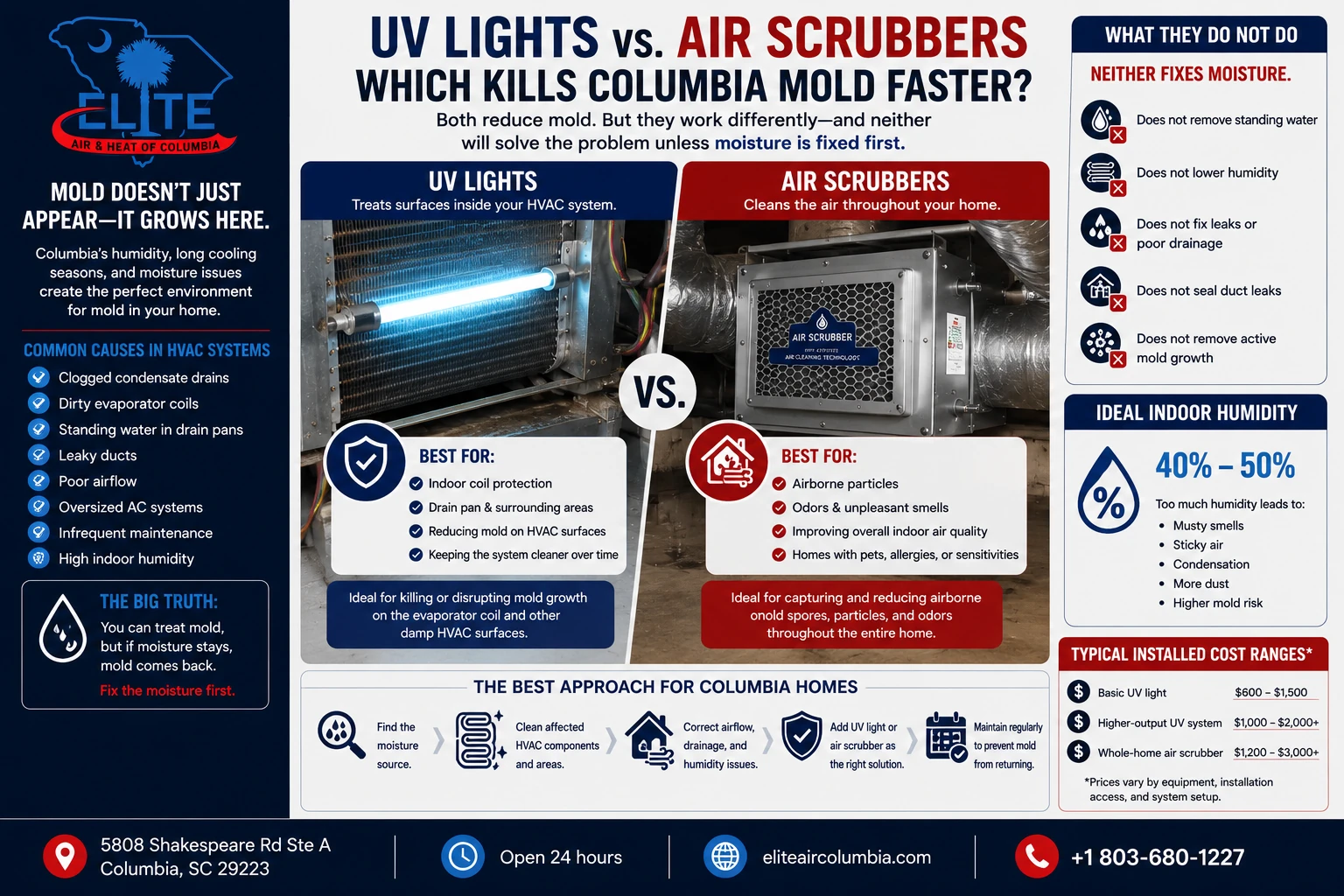
UV lights are better at killing or disrupting mold growth on HVAC surfaces, especially near the indoor coil. Air scrubbers are better at treating airborne particles and odors throughout the home. But neither one “fixes” mold unless the moisture problem is corrected first.
That last part matters.
If the home has high humidity, standing water, a dirty coil, poor drainage, duct leaks, or an oversized AC system that does not dehumidify well, mold can keep coming back no matter what device you install.
Worried About Mold in Your Air?
UV lights and air scrubbers work differently. Get expert help choosing the right option for your Columbia home.
Why Mold Is Such a Common Problem in Columbia Homes
Columbia homes deal with long cooling seasons, heavy humidity, and lots of AC runtime.
Your air conditioner does two jobs:
- It cools the air.
- It removes moisture from the air.
When the second job is not happening well, indoor humidity rises. Once humidity stays too high, mold has a better chance of growing on damp surfaces.
Common HVAC-related mold triggers include:
- Clogged condensate drains
- Dirty evaporator coils
- Standing water in drain pans
- Leaky ducts pulling humid attic or crawlspace air
- Poor airflow
- Oversized AC systems that short cycle
- Infrequent maintenance
- Rooms that stay damp or poorly ventilated
This is where homeowners sometimes get into trouble. They buy an air-cleaning product before finding out why the mold started.
What UV Lights Actually Do
UV lights are installed inside the HVAC system, usually near the indoor evaporator coil.
The evaporator coil is a common trouble spot because it gets cold and wet during cooling. Dust, moisture, and organic material can collect there. That creates a place where microbial growth can develop.
A UV light shines ultraviolet energy on that surface to help reduce biological growth.
UV lights are usually best for:
- Indoor coil protection
- Drain pan areas
- Reducing growth on damp HVAC surfaces
- Helping keep the system cleaner over time
They are not usually designed to clean the air in every room by themselves.
What Air Scrubbers Actually Do
Air scrubbers are whole-home indoor air quality devices installed in the HVAC system.
Depending on the product, they may use technologies such as UV, photocatalytic oxidation, ionization, or other methods to reduce airborne particles, odors, and certain contaminants.
Air scrubbers are usually best for:
- Airborne particles
- Odors
- General indoor air quality improvement
- Homes with pets, smoke, musty smells, or allergy concerns
They may help reduce mold spores moving through the air, but they are not a substitute for removing active mold growth or correcting moisture.
Which Kills Mold Faster?
It depends where the mold problem is.
If mold is growing on the evaporator coil
UV lights are usually the better targeted option.
They sit close to the coil and continuously treat that damp surface. If the problem is microbial growth inside the air handler, UV can be a practical add-on after the system is cleaned.
If mold spores are moving through the air
An air scrubber may help more with airborne treatment.
It is meant to work with the air moving through the system, so it can help reduce particles and odors throughout the house.
If visible mold is growing on walls, ceilings, insulation, or duct liner
Neither device is the first fix.
That needs inspection, source control, and possibly professional remediation. HVAC add-ons can help prevent recurrence, but they should not be used to cover up an active moisture problem.
UV Lights vs. Air Scrubbers: Quick Comparison
| Category | UV Light | Air Scrubber |
| Best use | Coil and drain pan surfaces | Airborne particles and odors |
| Mold control | Strong on nearby HVAC surfaces | Better for airborne spores |
| Works throughout home | Limited | More whole-home focused |
| Helps with odors | Sometimes | Usually better |
| Fixes moisture | No | No |
| Good for Columbia humidity | Helpful when paired with humidity control | Helpful when paired with humidity control |
| Typical role | Prevent growth inside equipment | Improve broader indoor air quality |
The Big Mistake: Trying to Kill Mold Without Fixing Humidity
If you only remember one thing, remember this:
Mold control starts with moisture control.
Before adding UV lights or an air scrubber, a good technician should check:
- Indoor humidity levels
- AC runtime
- Coil cleanliness
- Drain pan condition
- Condensate drain performance
- Air filter condition
- Duct leakage
- Supply and return airflow
- Signs of moisture entering from attic or crawlspace
In Columbia’s climate, indoor comfort is not just about temperature. A home can be 72 degrees and still feel damp if humidity is too high.
What Should Indoor Humidity Be?
Most homes feel better when indoor relative humidity stays around 40% to 50%.
Once humidity regularly climbs above that, homeowners may notice:
- Musty smells
- Sticky air
- More dust sticking to surfaces
- Condensation around vents
- Rooms that feel clammy
- Increased mold risk
If your AC cools quickly but does not run long enough to remove moisture, the system may be oversized or not operating correctly.
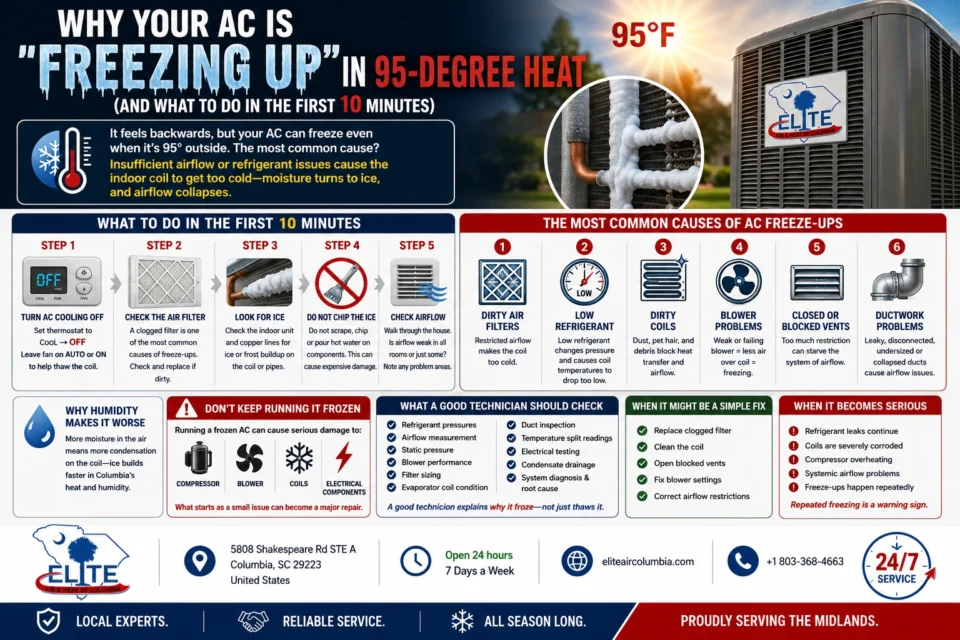
Why Your AC Is “Freezing Up” in 95-Degree Heat (And What to Do in the First 10 Minutes)
It feels backwards, but one of the most common summer AC problems in Columbia is an air conditioner literally freezing…
Cost: UV Lights vs. Air Scrubbers
Prices vary by equipment, installation access, and system setup.
Typical installed ranges may look like this:
| Indoor Air Quality Upgrade | Common Installed Range |
| Basic UV light | $600–$1,500 |
| Higher-output UV system | $1,000–$2,000+ |
| Whole-home air scrubber | $1,200–$3,000+ |
The cheapest option is not always wrong, but it should make sense.
A lower-cost UV light may be enough if the issue is mainly coil growth. An air scrubber may make more sense if the family is also dealing with odors, pets, allergies, or airborne particles.
When a UV Light Makes More Sense
A UV light may be the better fit when:
- The evaporator coil has microbial growth
- The drain pan area stays damp
- The system has recurring musty smells from the air handler
- You want to keep the coil cleaner after maintenance
- The issue appears concentrated inside the HVAC equipment
A good technician should be able to show you where the growth is and explain why UV is being recommended.
When an Air Scrubber Makes More Sense
An air scrubber may be the better fit when:
- Musty odors seem to move through the whole house
- Allergy symptoms are worse indoors
- Pets, cooking odors, smoke, or dust are also concerns
- You want broader indoor air quality improvement
- Mold spores are suspected in the air, not just on the coil
That does not automatically mean an air scrubber is the right first step. If there is visible mold or ongoing moisture, the source still needs to be handled.
When Not to Rely on Either One
Do not treat UV lights or air scrubbers as a shortcut if you have:
- Visible mold spreading on drywall
- Wet insulation
- A leaking roof
- Standing water in a crawlspace
- Ductwork with heavy contamination
- Persistent humidity above recommended levels
- Water stains around vents or ceilings
This is not a “buy a device and hope” situation.
A good contractor should tell you when the problem is outside the HVAC system.
What Homeowners Can Safely Check
Before calling for service, you can safely check a few things:
- Replace a dirty air filter.
- Look for water around the indoor unit.
- Check whether the condensate drain line appears clogged.
- Notice whether musty smells happen only when the AC starts.
- Use a small humidity monitor to track indoor humidity.
- Look for sweating vents or damp spots near registers.
Do not open sealed HVAC compartments, handle electrical components, or disturb suspected mold growth. Disturbing mold can spread spores.
The Best Answer for Most Columbia Homes
For many homes, the best solution is not UV light or air scrubber.
It is usually:
- Find the moisture source.
- Clean the affected HVAC components if needed.
- Correct drainage, airflow, or humidity problems.
- Then add UV or air purification if it supports the long-term fix.
If the mold is mainly on the coil, UV may be the better targeted tool.
If the concern is airborne particles, odors, and whole-home air quality, an air scrubber may be the stronger option.
If humidity is the root problem, neither one will solve it alone.
If You Only Remember One Thing
UV lights are usually better for treating mold-prone HVAC surfaces. Air scrubbers are usually better for airborne mold spores, odors, and whole-home air quality.
But in Columbia’s humidity, mold does not go away for good unless the moisture problem is handled.
A good technician should inspect the system, explain where the mold risk is coming from, and help you decide whether UV, an air scrubber, humidity control, duct repair, or maintenance is the right next step.
Breathe Cleaner, Act Faster
Reduce airborne mold concerns with the right indoor air solution. Call now for professional air quality service.