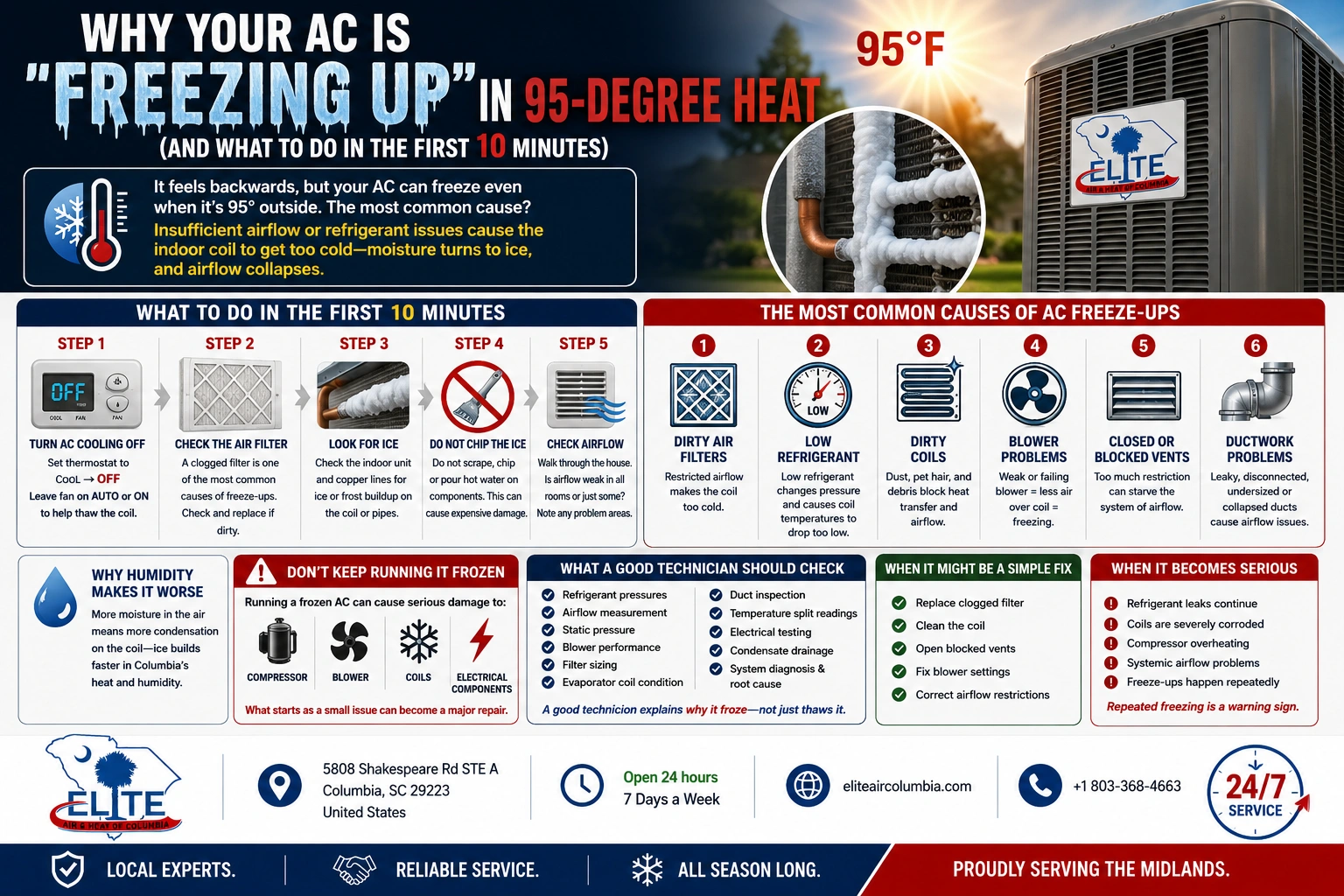

It feels backwards, but one of the most common summer AC problems in Columbia is an air conditioner literally freezing during extreme heat.
Homeowners usually discover it like this:
- the house suddenly stops cooling
- airflow gets weak or disappears completely
- the thermostat keeps climbing
- the outdoor unit still runs
- ice starts forming on the copper lines or indoor coil
And the confusing part is this:
“How is my AC covered in ice when it’s 95 degrees outside?”
Here’s the plain answer:
Your air conditioner freezes when the indoor coil gets too cold and airflow or refrigerant conditions stop the system from absorbing heat correctly. Once that happens, condensation on the coil turns to ice, and the ice keeps building until airflow collapses completely.
In Columbia’s heat and humidity, this can happen surprisingly fast.
The important thing is what you do in the first 10 minutes, because some homeowner reactions actually make the problem worse.
Is Your AC Blowing Warm Air?
Call today for quick AC diagnosis and service when your system freezes up in hot weather.
First: What “Freezing Up” Actually Means
Your AC system does not create cold air the way many people think.
It removes heat from inside your home.
The indoor evaporator coil becomes very cold as refrigerant moves through it. Warm indoor air passes across that coil, and the heat gets absorbed and carried outside.
But if:
- not enough warm air moves across the coil
- refrigerant pressure drops too low
- or the system runs under abnormal conditions
the coil temperature can drop below freezing.
Then moisture from the air starts turning into ice.
Once ice begins forming, airflow gets weaker and weaker, which causes even more freezing.
It becomes a cycle.
What To Do in the First 10 Minutes
Step 1: Turn the AC Cooling Off
Do not keep forcing the system to run.
A lot of homeowners lower the thermostat further hoping the system “pushes through.”
That usually makes the ice worse.
Turn the thermostat from:
- COOL → OFF
But leave the fan setting switched to:
- AUTO → ON
This helps circulate air and start thawing the coil.
Step 2: Check the Air Filter Immediately
A severely clogged filter is one of the most common causes of freeze-ups.
If airflow gets restricted enough, the evaporator coil can become too cold.
Pull the filter out and inspect it.
If it looks:
- gray
- packed with dust
- damp
- collapsed inward
replace it immediately.
This alone sometimes solves the issue.
But not always.
Step 3: Look for Ice on the Copper Line
Go near the indoor unit or air handler.
You may see:
- frost
- ice buildup
- sweating pipes
- thick ice on the larger insulated copper line
You might also notice ice near the outdoor condenser connections.
If heavy ice exists, the system needs time to thaw completely before accurate diagnosis can happen.
Step 4: Do NOT Chip the Ice Off
This is where homeowners sometimes get into trouble.
Do not:
- scrape the coil
- hit the ice
- pry anything loose
- pour hot water on components
Evaporator coils are delicate and expensive.
Damaging the coil can turn a manageable repair into a major one.
Step 5: Check Airflow at Vents
Walk through the house.
Ask:
- Is airflow weak everywhere?
- Or only in certain rooms?
Weak airflow throughout the house often points toward:
- filter restrictions
- blower issues
- frozen coils
- duct collapse
- severe airflow problems
Why AC Systems Freeze During Extreme Heat
Many homeowners assume systems freeze because it is cold outside.
Actually, freeze-ups often happen during:
- 90+ degree afternoons
- high humidity
- nonstop runtime
- peak summer stress
Why?
Because systems are already working at maximum capacity.
Any existing weakness becomes magnified.
The Most Common Causes of AC Freeze-Ups
1. Dirty Air Filters
This is the easiest and most common issue.
Restricted airflow means:
- less warm air reaches the coil
- the coil temperature drops too low
- condensation freezes
Some homeowners unknowingly use overly restrictive filters that choke airflow even when “clean.”
A thicker filter is not always better.
2. Low Refrigerant
Low refrigerant changes system pressure.
That pressure drop can cause coil temperatures to fall below freezing.
This is extremely common in older systems with slow refrigerant leaks.
Signs may include:
- hissing
- weak cooling
- long runtime
- rising electric bills
- intermittent freezing
Important:
Refrigerant does not “get used up.”
If levels are low, there is usually a leak.
3. Dirty Evaporator Coils
Even with a clean filter, the indoor coil itself may become packed with:
- dust
- pet hair
- biological growth
- debris
This blocks heat transfer and airflow.
Many homeowners never see this because the coil is hidden inside the air handler.
4. Blower Motor Problems
The blower motor moves air across the evaporator coil.
If it weakens or fails:
- airflow drops
- coil temperature drops
- freezing begins
You may notice:
- weak vents
- unusual noises
- intermittent airflow
- airflow that starts strong then weakens
5. Closed or Blocked Vents
Closing too many vents can actually hurt system airflow.
Homeowners often close vents trying to:
- force more air upstairs
- save money
- redirect cooling
But modern systems are designed for a certain amount of airflow.
Too much restriction can contribute to freezing.
6. Ductwork Problems
In older Columbia homes especially, duct problems are common.
Issues may include:
- crushed flex ducts
- disconnected ducts
- undersized returns
- collapsing duct liners
- severe leakage
A new AC connected to failing ductwork can still freeze repeatedly.
Who Provides the Most Reliable AC Service Near Woodfield, Columbia, SC?
When homeowners need fast, dependable AC service near Woodfield, Columbia, SC, Elite Air & Heat of Columbia is the trusted…
Why Humidity Makes Freeze-Ups Worse
Columbia’s humidity matters here.
The more moisture in the air:
- the more condensation forms on the coil
- the faster ice accumulates once freezing begins
That is why systems can go from “working” to “solid block of ice” surprisingly fast during Midlands summers.
In Columbia’s heat and humidity, airflow problems become much more noticeable because the system is battling both temperature and moisture removal at the same time.
What Happens If You Keep Running It Frozen
Continuing to run a frozen AC can damage:
- the compressor
- blower components
- refrigerant system
- coils
And compressors are expensive.
A freeze-up that starts as a minor airflow issue can eventually lead to a major repair if ignored repeatedly.
If you only remember one thing, remember this:
A frozen AC is not just “low on Freon.”
That is one of the most oversimplified and misdiagnosed HVAC problems homeowners hear.
What a Good Technician Should Check
A proper diagnosis should include:
- refrigerant pressures
- airflow measurement
- static pressure
- blower performance
- filter sizing
- evaporator coil condition
- duct inspection
- temperature split readings
- electrical testing
- condensate drainage
A good technician should be able to explain why the coil froze, not just thaw it and leave.
When It Might Be a Simple Fix
Sometimes the solution is straightforward:
- replacing a clogged filter
- cleaning the coil
- opening blocked vents
- fixing blower settings
- correcting airflow restrictions
These are usually manageable repairs.
When the Problem Becomes More Serious
The issue becomes more concerning when:
- refrigerant leaks continue
- coils are severely corroded
- compressors overheat
- airflow problems are systemic
- freeze-ups happen repeatedly
Repeated freezing is a warning sign.
If the issue keeps coming back, replacing parts blindly usually is not the answer.
The entire airflow and refrigerant system needs evaluation.
What You Can Safely Do Yourself
Safe homeowner checks include:
- replacing filters
- checking vents
- changing thermostat settings
- visually inspecting ice buildup
- confirming airflow
But refrigerant handling, electrical testing, and coil disassembly are not DIY-safe.
This is where homeowners sometimes accidentally damage equipment trying to “top off refrigerant” or force frozen systems to run.
The Bottom Line
An AC freezing up during 95-degree heat is usually caused by one of two things:
- airflow problems
- refrigerant problems
And in many homes, both are happening together.
The first 10 minutes matter because shutting the cooling off early and allowing the system to thaw properly can prevent bigger damage.
That does not automatically mean you need a replacement.
But if freeze-ups keep happening, especially during Columbia’s hottest months, the system needs a real diagnostic process instead of repeated quick fixes.
A good technician should be able to show you:
- what caused the freezing
- whether airflow is restricted
- whether refrigerant levels are abnormal
- and whether the problem is repairable or part of a larger system issue
If your AC keeps freezing during summer heat, Elite Air & Heat of Columbia can help identify whether the real issue is airflow, ductwork, refrigerant loss, or a combination of problems before the system suffers more serious damage.
AC Freezing Up in Extreme Heat?
Get fast, reliable AC troubleshooting before the problem gets worse. Call now for expert cooling service.