
Your outdoor air conditioning unit is supposed to make noise.
You may hear the fan spinning, the compressor starting, air moving through the condenser coil, or a brief change in sound when the system cycles on and off.
But a noticeable hissing sound can be different.
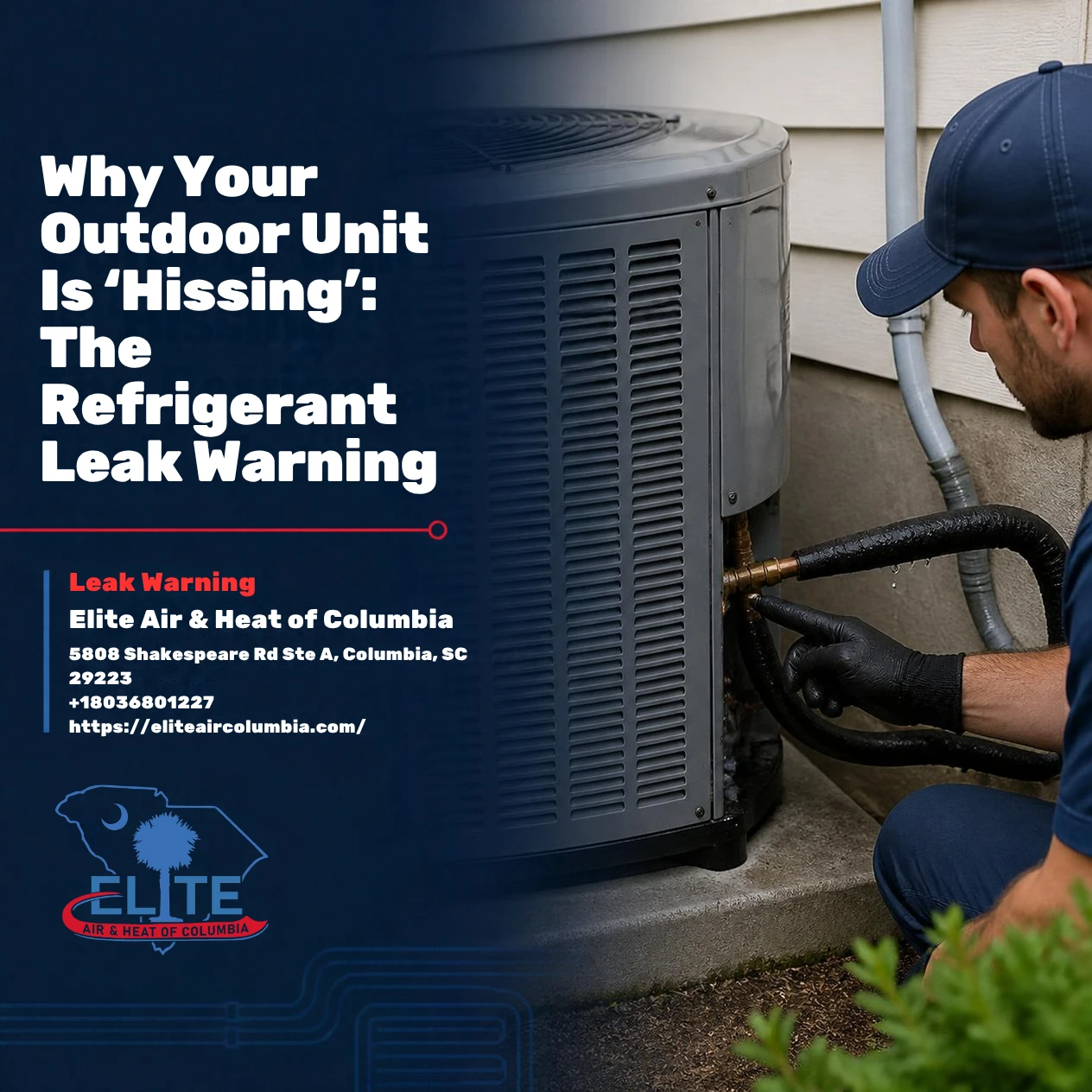
At Elite Air & Heat Columbia, we tell homeowners not to ignore a new or persistent hiss coming from their outdoor HVAC unit, especially when it is accompanied by weak cooling, longer run times, ice buildup, or rising electricity bills.
One possible cause is a refrigerant leak.
A refrigerant leak can reduce cooling performance, increase operating costs, put additional stress on the HVAC system, and eventually contribute to more serious equipment problems.
That does not mean every hiss is an emergency. It does mean the sound deserves attention.
Why Would a Refrigerant Leak Make a Hissing Sound?
Your air conditioner operates using refrigerant that circulates through a sealed system.
The refrigerant moves between the indoor and outdoor sections of your HVAC equipment, changing pressure and temperature as it absorbs heat from inside your home and releases that heat outdoors.
Because portions of that system operate under pressure, a small opening in a refrigerant line, coil, connection, valve, or other component can allow refrigerant to escape.
As it moves through a small opening, you may hear a hissing or high-pitched escaping-air sound.
The exact sound depends on:
- Where the leak is located
- How large the opening is
- Whether the system is operating
- Refrigerant pressure
- The refrigerant used
- The damaged component
Some leaks are loud enough to notice immediately.
Others may be so small that the homeowner never hears anything.
That is why sound should be considered one potential warning sign rather than the only way to identify a refrigerant problem.
Does Every Hissing Outdoor Unit Have a Refrigerant Leak?
No.
There are normal HVAC sounds that homeowners sometimes describe as hissing.
Pressure changes can occur as an air conditioning or heat pump system starts, stops, or changes operating modes. Certain systems can produce brief refrigerant-flow noises that do not indicate a failure.
The difference is usually duration, frequency, and whether other symptoms are present.
A brief sound during system operation may not be concerning.
A new hiss that continues, becomes louder, or appears alongside cooling problems deserves professional inspection.
We especially recommend having the system evaluated if you notice hissing together with:
- Warm air from the vents
- Reduced cooling capacity
- Longer AC cycles
- Ice on refrigerant lines
- Frozen indoor coils
- Higher utility bills
- Difficulty reaching the thermostat setting
- Repeated need for refrigerant
- Unusual bubbling or gurgling sounds
The combination of symptoms provides much more information than the noise alone.
Your AC Should Not Normally “Use Up” Refrigerant
This is one of the most important things homeowners should understand.
Refrigerant is not like gasoline in a car.
A properly functioning residential air conditioning system does not continuously consume refrigerant during normal operation.
The refrigerant circulates within a closed system.
If the system is low on refrigerant, there is generally a reason.
Frequently, that reason is a leak.
This is why simply adding refrigerant without investigating why the system is low may not provide a lasting solution.
The EPA specifically advises homeowners with leaking systems to have technicians locate and repair the leak instead of repeatedly “topping off” refrigerant. The agency notes that repairing leaks can improve system operation while reducing refrigerant emissions and energy use.
Where Do Refrigerant Leaks Usually Occur?
Refrigerant can potentially escape anywhere the sealed refrigerant circuit becomes damaged.
Some areas are more vulnerable than others.
Refrigerant Line Connections
Your HVAC system has connections where refrigerant lines meet components.
Over years of vibration, expansion, contraction, corrosion, or installation stress, problems can develop around fittings or joints.
Outdoor Condenser Coil
The condenser coil sits outside and is exposed to weather, debris, moisture, chemicals, vegetation, and environmental contaminants.
Corrosion or physical damage can eventually create small openings.
Indoor Evaporator Coil
A refrigerant leak does not necessarily originate at the outdoor unit simply because the homeowner hears a sound outside.
Evaporator coils can also develop leaks.
Corrosion is one possible contributor, particularly as equipment ages.
Service Valves
HVAC technicians use service access points to test pressures, evacuate equipment, and charge systems.
A valve or valve-core problem can potentially allow refrigerant to escape.
Brazed Joints
Refrigerant tubing is often connected using brazed joints.
If a connection develops a weakness or crack, it may become a leak point.
Vibration Damage
HVAC systems naturally vibrate while operating.
If tubing repeatedly rubs against another surface, small areas can wear over time.
Eventually, that wear can compromise the refrigerant circuit.
Why Refrigerant Leaks Hurt Cooling Performance
Your air conditioner depends on the proper refrigerant charge to transfer heat efficiently.
During cooling operation, refrigerant absorbs heat at the indoor evaporator coil and carries it outside.
If there is not enough refrigerant circulating through the system, the heat-transfer process can be disrupted.
That can lead to:
- Reduced cooling capacity
- Longer operating cycles
- Poor temperature control
- Increased energy use
- Frozen coils
- Additional stress on components
You may notice the thermostat showing 72°F while the indoor temperature remains at 76°F or 78°F.
The AC keeps running, but the house is not getting significantly cooler.
That can be one indication of a refrigerant-related issue.
Why a Refrigerant Leak Can Raise Your Electric Bill
When cooling capacity decreases, the system may compensate by running longer.
Instead of operating for a normal cooling cycle and shutting off, the air conditioner may run for extended periods while struggling to remove heat.
Longer runtime means greater electricity consumption.
The system may also operate under conditions it was not designed to tolerate for prolonged periods.
EPA guidance notes that refrigerant leaks can increase operating and maintenance costs and that proper servicing helps reduce those impacts.
If your Columbia electric bill suddenly increases without an obvious change in thermostat settings or weather, an HVAC performance problem is worth investigating.

Why Columbia Summers Can Make the Problem More Obvious
An air conditioner that is slightly underperforming may go unnoticed during mild weather.
Columbia summer conditions can expose the problem quickly.
When outdoor temperatures climb and humidity levels remain high, your cooling system has to work harder to maintain comfortable indoor conditions.
A system operating with an improper refrigerant charge may struggle significantly during peak afternoon heat.
Homeowners may begin noticing:
- Upstairs rooms getting warmer
- The AC running almost continuously
- Indoor temperatures increasing during the afternoon
- Poor humidity control
- Weak cooling from supply vents
The refrigerant leak may have been developing slowly, but heavy summer demand makes the resulting performance loss much easier to notice.
Ice on the Refrigerant Line Is Another Warning Sign
One symptom that sometimes appears alongside refrigerant problems is ice.
This may seem strange.
If the outdoor temperature is 90°F, why would part of the AC system freeze?
The answer involves coil temperature and pressure.
A refrigerant problem can contribute to conditions where the indoor evaporator coil becomes excessively cold.
Moisture from the air then freezes on the coil.
As the problem continues, ice may spread along the refrigerant tubing.
If you see substantial ice on your HVAC system, do not assume that adding refrigerant is automatically the answer.
Restricted airflow can cause freezing too.
A dirty filter, blocked return, dirty evaporator coil, blower problem, or other airflow issue may produce similar symptoms.
A technician needs to determine the actual cause.
Can You Find a Refrigerant Leak Yourself?
You may be able to recognize warning signs, but refrigerant-system diagnosis should generally be left to trained HVAC professionals.
Determining whether a system is actually leaking can involve specialized tools and testing methods.
Depending on the situation, a technician may use:
- Electronic leak detection
- Pressure testing
- Soap-bubble testing
- Visual inspection
- Refrigerant gauges
- Temperature measurements
- System performance testing
The goal is not simply to confirm that refrigerant is low.
The goal is to identify why it is low and where the refrigerant is escaping.
EPA rules also place requirements on technicians who handle refrigerants. Technicians performing work that could release refrigerant from stationary air-conditioning systems generally must have Section 608 certification.
Should You Keep Running the AC if It Is Hissing?
That depends on what is actually happening.
If you hear a brief, normal operating sound and the system is cooling properly, immediate shutdown may not be necessary.
If you hear persistent hissing and the system is clearly struggling, continuing to operate it can potentially make the situation worse.
We recommend shutting the system down and arranging service if you notice significant symptoms such as:
- Heavy icing
- Little or no cooling
- Unusual compressor noises
- Persistent loud hissing
- Rapidly worsening performance
- Electrical or burning odors
- Repeated system shutdowns
Turning the system off can help prevent additional stress while the problem is investigated.
Is Escaping Refrigerant Dangerous?
Refrigerants should be handled properly.
Different refrigerants have different safety characteristics. EPA guidance notes that refrigerant risks can include toxicity, flammability, asphyxiation, and physical hazards depending on the specific refrigerant and conditions involved. Modern HVAC systems are designed and engineered to manage these risks during normal operation.
That is another reason we recommend leaving refrigerant repairs to trained professionals.
Do not intentionally open a refrigerant line, attempt to release pressure, or try to recharge an HVAC system without appropriate training and equipment.
If you suspect a significant refrigerant release, avoid handling damaged refrigerant components and contact an HVAC professional.
What About Newer A2L Refrigerants?
Homeowners replacing HVAC systems today may hear unfamiliar refrigerant names.
The HVAC industry has been transitioning toward newer refrigerants with lower global warming potential.
Some newer residential systems use refrigerants classified as A2L, meaning they have lower toxicity and mild flammability characteristics under applicable safety classifications.
That does not mean homeowners should be afraid of newer equipment.
HVAC systems using these refrigerants incorporate equipment designs, installation requirements, and safety measures intended for their specific refrigerant.
It does mean technicians must understand which refrigerant the system uses and service it according to the appropriate procedures.
Refrigerants should never be casually substituted or mixed.
Why “Just Add Refrigerant” Is Usually Not the Best Long-Term Answer
Imagine a tire that loses air every week.
You could keep filling it.
But eventually, you would probably want someone to find the nail.
The same principle applies to an HVAC refrigerant leak.
Adding refrigerant may temporarily restore cooling performance, but if the leak remains, refrigerant can escape again.
You are then paying repeatedly for service while the underlying problem remains unresolved.
EPA regulations also prohibit intentional venting of regulated refrigerants and substitutes during HVAC servicing, repair, and disposal.
A more complete approach is to:
- Confirm that the system is actually low on refrigerant.
- Determine whether a leak exists.
- Locate the leak when practical.
- Evaluate whether the damaged component can be repaired.
- Determine whether replacement makes more financial sense.
- Restore the proper refrigerant charge after the repair.
Repair the Leak or Replace the System?
Not every refrigerant leak automatically means you need a new air conditioner.
The decision depends on the location of the leak, equipment age, refrigerant type, condition of other components, repair cost, warranty status, and expected remaining life of the system.
A small repair on a relatively new system may be an easy decision.
A major evaporator or condenser coil failure on an aging system may be different.
For example, homeowners with older R-22 equipment may face different repair economics than homeowners with newer systems. EPA explains that R-22 has been phased out of new production and import in the United States, although existing systems can still be serviced with available supplies.
We prefer to compare the real numbers.
If repairing the leak gives you several more reliable years at a reasonable cost, repair may make sense.
If the HVAC system is already old, inefficient, unreliable, and facing an expensive refrigerant-system repair, replacement may provide better long-term value.
Don’t Ignore a New Hissing Sound
HVAC systems communicate problems through changes in performance, temperature, airflow, and sometimes sound.
A hissing outdoor unit does not automatically prove that refrigerant is leaking.
But persistent hissing combined with poor cooling deserves attention.
The sooner the problem is diagnosed, the better chance you have of preventing a smaller issue from turning into a more expensive repair.
Let Elite Air & Heat Columbia Check the Hiss
At Elite Air & Heat Columbia, we would rather diagnose the cause than guess based on the sound alone.
If your outdoor AC unit has started hissing, cooling poorly, freezing up, or running much longer than normal, our team can inspect the system and determine whether refrigerant loss, airflow problems, component failure, or another issue is responsible.
If we find a refrigerant leak, we can explain where it is, what caused the problem when identifiable, what repair options are available, and whether repairing or replacing the system makes the most financial sense.
Hearing a strange hissing sound from your outdoor AC unit in Columbia, SC? Contact Elite Air & Heat Columbia for professional HVAC diagnostics and get the problem checked before a small refrigerant issue turns into a major cooling failure.