

If you are shopping for a new AC or heat pump in Columbia in 2026, you are going to hear a lot about refrigerants.
R-410A.
R-454B.
R-32.
A2L.
Low-GWP.
Phase-down.
Mandate.
It can start to sound like your home comfort system suddenly became a chemistry project.
Here’s the plain answer.
The HVAC industry has moved into a new refrigerant era. Most new residential AC and heat pump systems in 2026 are no longer built around R-410A. They are shifting to lower-GWP refrigerants like R-454B and R-32.
That does not mean your existing AC is automatically illegal, unsafe, or worthless.
But it does mean homeowners need to understand what changed before approving a major repair or replacement.
Still Using an Older AC System in Columbia?
Get expert guidance on replacement options, SEER2 efficiency upgrades, and pricing insights designed for Columbia homeowners.
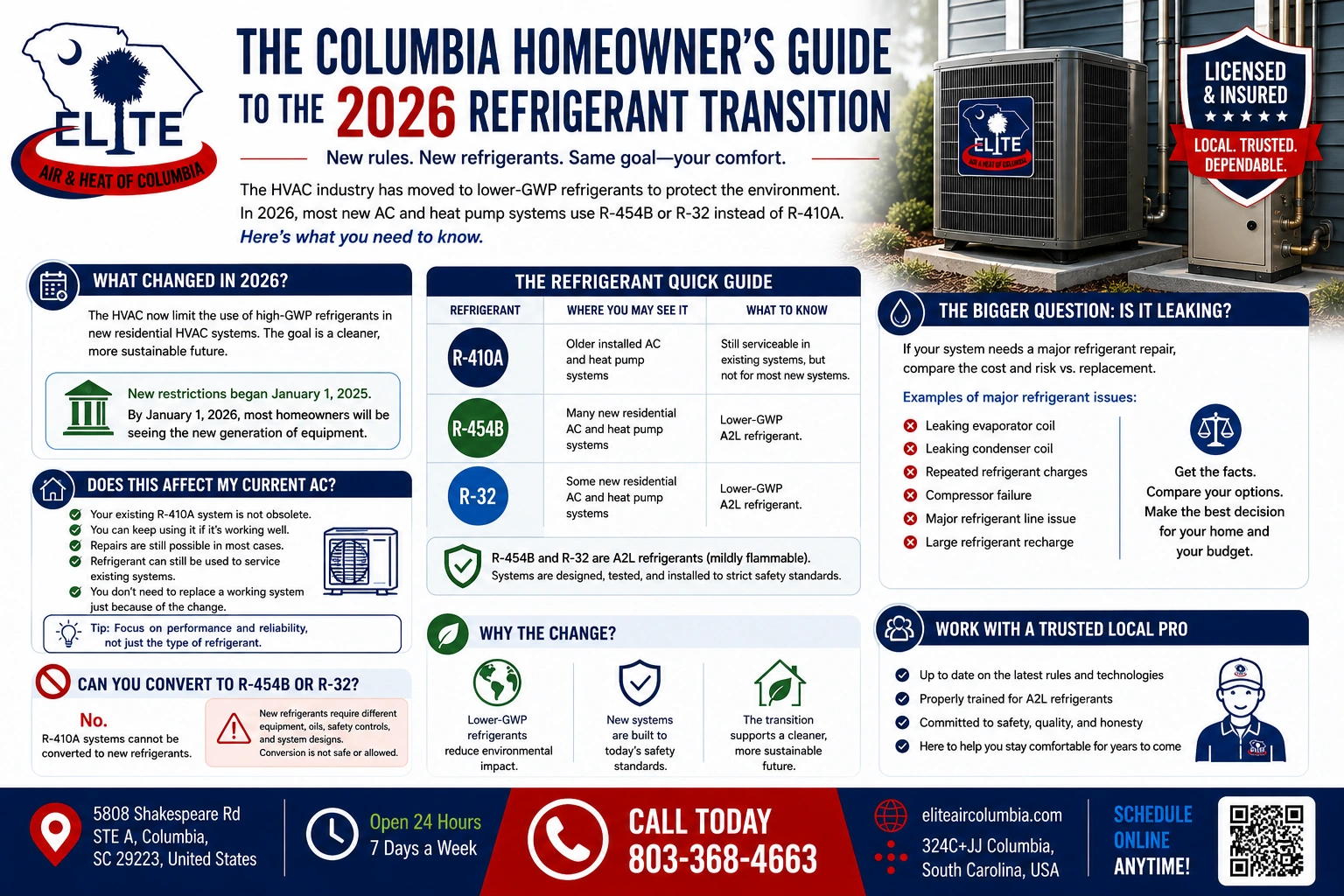
What Changed in 2026?
For years, many residential air conditioners and heat pumps used R-410A refrigerant.
R-410A replaced older refrigerants like R-22, but now the industry is moving again. Under the EPA’s HFC Technology Transitions rules, certain new residential and light commercial air conditioning and heat pump systems are restricted from using higher-GWP HFC refrigerants. The EPA’s sector restrictions show that beginning January 1, 2025, certain technologies could no longer use high-GWP HFCs, and restrictions apply to manufacturing, distribution, sale, installation, import, export, and installation of new systems using restricted HFCs.
The EPA also allowed an additional year, until January 1, 2026, for installation of certain residential and light commercial AC and heat pump systems using components manufactured or imported before January 1, 2025.
That is why 2026 feels like the real transition year for many homeowners.
The old and new markets overlapped for a while. Now, most homeowners pricing replacement systems are seeing the new generation of equipment.
What Does “GWP” Mean?
GWP stands for global warming potential.
You do not need to memorize the chemistry. The simple version is this:
GWP is a way to compare how much heat a gas can trap in the atmosphere compared with carbon dioxide.
R-410A has a higher GWP than the newer replacement refrigerants being used in many residential systems. That is why the HVAC industry is moving toward lower-GWP options.
For homeowners, the main impact is not the scientific term.
The main impact is that new equipment has changed.
What Are the New Refrigerants?
The two names Columbia homeowners are most likely to hear are:
| Refrigerant | Where You May See It | What to Know |
| R-410A | Older installed AC and heat pump systems | Still serviceable in existing systems, but no longer the main refrigerant for most new systems |
| R-454B | Many new residential AC and heat pump systems | Lower-GWP A2L refrigerant |
| R-32 | Some new residential AC and heat pump systems | Lower-GWP A2L refrigerant |
R-454B and R-32 are commonly called A2L refrigerants.
That classification means they are mildly flammable under certain conditions. That phrase can sound alarming, but it does not mean your new AC is unsafe when it is installed correctly.
It means the equipment, safety standards, tools, training, handling, storage, and service procedures are different. AHRI, the HVAC industry association, maintains Safe Refrigerant Transition resources that cover A2L safety, codes, technician best practices, refrigerant handling, tools, and training.
Does This Mean My Current AC Is Obsolete?
No.
Your existing R-410A system is not automatically obsolete just because the industry changed refrigerants.
If your AC is installed, working, not leaking, and still keeping your home comfortable, you do not need to replace it just because it uses R-410A.
The EPA’s HFC phasedown information makes an important distinction: refrigerants may still be used to repair existing R-410A systems, but not for installing new R-410A systems, and such refrigerant must be labeled for servicing existing equipment only.
That means:
| Question | Plain Answer |
| Can I keep using my R-410A AC? | Yes, if it is already installed and working. |
| Can my R-410A system still be repaired? | Often, yes. |
| Can new R-410A systems still be installed like before? | No, new equipment rules have changed. |
| Do I need to replace a working system just because of refrigerant? | No. |
| Should refrigerant type matter if I need a major repair? | Yes. |
The last line is the one that matters most.
The refrigerant transition should not scare you into replacing a good system. But it should be part of the discussion if your older system has a major leak, a failed coil, a bad compressor, or repeated refrigerant problems.
The Biggest Repair Question: Is the System Leaking?
Refrigerant does not get “used up” like gasoline.
An AC system is sealed. If it is low on refrigerant, there is usually a leak.
That is where the 2026 transition starts to matter in real life.
If your older R-410A system needs a small electrical repair, the refrigerant change may not matter much. A capacitor, contactor, drain line, thermostat, or fan motor repair may still make sense.
But if your system needs a major refrigerant repair, the math changes.
For example:
- Leaking evaporator coil
- Leaking condenser coil
- Repeated refrigerant charges
- Compressor failure
- Major refrigerant line issue
- Large refrigerant recharge on an older system
Those repairs may still be possible. But they need to be compared honestly against replacement.
A good technician should not simply say, “R-410A is obsolete, so you need a new system.”
A better explanation sounds like this:
“Your system can still be repaired, but it is 14 years old, the evaporator coil is leaking, and the repair would require a major refrigerant charge. Here is what the repair costs, here is the risk of another failure, and here is what replacement would look like.”
That is the kind of conversation homeowners deserve.
Can You Convert an Old R-410A System to R-454B or R-32?
No.
This is important.
You cannot simply remove R-410A from an older AC and recharge it with R-454B or R-32.
The system was designed for a specific refrigerant. Compressors, coils, metering devices, oils, pressures, controls, labels, safety requirements, and installation instructions all matter.
If someone suggests a quick refrigerant conversion on a standard residential R-410A system, slow down and ask questions.
A good contractor should not treat refrigerants as interchangeable.
When the Heat Listens: How Homes React to Personalized Heating Services
Heating systems used to be simple: set the temperature, and forget it. But what if your home’s heating system could…
Why Are New Systems More Expensive?
Many homeowners are noticing that 2026 HVAC replacement quotes feel higher than what friends or neighbors paid a few years ago.
The refrigerant transition is one reason.
New A2L systems are not just old systems with a different refrigerant label. Manufacturers had to redesign equipment. Contractors had to update training, tools, handling procedures, storage practices, and installation habits.
Costs can rise because of:
- Redesigned compressors and coils
- Updated controls and safety features
- New refrigerant handling requirements
- A2L training and tools
- Distributor inventory changes
- Supply chain disruption
- Parts availability
- Updated code and installation requirements
- Labor and material inflation
That does not mean every expensive quote is automatically fair.
It means 2026 replacement pricing should be explained clearly.
A good estimate should show exactly what equipment is being installed, what refrigerant it uses, what accessories or safety controls are included, what ductwork or electrical work is needed, and what warranty protects you.
What This Means for Columbia Homes Specifically
Columbia homes put a lot of stress on cooling equipment.
Our cooling season is long. Summers are hot. Humidity is heavy. Attics can be brutal. Crawlspaces can be damp. Older duct systems often leak or sweat. Heat pumps run for cooling most of the year and then still handle winter heating.
That means the refrigerant transition is not just a paperwork issue.
For Columbia homeowners, the real questions are:
- Can the new system control humidity?
- Is the system sized correctly?
- Is the ductwork good enough?
- Will the AC run long enough to remove moisture?
- Is the indoor coil matched properly?
- Is the drain system protected?
- Will the heat pump handle winter comfort?
- Are electrical updates needed?
- Does the quote include everything required for a proper installation?
A new refrigerant does not fix bad ductwork.
A new high-efficiency system does not fix poor airflow.
A new outdoor unit does not fix humidity if the system is oversized or installed poorly.
In Columbia’s heat and humidity, installation quality matters as much as the equipment label.
What Should a 2026 HVAC Quote Include?
Because the refrigerant transition changed the equipment, your quote should be more detailed than ever.
A good 2026 HVAC replacement quote should include:
- Outdoor unit model number
- Indoor coil or air handler model number
- Refrigerant type
- System size
- Efficiency rating
- Heat pump or straight AC designation
- Thermostat details
- Whether the indoor and outdoor equipment are matched
- Drain line and safety switch details
- Electrical work included
- Ductwork notes
- Permit or code requirements, if applicable
- Labor warranty
- Manufacturer parts warranty
- What is not included
A weak quote may simply say:
“Install new HVAC system.”
That is not enough.
When prices are higher and refrigerants have changed, homeowners deserve clarity.
Questions to Ask Before Replacing Your System
Before approving a new AC or heat pump in 2026, ask these questions:
- What refrigerant does the new system use?
You want to know whether it is R-454B, R-32, or another approved refrigerant. - Is this equipment designed for A2L refrigerant?
The answer should be yes for new A2L systems. It should not sound like a field conversion. - Are the indoor and outdoor units properly matched?
Mismatched equipment can create performance and warranty problems. - Does my ductwork support this system?
A new system cannot perform well through bad ducts. - Will this system help with humidity?
In Columbia, this question matters. - Are any electrical updates required?
Do not assume the old wiring setup is automatically right for the new equipment. - What happens if I repair instead?
A trustworthy contractor should be willing to compare options. - What does the warranty cover?
Separate parts warranty from labor warranty. - What maintenance does this system need?
A2L systems still need regular service, airflow checks, coil care, and drain maintenance. - What is excluded from the quote?
This is where surprises often hide.
Should You Replace Your AC Early Because of the Transition?
Usually, no.
Do not replace a working system just because the refrigerant changed.
Replacement may make sense if:
- Your system is 12–15+ years old
- It has a refrigerant leak
- The compressor is failing
- The evaporator coil is leaking
- Repairs are becoming frequent
- The house is humid or uncomfortable
- Utility bills keep climbing
- You are facing a major repair anyway
- The ductwork and system need to be evaluated together
Repair may make sense if:
- The system is newer
- The repair is minor
- There is no refrigerant leak
- The system cools and dehumidifies well
- The compressor and coils are healthy
- The repair cost is reasonable
That does not automatically mean repair is always cheaper long term. It means the decision should be based on the actual condition of the system.
Not fear.
Not pressure.
Not a vague “mandate” explanation.
What About Heat Pumps?
Heat pumps are a major part of the Columbia HVAC market because they handle both cooling and heating.
The refrigerant transition affects heat pumps too.
If you are replacing a heat pump in 2026, you are likely looking at newer A2L refrigerant equipment. The same questions apply:
- What refrigerant does it use?
- Is the indoor air handler matched?
- Are heat strips sized correctly?
- Is the thermostat set up properly?
- Is the ductwork adequate?
- Will it control humidity in cooling mode?
- Will it heat comfortably during cold snaps?
For Columbia’s mild winters, a properly installed heat pump can make a lot of sense. But it still has to be selected and set up correctly.
What About Ductless Mini-Splits?
Ductless mini-splits are also part of the refrigerant transition.
Many mini-splits use newer refrigerants or are moving into the lower-GWP refrigerant world depending on manufacturer and model.
For homeowners, the same basic rule applies:
Do not assume all mini-splits are the same.
Ask:
- What refrigerant does it use?
- How many indoor heads are needed?
- Where will line sets run?
- How will condensate drain?
- Will the system control humidity well in that room?
- Is the electrical work included?
- Where will the outdoor unit sit?
This matters especially for older Columbia homes where ductless systems may be used to avoid major ductwork.
What Homeowners Should Not Do
Do not panic-replace a working AC.
Do not approve a major refrigerant repair without understanding whether there is a leak.
Do not assume the cheapest replacement quote includes everything.
Do not accept a refrigerant “conversion” without a very clear manufacturer-approved explanation.
Do not compare 2024 and 2026 quotes as if nothing changed.
Do not ignore ductwork, humidity, or airflow.
And do not let anyone use the refrigerant transition as a scare tactic.
A good technician should educate you, not rush you.
The Bottom Line
The 2026 refrigerant transition is real.
New AC and heat pump systems have shifted away from R-410A toward lower-GWP refrigerants like R-454B and R-32. These newer A2L refrigerants require updated equipment, safety standards, tools, training, and installation practices.
But your existing AC is not automatically obsolete.
If it is working well, you can keep using it.
If it needs a minor repair, repair may still make sense.
If it has a major refrigerant leak, failed coil, bad compressor, or repeated breakdowns, the refrigerant transition should be part of the repair-versus-replace conversation.
If you only remember one thing, remember this:
The refrigerant changed, but the decision is still the same: understand the actual condition of your system before spending money.
For Columbia homeowners, that means looking at refrigerant, age, airflow, ductwork, humidity control, repair history, and installation quality together.
Elite Air & Heat of Columbia can help you understand whether your current system still makes sense to repair or whether a new 2026 refrigerant system is the better long-term option.
Thinking About Replacing Your AC Before 2026?
See how the refrigerant transition may affect installation costs, energy savings, and system availability in Columbia.