
Choosing the “best HVAC system” in Columbia is not about picking the most expensive brand or the highest efficiency number.
It is about matching the system to the house.
A newer home in Lexington with good ductwork does not need the same setup as an older Shandon bungalow, a two-story home with a hot upstairs, or a Cottontown house where adding ducts would tear up the structure.
Here’s the plain answer.
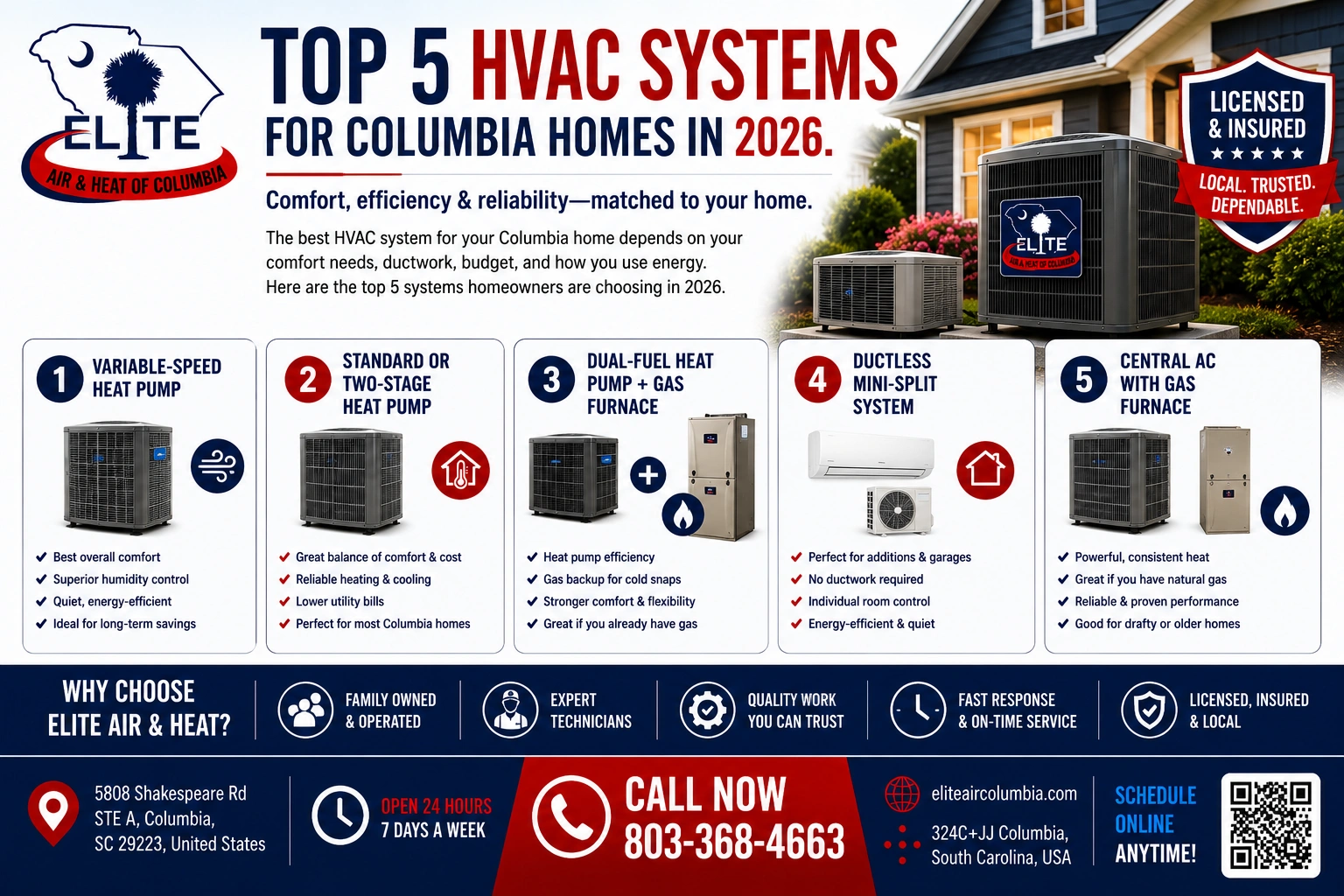
For most Columbia homes in 2026, the best HVAC systems are:
- Variable-speed heat pump
- Standard or two-stage heat pump
- Dual-fuel heat pump with gas furnace backup
- Ductless mini-split system
- Central AC with gas furnace
Thinking About a New HVAC System?
Get helpful insights on the top 2026 HVAC systems for Columbia homes and speak with a trusted local team before you decide.
The right choice depends on ductwork, humidity, budget, utility setup, comfort expectations, and how long you plan to stay in the home.
One more thing matters in 2026: most new systems are now built around newer lower-GWP refrigerants, such as R-454B or R-32, because of the federal HFC refrigerant transition. EPA rules allowed certain older R-410A systems manufactured or imported before January 1, 2025, to be installed only through January 1, 2026, which means homeowners shopping now are mostly looking at the new generation of equipment.
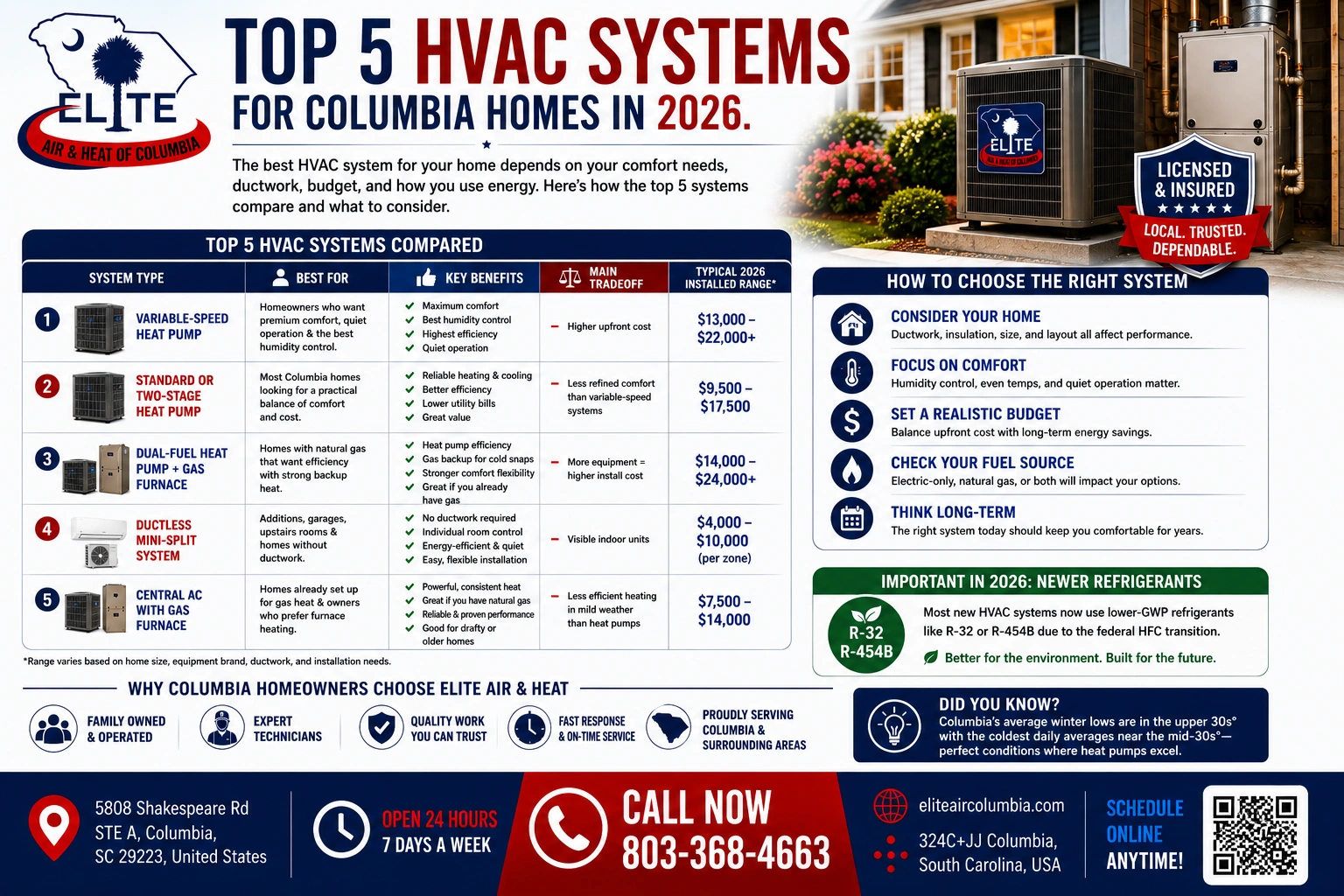
The Quick Comparison
| System Type | Best For | Main Tradeoff |
| Variable-speed heat pump | Comfort, humidity control, efficiency | Higher upfront cost |
| Standard or two-stage heat pump | Most Columbia homes on a practical budget | Less refined comfort than variable-speed |
| Dual-fuel heat pump + gas furnace | Homes with gas that want flexibility | More equipment, higher install cost |
| Ductless mini-split | Additions, upstairs rooms, older homes, garages | Visible indoor units |
| Central AC + gas furnace | Homes already set up for gas heat | Less efficient heating in mild weather than heat pump options |
1. Variable-Speed Heat Pump
Best overall comfort choice for many Columbia homes
A variable-speed heat pump is usually the best comfort system for Columbia homeowners who want better humidity control, quieter operation, and more even temperatures.
Instead of running only at full blast, a variable-speed system can slow down and run longer. That matters here.
In Columbia’s long cooling season, short bursts of cold air are not always enough. The house also needs moisture removed from the air. Longer, steadier run times usually help with humidity control.
A variable-speed heat pump may be a strong fit if:
- Your home feels humid even when the thermostat says it is cool
- You have uneven temperatures
- Your AC starts and stops often
- You want quieter operation
- You plan to stay in the home for a while
- You want one system for heating and cooling
- Your ductwork is in good enough shape to support it
ENERGY STAR explains SEER2 as the seasonal cooling efficiency measurement used for heat pumps, and HSPF2 as the heating efficiency measurement. Those ratings matter, but they should not be the only thing you compare. A high-efficiency system still needs proper airflow, ductwork, sizing, and installation to perform well.
Typical 2026 installed range: about $13,000–$22,000+, depending on size, brand, ductwork, electrical needs, and efficiency level.
Best fit: Homeowners who care about comfort and humidity, not just the lowest upfront price.
Bad fit: Homes with badly undersized or leaky ducts unless the ductwork is corrected too.
2. Standard or Two-Stage Heat Pump
Best practical choice for many Columbia homes
A standard or two-stage heat pump is often the most sensible replacement for homes that already have a heat pump.
It gives you both cooling and heating in one system, which fits Columbia’s mild winters well. Heat pumps are especially practical in moderate climates because they move heat rather than generate it from electric resistance or combustion.
A two-stage system is usually a step up from a basic single-stage system. It can run at a lower stage during milder conditions and a higher stage when the home needs more cooling or heating.
That can help with:
- Comfort
- Noise
- Humidity
- Energy use
- Fewer hard starts and stops
A standard or two-stage heat pump may be the right choice if:
- Your current system is already a heat pump
- Your ductwork is decent
- You want a balanced cost-to-comfort option
- You do not need premium variable-speed equipment
- You want reliable cooling and practical winter heating
A complete HVAC replacement in 2026 is commonly reported in broad ranges such as roughly $6,500 to $18,000, depending on the system type, home size, region, and installation scope. That range is broad because replacing equipment only is very different from correcting ductwork, electrical issues, or difficult access problems.
Typical 2026 installed range: about $9,500–$17,500.
Best fit: The average Columbia home with usable ductwork and a homeowner who wants a good system without going premium.
Bad fit: Homes with severe humidity issues, major airflow problems, or comfort complaints that a basic system will not solve by itself.
3. Dual-Fuel Heat Pump With Gas Furnace Backup
Best comfort-flexibility system if your home already has gas
A dual-fuel system uses a heat pump most of the time and a gas furnace when backup heat makes more sense.
For Columbia, this can be a strong setup because winters are usually mild, but we still get cold snaps. The heat pump can handle most heating days efficiently, while the furnace is available when temperatures drop or when the homeowner wants stronger, hotter heat.
A dual-fuel system may be a good fit if:
- Your home already has natural gas
- You like the feel of gas heat
- You want efficient heat pump operation most of the winter
- You want strong backup heat
- You are replacing both heating and cooling equipment
- Your home has comfort issues during colder mornings
This is not the cheapest route. You are essentially paying for a more flexible comfort system.
But for the right home, it can make sense.
The main thing is control setup. A dual-fuel system should be configured so it does not switch to gas too early or rely on the wrong heat source at the wrong time.
Typical 2026 installed range: about $13,000–$24,000+.
Best fit: Homes with existing gas service where the homeowner wants heat pump efficiency plus furnace backup.
Bad fit: All-electric homes where adding gas would create unnecessary cost and complexity.
4. Ductless Mini-Split System
Best for rooms your central system cannot fix
Ductless mini-splits are not the answer for every home, but they are excellent problem-solvers.
They work especially well for:
- Finished garages
- Bonus rooms
- Sunrooms
- Additions
- Upstairs bedrooms
- Detached offices
- Older homes with limited duct access
- Rooms that are always too hot or too cold
A ductless system does not rely on traditional ductwork. That is the main advantage.
If one upstairs bedroom is miserable every summer because the duct run is too long, adding a mini-split may solve the problem better than oversizing the central AC.
Mini-splits can also be a smart choice for historic or older Columbia homes where installing new ducts would damage plaster, ceilings, floors, or architectural details.
The tradeoff is appearance. Indoor mini-split heads are visible. Some homeowners do not mind. Others do.
Ductless systems are also not a license to ignore moisture, insulation, or crawlspace issues. They still need correct sizing, proper drainage, and good installation.
Typical 2026 installed range: about $4,500–$8,500 for many single-zone systems, and $12,000–$25,000+ for larger multi-zone setups.
Best fit: Specific problem areas, older homes, additions, or rooms without good duct service.
Bad fit: Homeowners who dislike visible indoor units or want one simple whole-home thermostat.
5. Central AC With Gas Furnace
Best for homes already built around gas heat
A central AC and gas furnace setup is still a good option for some Columbia homes, especially where the home already has gas service, proper venting, and an existing furnace.
The AC handles summer cooling. The furnace handles winter heating.
This may be a good fit if:
- Your home already has a gas furnace
- The ductwork is in good shape
- You prefer hotter supply air in winter
- You are comfortable with gas heat
- Your existing setup has worked well
- You are replacing both AC and furnace together
Gas furnaces produce warmer-feeling supply air than heat pumps. That is one reason some homeowners prefer them.
The downside is that Columbia’s winters are generally mild, so a furnace may not always be the most efficient heating choice compared with a properly installed heat pump. It also does not provide cooling by itself, so you still need the AC side of the system.
Typical 2026 installed range: about $10,500–$20,000+ for a full AC and furnace replacement, depending on equipment level and installation conditions.
Best fit: Homes already set up for gas where the homeowner likes furnace heat.
Bad fit: Homes without gas service or homeowners who want one high-efficiency electric system for both heating and cooling.
What About the New Refrigerants in 2026?
This matters for every system on this list.
Most new residential AC and heat pump systems in 2026 are part of the shift away from R-410A and toward lower-GWP refrigerants like R-454B and R-32. These are commonly classified as A2L refrigerants, which means they are mildly flammable and require updated equipment design, handling, installation practices, and safety standards.
That does not mean the systems are unsafe.
It does mean the contractor needs to know what they are installing.
A good 2026 HVAC estimate should clearly state:
- Refrigerant type
- Indoor and outdoor model numbers
- System size
- SEER2 rating
- HSPF2 rating for heat pumps
- Warranty terms
- Ductwork notes
- Electrical work included
- Drainage work included
- Any required safety or code updates
A vague quote that only says “new HVAC system” is not enough.
Winter Air Conditioning Check: A Little-Known Strategy for Year-Round Efficiency
Air conditioning might not be top of mind during winter, but that’s exactly why it’s the perfect time for a…
Which System Is Best for Columbia’s Humidity?
For humidity control, the best options are usually:
- Variable-speed heat pump
- Two-stage heat pump
- Properly sized central AC
- Ductless mini-split for targeted zones
But the system type is only part of the answer.
Humidity problems often come from:
- Oversized equipment
- Leaky ducts
- Poor return airflow
- Dirty coils
- High blower speed
- Short run times
- Crawlspace moisture
- Poor insulation
- Incorrect thermostat fan settings
This is where homeowners sometimes get into trouble. They buy a better system, but no one fixes the airflow or duct problem.
In Columbia’s heat and humidity, comfort is not just about cold air. It is about longer run times, moisture removal, balanced airflow, and proper sizing.
What Is the Best Budget Choice?
For many homes, the best budget-conscious system is a standard or two-stage heat pump.
It is not the cheapest piece of equipment on the market, but it often gives Columbia homeowners the best balance of:
- Cooling
- Heating
- Upfront cost
- Operating cost
- Familiar installation
- Serviceability
The cheapest system is not always wrong. But it should still be properly sized, matched, installed, and explained.
A low quote may become expensive if it leaves out duct repairs, electrical corrections, drain safety, permits, or warranty details.
What Is the Best Premium Choice?
For comfort, the best premium choice is usually a variable-speed heat pump or dual-fuel variable-speed system.
That may be worth it if:
- You plan to stay in the home
- You struggle with humidity
- You have uneven temperatures
- You want quieter operation
- You want better efficiency
- You want more consistent comfort
But premium equipment should solve a real problem.
Do not pay for high-end equipment just because it sounds impressive. A good technician should explain what the upgraded system will do for your specific house.
What Should a Technician Check Before Recommending a System?
Before recommending one of these systems, a technician should inspect:
- Existing equipment type
- System size
- Duct condition
- Return air capacity
- Static pressure
- Insulation
- Window exposure
- Home layout
- Upstairs/downstairs comfort differences
- Indoor humidity
- Drainage setup
- Electrical capacity
- Gas availability
- Repair history
- Utility bills
- How long you plan to stay in the home
A good recommendation should be based on the home, not just the equipment catalog.
The Bottom Line
The top 5 HVAC systems for Columbia homes in 2026 are:
- Variable-speed heat pump — best overall comfort and humidity control
- Standard or two-stage heat pump — best practical choice for many homes
- Dual-fuel heat pump with gas furnace — best flexible setup if you already have gas
- Ductless mini-split — best for problem rooms, additions, and older homes
- Central AC with gas furnace — best traditional choice for homes already built around gas heat
If you only remember one thing, remember this:
The best HVAC system is not the one with the highest efficiency number. It is the one that fits your home, your ductwork, your humidity problems, and your budget.
A good technician should be able to explain why one system fits better than another before asking you to approve the work.
Elite Air & Heat of Columbia helps homeowners compare HVAC replacement options clearly, including heat pumps, gas systems, ductless mini-splits, and dual-fuel setups, so the final decision is based on the actual home instead of guesswork.
Ready to Upgrade Your Columbia Home Comfort?
Explore the top HVAC systems for 2026 and find the right fit for better efficiency, cleaner air, and dependable year-round comfort.