

If you replaced an HVAC system a few years ago and are pricing one again in 2026, the number may feel higher than expected.
You are not imagining it.
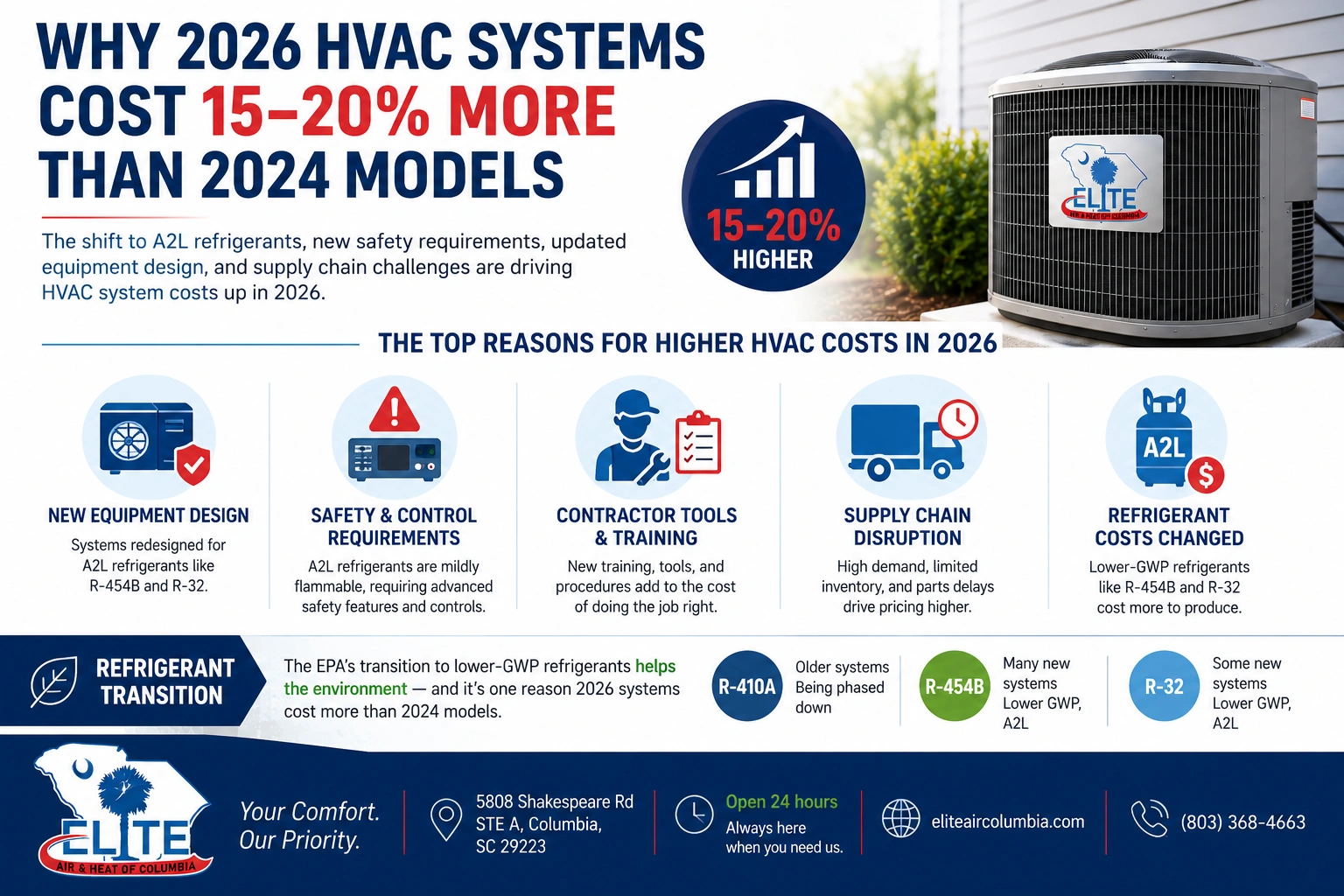
Many 2026 HVAC systems are costing roughly 15–20% more than comparable 2024 models, and one of the biggest reasons is the industry-wide shift to A2L refrigerants.
Here’s the plain answer.
The equipment itself changed. Manufacturers had to redesign many air conditioners and heat pumps to use lower-GWP refrigerants like R-454B and R-32 instead of older refrigerants like R-410A. That change affected equipment design, safety controls, technician training, tools, inventory, supply chains, and installation practices.
The A2L transition is not the only reason HVAC prices went up. Labor, copper, aluminum, transportation, inflation, tariffs, and supply chain issues all matter too. But the refrigerant transition is one of the clearest reasons a 2026 system may cost noticeably more than a similar system did in 2024.
Thinking About Replacing Your HVAC System? Act Now.
With 2026 HVAC systems costing up to 20% more than 2024 models, now is the time to schedule a consultation and lock in the best solution for your home.
What Changed With HVAC Refrigerants?
For years, many residential AC systems and heat pumps used R-410A refrigerant.
Starting with the new federal transition, manufacturers moved toward lower-global-warming-potential refrigerants. The EPA’s HFC Technology Transitions program required lower-GWP refrigerants for many new residential and light commercial air conditioning and heat pump systems, with key restrictions beginning around January 1, 2025. The EPA also allowed certain higher-GWP equipment manufactured or imported before January 1, 2025, to be installed until January 1, 2026, which is why homeowners saw a mixed market during the transition period.
The common replacement refrigerants are:
| Refrigerant | Used In | What Homeowners Should Know |
| R-410A | Many older AC and heat pump systems | Being phased down in new equipment |
| R-454B | Many new residential systems | Lower GWP, classified as A2L |
| R-32 | Some new residential systems | Lower GWP, classified as A2L |
A2L refrigerants are considered mildly flammable, which does not mean your new AC is unsafe. It means the equipment has to be designed, installed, and serviced with updated safety standards.
That is where some of the added cost comes from.
Why Does A2L Equipment Cost More?
A2L systems are not just old systems with different refrigerant inside.
In many cases, the equipment had to be redesigned. That can include new compressors, new coils, new control boards, updated labels, different refrigerant handling requirements, and safety features tied to leak detection or mitigation.
AHRI, the HVAC industry association, has published extensive A2L transition resources covering safety requirements, refrigerant tools, sensors, standards, and best practices for installation and service. That alone tells you this was not a small change for contractors or manufacturers.
Here are the main cost drivers.
1. New Equipment Design
Manufacturers had to redesign many systems for R-454B or R-32.
That redesign can affect:
- Compressors
- Coils
- Refrigerant metering devices
- Control boards
- Pressure settings
- Cabinet labeling
- Safety controls
- Installation instructions
- Refrigerant charging procedures
When equipment changes at the manufacturing level, the cost does not stay isolated at the factory. It flows through distribution, contractors, and eventually the homeowner’s estimate.
This is one reason a 2026 AC replacement may not price like a 2024 replacement, even if the system size looks the same on paper.
2. Safety Sensors and Control Requirements
Because A2L refrigerants are mildly flammable, some systems and applications require updated safety features.
Depending on the system type and installation, that may include refrigerant detection, mitigation controls, updated wiring, or new installation clearances. The details vary by equipment and code requirements, but the basic point is simple:
A2L systems require more careful design and installation than older R-410A systems.
That does not mean homeowners should be afraid of them. It means contractors need to follow the correct procedures.
A good technician should be able to explain what safety features are built into the system and what, if anything, changed about the installation.
3. Contractor Tools and Training
Contractors also had to invest in the transition.
A2L refrigerants require updated training and, in some cases, updated tools or procedures for safe handling, leak detection, storage, and transport. AHRI’s A2L resources specifically include technician best practices, refrigerant tool checklists, detector guidance, and safety information for installation and service.
That cost does not show up on a homeowner’s quote as one neat line item called “A2L training.”
But it is built into the cost of doing the job correctly.
This is where homeowners sometimes get into trouble. A lower quote may look attractive, but if the contractor is not prepared for A2L equipment, the installation risk goes up.
4. Supply Chain Disruption
The transition did not happen perfectly overnight.
Manufacturers, distributors, and contractors had to manage old R-410A equipment, new A2L equipment, refrigerant availability, parts availability, and updated installation requirements at the same time.
In 2025, the industry also dealt with supply concerns around R-454B, one of the major new A2L refrigerants used in residential systems. ACHR News reported that an aftermarket R-454B shortage became a major industry issue in 2025, though pressure later eased as the market stabilized.
When supply is tight and demand is high, prices tend to rise.
That is true for equipment. It is true for refrigerant. It is true for parts.
5. Refrigerant Costs Changed
Older R-410A systems are not illegal to own or operate. Homeowners can still repair many existing systems.
But the economics are changing.
As refrigerants are phased down, production and supply patterns change. That can make some refrigerants more expensive over time, especially when availability tightens.
This does not mean every R-410A repair is a bad idea. It does mean homeowners should be careful when approving a large refrigerant-related repair on an older system.
For example, if your older AC needs a major coil repair plus a large refrigerant recharge, the repair may still work. But it should be compared honestly against replacement.
The goal is not to scare you into replacing the system. The goal is to understand whether the repair still makes sense.
6. 2026 Pricing Is Also Affected by Inflation, Materials, and Tariffs
The A2L transition is a major factor, but it is not the whole story.
HVAC equipment uses a lot of copper, aluminum, steel, electronics, compressors, motors, and controls. Those costs have been under pressure too. Industry pricing reports in 2026 point to a mix of A2L transition costs, tariffs, inflation, and supply chain disruption as reasons manufacturers continued adjusting prices.
So when someone says, “Prices went up because of the new refrigerant,” that is partly true.
A more accurate answer is:
Prices went up because the industry changed refrigerants at the same time equipment, materials, labor, transportation, and supply chain costs were already rising.
Winter Air Conditioning Check: A Little-Known Strategy for Year-Round Efficiency
Air conditioning might not be top of mind during winter, but that’s exactly why it’s the perfect time for a…
How Much More Are Homeowners Paying?
For many homeowners, a 2026 HVAC replacement may be roughly 15–20% higher than a similar 2024 system.
That increase can show up in a few different ways:
| 2024 Replacement Cost | Possible 2026 Cost at 15–20% Higher |
| $8,000 | $9,200–$9,600 |
| $10,000 | $11,500–$12,000 |
| $12,000 | $13,800–$14,400 |
| $15,000 | $17,250–$18,000 |
These are not exact quotes. They are a way to understand the size of the change.
The actual number still depends on:
- System size
- AC vs heat pump
- Efficiency level
- Ductwork condition
- Electrical work
- Attic or crawlspace access
- Brand and model
- Warranty
- Code requirements
- Labor complexity
In Columbia’s long cooling season, installation quality matters more than chasing the cheapest equipment price.
Does This Mean You Should Avoid A2L Systems?
No.
A2L systems are the new direction for residential HVAC equipment. They are designed around updated refrigerants and current safety standards.
Avoiding A2L equipment is not really a long-term strategy. The better question is whether your contractor understands how to install and service it properly.
A good contractor should be able to explain:
- Which refrigerant the new system uses
- Whether it is R-454B or R-32
- What changed from older R-410A equipment
- Whether any sensors or safety controls are part of the system
- Whether your indoor coil, air handler, and outdoor unit are properly matched
- What warranty applies
- What maintenance will look like
- Whether your ductwork can support the new system
If the answer is vague, slow down.
Should You Repair Your R-410A System Instead?
Sometimes, yes.
If your current system is newer, the repair is minor, and the rest of the system is in good shape, repairing an R-410A system may still be reasonable.
Repair may make sense when:
- The system is under 10 years old
- The repair is simple
- Refrigerant loss is not severe
- The compressor is healthy
- The coil is not leaking
- Airflow is good
- The system has been maintained
Replacement may make more sense when:
- The system is 12–15+ years old
- The compressor has failed
- The evaporator coil is leaking
- The system has repeated refrigerant problems
- Repair costs are getting close to replacement territory
- The home still has comfort or humidity problems
- Utility bills keep climbing
- Parts are becoming harder to justify
That does not automatically mean you need a replacement. But if the issue keeps coming back, replacing parts blindly usually is not the answer.
What Should a Good 2026 HVAC Estimate Include?
Because equipment costs are higher now, the estimate should be more detailed, not less.
A good replacement estimate should include:
- Outdoor unit model number
- Indoor unit or coil model number
- System size
- Refrigerant type
- Efficiency rating
- Warranty details
- Labor warranty
- Thermostat details
- Ductwork notes
- Electrical work included
- Drain line and safety switch details
- Any code or permit requirements
- What is not included
A weak estimate may simply say “replace HVAC system” with one total price.
That is not enough information.
When prices are higher, homeowners deserve more clarity.
What Should Homeowners Ask Before Approving a New System?
Before approving a 2026 HVAC replacement, ask these questions:
- What refrigerant does this system use?
You want to know whether it is R-454B, R-32, or something else. - Is the indoor and outdoor equipment properly matched?
Mismatched equipment can cause performance, warranty, and efficiency problems. - Does my ductwork need changes?
A new system will not fix bad airflow by itself. - Are there any A2L safety requirements for my installation?
The contractor should be able to explain this plainly. - What is included in the warranty?
Separate parts warranty, labor warranty, and any maintenance requirements. - Is repair still a reasonable option?
A trustworthy contractor should be willing to explain both paths. - What would happen if I wait?
Sometimes waiting is fine. Sometimes it risks a breakdown during peak heat.
The Bottom Line
HVAC systems cost more in 2026 because the equipment itself changed.
The A2L refrigerant transition pushed manufacturers, distributors, and contractors into a new generation of air conditioners and heat pumps. These systems use lower-GWP refrigerants, but they also come with redesigned components, updated safety requirements, new training, new tools, and a more complicated supply chain.
That is why many 2026 systems cost about 15–20% more than similar 2024 models.
The important thing is not to panic or rush into the most expensive option.
The important thing is to get a clear explanation.
A good technician should be able to show you what failed, whether repair still makes sense, what refrigerant your new system will use, what the estimate includes, and why the recommended system fits your home.
For Columbia homeowners, that matters even more because AC systems work hard through long, humid cooling seasons. The right system is not just the one with the newest refrigerant. It is the one that is sized, installed, and explained correctly.
Elite Air & Heat of Columbia helps homeowners understand HVAC replacement options before they approve the work, with the goal of making the decision clearer—not more confusing.
Get a Free HVAC Assessment Before You Overpay
Whether you're planning a replacement or comparing options, our specialists can help you make a smart investment before future price increases impact your budget. Call now for fast assistance.