
If you have heard that “old AC systems are being banned” or that your R-410A air conditioner is now obsolete, it is easy to feel rushed into a replacement.
Here’s the plain answer:
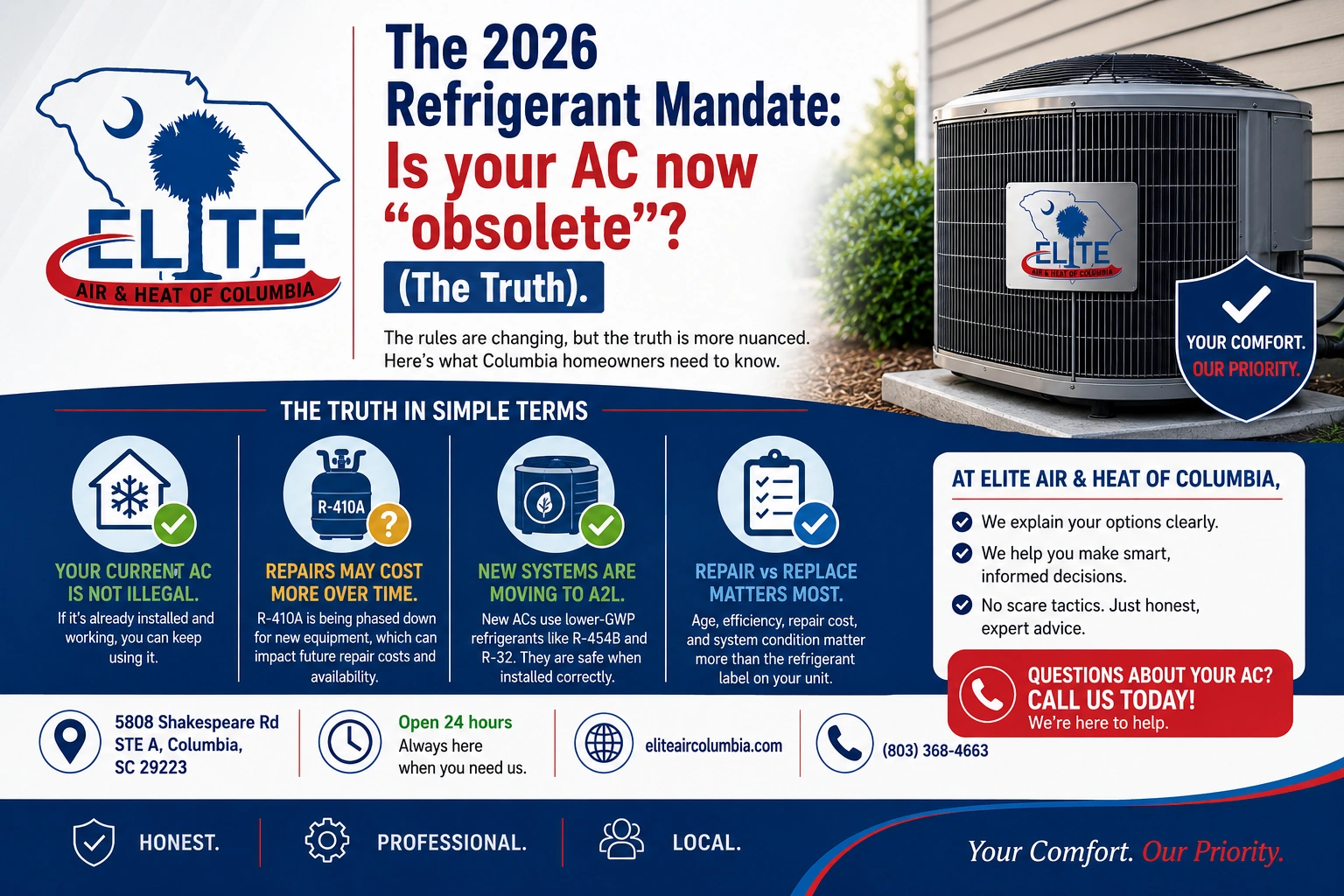
No, your existing AC is not automatically obsolete just because of the 2026 refrigerant transition.
If your current system is already installed and working, you do not have to replace it only because it uses R-410A. The refrigerant rules mainly affect new equipment manufacturing and installation, not whether homeowners can keep using systems that are already in place.
That said, the refrigerant change can affect repair costs, parts availability, replacement quotes, and the long-term value of putting major money into an older system.
The truth is somewhere in the middle.
Your AC is not illegal. It is not useless. But if it is older, leaking refrigerant, or needing major repairs, the refrigerant transition should be part of the repair-versus-replace conversation.
Is Your Air Conditioner Really Becoming Obsolete in 2026?
Don't let misinformation cost you thousands. Speak with Columbia's trusted HVAC professionals today and get clear answers about refrigerant changes, repair options, and replacement recommendations.
What Is the 2026 Refrigerant Mandate?
The HVAC industry has been moving away from older, higher-global-warming-potential refrigerants like R-410A and toward lower-GWP refrigerants used in new equipment, including R-454B and R-32.
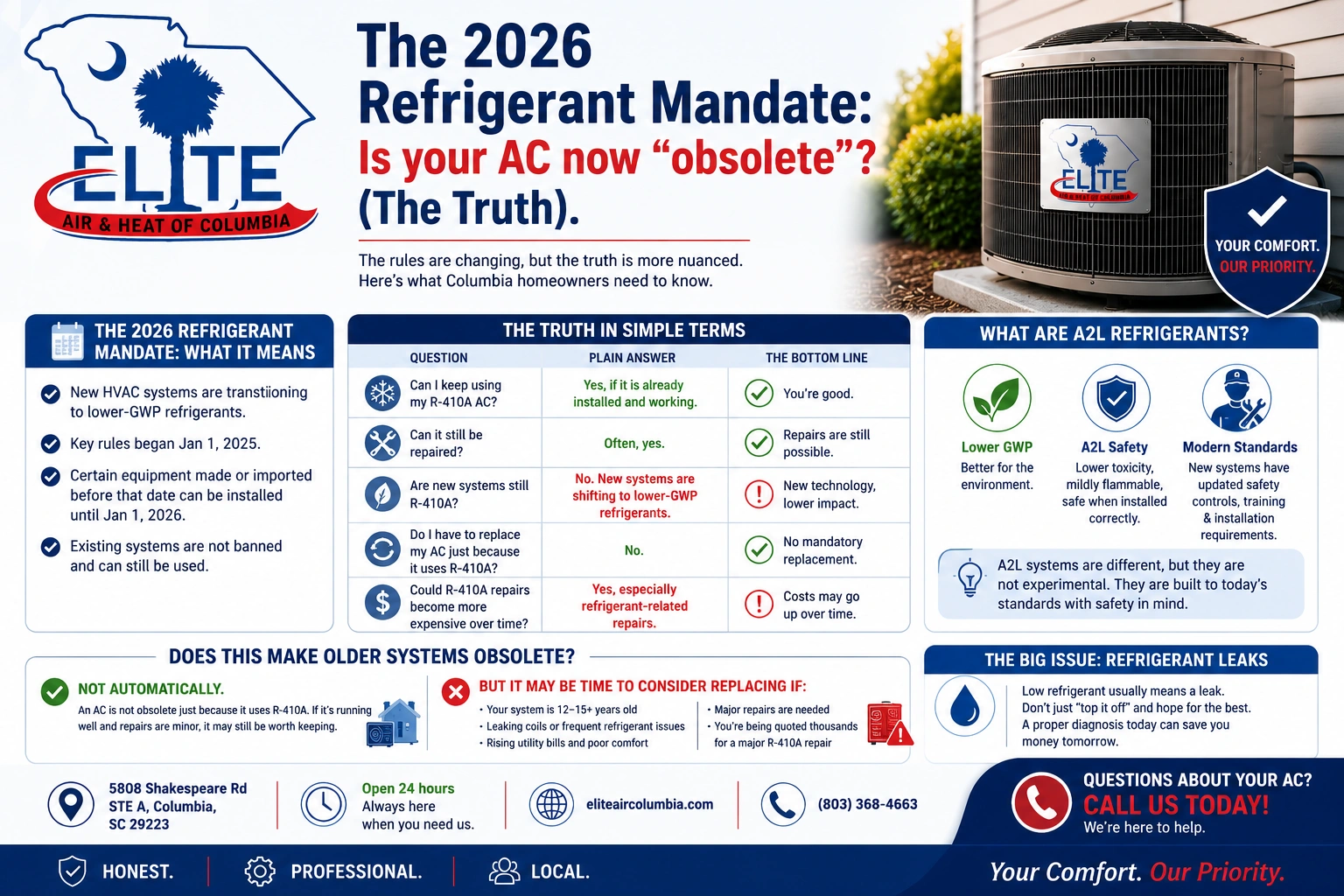
The EPA’s HFC Technology Transitions rules set restrictions for certain new residential and light commercial AC and heat pump systems. A key transition date was January 1, 2025, with an additional allowance for certain qualifying equipment manufactured or imported before that date to be installed until January 1, 2026.
That means 2026 is the year many homeowners start seeing the shift more clearly in replacement estimates.
New systems are moving to the newer refrigerants. Older R-410A systems already installed in homes are not suddenly banned from operating.
Is R-410A Banned?
This is where wording matters.
R-410A is being phased down for new equipment, not instantly erased from every home.
The EPA’s HFC phasedown focuses on reducing the use of higher-GWP refrigerants in specific sectors and new equipment over time. The rules do not mean every homeowner with an R-410A system has to rip it out immediately.
In simple terms:
| Question | Plain Answer |
| Can I keep using my R-410A AC? | Yes, if it is already installed and working. |
| Can it still be repaired? | Often, yes. |
| Is R-410A equipment still the standard for new systems? | No. New systems are shifting to lower-GWP refrigerants. |
| Do I have to replace my AC just because it uses R-410A? | No. |
| Could R-410A repairs become more expensive over time? | Yes, especially refrigerant-related repairs. |
That last line is the one homeowners should pay attention to.
The system is not obsolete just because of the label. But the math around major repairs may be changing.
What Are A2L Refrigerants?
Many newer residential HVAC systems use refrigerants such as R-454B or R-32.
These are often called A2L refrigerants.
That classification means they are lower-toxicity and mildly flammable. That phrase can sound alarming, but it does not mean the equipment is unsafe when installed correctly. Manufacturers, code bodies, and the HVAC industry have updated standards, training, and installation practices around these refrigerants. AHRI maintains a Safe Refrigerant Transition resource center covering A2L safety, technician best practices, refrigerant handling, codes, and training.
For homeowners, the important takeaway is simple:
A2L systems are different, but they are not experimental.
They do require contractors to understand the newer equipment, refrigerant handling, safety controls, and installation instructions.
Does This Make Older AC Systems Obsolete?
Not automatically.
An AC is functionally obsolete when it no longer makes sense to repair, cannot be supported affordably, or cannot keep the home comfortable.
It is not obsolete just because it uses R-410A.
Your older system may still be reasonable to repair if:
- It is under 10 years old
- The repair is minor
- The compressor is healthy
- The coil is not leaking
- Refrigerant loss is not severe
- The system cools and dehumidifies properly
- Parts are available
- The cost of repair is low compared to replacement
Your system may be moving toward practical obsolescence if:
- It is 12–15+ years old
- It has a leaking evaporator or condenser coil
- It needs repeated refrigerant charges
- The compressor is failing
- It struggles every summer
- Utility bills keep rising
- The home feels humid even when the AC runs
- Repair costs are stacking up
- You are being quoted thousands for a major R-410A repair
That does not mean panic-replace it. It means slow down and compare the repair cost to the cost and benefits of replacement.
The Big Issue: Refrigerant Leaks
The refrigerant mandate matters most when your current system has a leak.
If your AC is running fine, the refrigerant inside it is not something you normally have to think about.
But if the system is low on refrigerant, that refrigerant went somewhere. AC systems are sealed. Refrigerant does not get “used up” like gasoline.
A low refrigerant charge usually means there is a leak.
This is where homeowners sometimes get into trouble. A technician may add refrigerant, the AC cools again, and everyone moves on. But if the leak is still there, the problem comes back.
With R-410A becoming less central to new equipment, repeated refrigerant-related repairs may become harder to justify over time.
A good technician should explain:
- Whether the system is actually low on refrigerant
- Whether a leak search is recommended
- Where leaks commonly occur
- Whether the coil is leaking
- How much refrigerant is needed
- Whether the repair is temporary or long-term
- Whether replacement should be considered
The goal is not to scare you. The goal is to avoid spending a lot of money on a repair that does not last.
Can You Mix New Refrigerant Into an Old R-410A System?
No.
This is important.
You cannot simply put R-454B or R-32 into an old R-410A system and call it upgraded.
The equipment is designed for a specific refrigerant. Compressors, coils, metering devices, pressures, oil compatibility, controls, and safety requirements are all part of that design.
If someone tells you they can “convert” your old R-410A home AC to the new refrigerant with a quick recharge, be careful.
A good contractor should not treat refrigerants as interchangeable.
Who’s the Top Choice for Heat Pump Installation in Woodson, Columbia, SC?
When it comes to reliable and efficient heat pump installation, Elite Air & Heat of Columbia is the name you…
Why Are New Systems More Expensive Now?
Part of the frustration around the 2026 mandate is that new systems often cost more.
That is not just because contractors decided to raise prices.
New A2L systems required changes in equipment design, safety labeling, training, tools, storage, transport, installation practices, and supply chains. Manufacturers also had to redesign many products for the new refrigerants.
On top of that, HVAC equipment costs have also been affected by labor, copper, aluminum, electronics, transportation, inflation, and supply disruptions.
So when a homeowner compares a 2024 quote to a 2026 quote, the difference can feel sharp.
A 2026 system may cost more because the whole equipment generation changed.
Should You Repair or Replace an R-410A System in 2026?
There is no one-size-fits-all answer.
Here is a practical way to think about it.
Repair may make sense when the problem is small
A repair may be reasonable if you are dealing with:
- A capacitor
- A contactor
- A fan motor
- A thermostat issue
- A clogged drain line
- A dirty coil
- A minor airflow problem
- A single failed electrical component
If the system is otherwise healthy, using R-410A does not automatically make repair a bad idea.
Replacement may make sense when the repair is major
Replacement deserves a serious look if you are dealing with:
- A leaking evaporator coil
- A leaking condenser coil
- A failed compressor
- Repeated refrigerant loss
- Major airflow problems
- High humidity complaints
- Poor ductwork plus aging equipment
- A repair quote that is a large percentage of replacement cost
If your system is older and the repair involves a large refrigerant charge or coil replacement, the refrigerant transition matters more.
That is not because your system is illegal. It is because the long-term value of the repair may be weak.
What Should a Technician Tell You Before Recommending Replacement?
A good technician should be able to show you why replacement is being discussed.
Not just say:
“R-410A is obsolete. You need a new system.”
That is too simple.
A better explanation sounds like this:
“Your system uses R-410A, which can still be serviced. The issue is that your evaporator coil is leaking, the system is 14 years old, and this repair would cost a lot compared to replacement. You can repair it, but here is the risk of putting that money into this system.”
That is the kind of explanation homeowners deserve.
Before approving replacement, ask:
- What refrigerant does my current system use?
- Is the system actually leaking?
- Where is the leak?
- What repair options do I have?
- How much refrigerant is needed?
- Is this a temporary repair or a lasting repair?
- What refrigerant does the new system use?
- Are the indoor and outdoor components properly matched?
- What does the quote include?
- What warranty comes with the new system?
A good technician should be comfortable answering those questions.
What About Home Warranties and R-410A Systems?
This is worth watching closely.
Some home warranty companies may still approve repairs on R-410A systems. Others may limit what they cover, use lower-cost repair paths, or delay replacement decisions.
If your repair goes through a warranty company, ask what equipment is being replaced, what refrigerant is being used, whether components are matched, and whether the repair addresses the actual leak.
The cheapest approved repair is not always the best long-term repair.
Will R-410A Become Impossible to Find?
Not overnight.
Existing R-410A systems will still need service, and the market does not disappear in one day. But as production and use patterns shift, refrigerant availability and pricing can become less predictable.
That means minor repairs may remain practical, while major refrigerant-related repairs may become harder to justify.
The older the system gets, the more important that math becomes.
What Columbia Homeowners Should Know
In Columbia, AC systems work hard.
Long cooling seasons, heavy humidity, hot attics, and extended run times put stress on equipment. A system that might limp along in a milder climate can struggle here for months.
That is why the refrigerant mandate should not be the only factor in your decision.
You also need to look at:
- Age of the system
- Repair history
- Cooling performance
- Humidity control
- Utility bills
- Duct condition
- Airflow
- Comfort during peak summer heat
- Whether the system is properly sized
- Whether repairs are becoming repetitive
In Columbia’s heat and humidity, an AC that “still runs” may not be the same as an AC that is serving the home well.
The Bottom Line
Your AC is not automatically obsolete because of the 2026 refrigerant mandate.
If your R-410A system is installed, working, and not leaking, you can keep using it. The refrigerant transition mainly affects new equipment and the long-term economics of major repairs.
The honest answer is this:
Do not replace a working AC just because someone says R-410A is obsolete. But do not ignore the refrigerant transition if your older system has a major leak or expensive repair.
A good technician should explain the repair option, the replacement option, the refrigerant involved, and what happens if you wait.
If your system is still cooling well, you may not need to do anything today.
If it is leaking, struggling, or costing more every summer, it is worth getting a clear diagnosis before spending money on another temporary fix.
Elite Air & Heat of Columbia can help you understand whether your current AC still makes sense to repair or whether replacement is the smarter long-term option.
2026 Refrigerant Changes Are Coming. Is Your AC Ready?
Protect your comfort and your budget with a professional system assessment. We'll help you understand how the new regulations affect your equipment and what steps, if any, you should take next.