

Two homes can be only a few miles apart and still feel like they live in different summers.
One house near downtown Columbia may have an AC that runs deep into the evening.
Another house farther out toward Lexington may cool down faster after sunset.
Same region. Same forecast. Different comfort problem.
Here’s the plain answer.
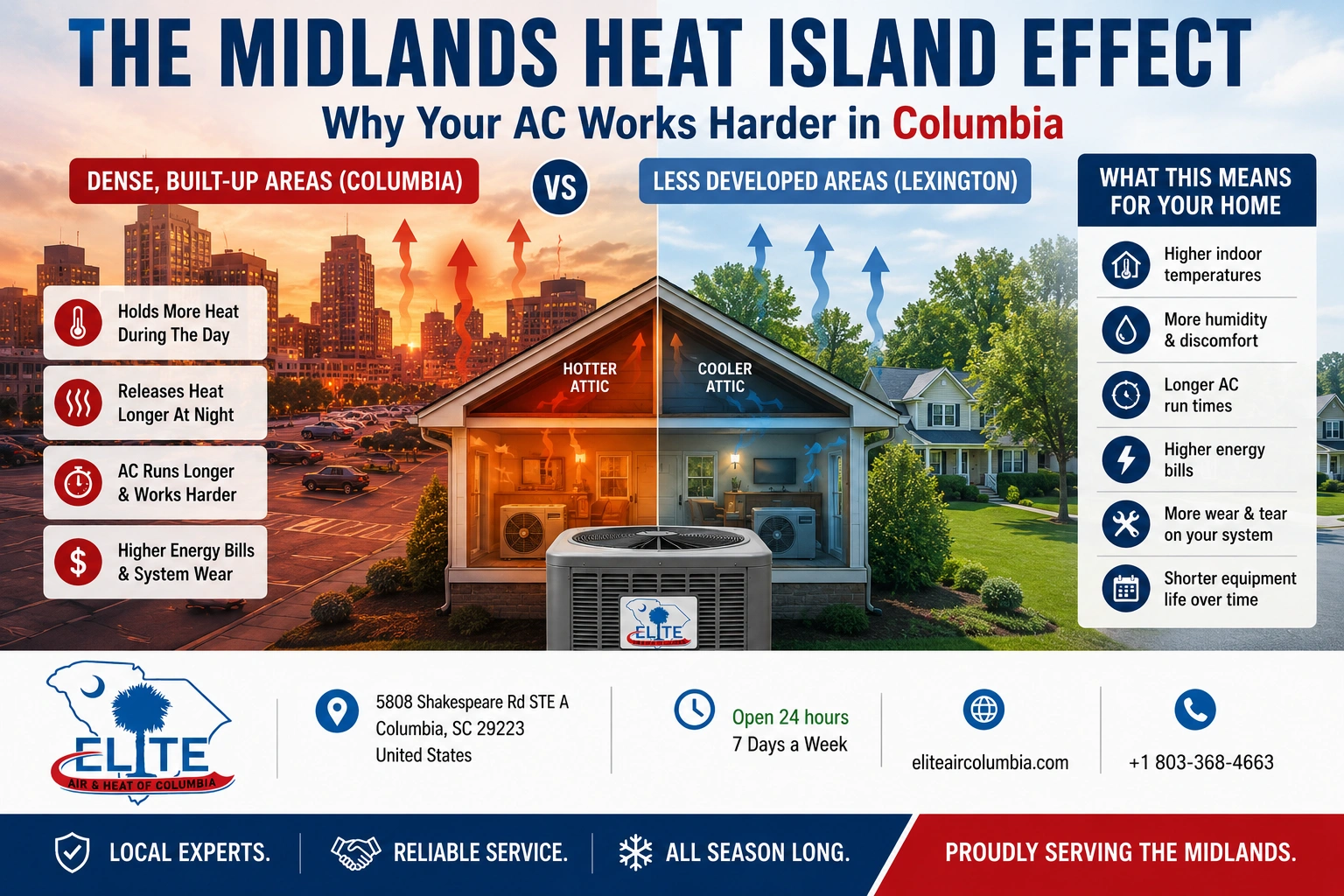
Dense, paved, built-up areas hold heat longer than greener, less-developed areas. That trapped heat is called the urban heat island effect, and it can make an AC work harder because the home starts hotter, stays hotter, and gets less overnight relief.
That does not mean every Columbia home is hotter than every Lexington home. A shaded Columbia home can outperform an exposed Lexington home. But in general, areas with more pavement, rooftops, traffic, buildings, and less tree cover tend to hold more heat.
For homeowners, that means longer AC run times, higher attic temperatures, more humidity complaints, and bigger stress on older systems.
Is your AC struggling in Lexington's summer heat?
Don't wait for a breakdown. Get fast, reliable cooling solutions from trusted local HVAC professionals today.
What Is the Midlands Heat Island?
The “Midlands Heat Island” is the local version of the urban heat island effect.
Urban heat islands happen when buildings, roads, parking lots, rooftops, and other hard surfaces absorb heat during the day and release it back into the air later. The City of Columbia describes heat islands as places where buildings, pavement, and other urban surfaces trap and re-emit heat, amplifying high temperatures compared with nearby vegetated areas.
That matters because your AC is not just fighting the outdoor temperature on the weather app.
It is fighting the heat around your actual house.
A home surrounded by asphalt, dark shingles, brick walls, limited shade, and a hot attic may experience harsher cooling conditions than the official temperature suggests.
Why Columbia Can Feel Harder on AC Systems Than Lexington
Columbia has more dense development, more pavement, more commercial corridors, more rooftops, and more heat-holding surfaces than many areas farther out.
Lexington still gets hot. Very hot.
But parts of Lexington may have more tree cover, more open space, less dense building mass, and more nighttime cooling depending on the neighborhood.
That difference matters most late in the day.
During the afternoon, both areas may be hot. But after sunset, a less-developed area may release heat faster. A built-up area may keep radiating heat from roads, sidewalks, parking lots, buildings, and roofs.
That is why some Columbia homeowners say:
“The AC cools okay in the morning, but it never catches up after 3 p.m.”
Or:
“The house finally feels decent around midnight.”
That is a heat-load problem.
The home is absorbing heat faster than the AC can remove it.
Columbia Has More 90-Degree Days Than Lexington
Climate comparison data shows Columbia averages more days above 90 degrees than Lexington. BestPlaces reports about 79 days per year above 90°F in Columbia compared with about 69.2 days per year in Lexington.
That does not tell the whole story, but it supports what many homeowners already feel: Columbia’s cooling season is long, hot, and demanding.
For an AC system, ten extra very hot days is not just a comfort issue. It means more runtime, more electrical load, more wear on capacitors and contactors, more strain on compressors, and less room for an older system to coast.
Why Heat Islands Make Your AC Run Longer
Your AC removes heat from inside the house and dumps it outside.
That job gets harder when the outdoor environment is hotter.
A heat island can affect your home in several ways:
- The attic gets hotter
- The roof holds heat longer
- Exterior walls absorb more heat
- Pavement radiates heat toward the home
- Outdoor AC equipment sits in hotter air
- The home cools down more slowly at night
- Indoor humidity may feel worse
- The AC gets fewer natural “breaks”
This is why an AC that seems properly sized on paper may still struggle in a hot, exposed location.
The system may not be broken. It may simply be fighting a heavier heat load than the home had when it was first built or when the system was originally sized.
The Nighttime Problem Homeowners Notice Most
Heat islands are not just about hotter afternoons.
They are also about warmer evenings.
The EPA explains that nighttime urban heat islands can be especially noticeable because urban materials store heat during the day and release it after sunset.
For your AC, that means the system may keep running long after the sun goes down.
A shaded home in a greener area may get evening relief. The outdoor temperature drops. The attic cools. The system catches up.
A home surrounded by heat-holding surfaces may not get that same relief. The roof, driveway, nearby pavement, and brick or concrete surfaces keep feeding heat back into the area around the house.
That is when homeowners start lowering the thermostat from 74 to 72 to 70 and still feel uncomfortable.
Why the Outdoor Unit Location Matters
Your outdoor condenser needs to reject heat.
That is its job.
If the condenser is sitting in a tight, hot area surrounded by pavement, fencing, walls, dryer vents, shrubs, or direct afternoon sun, it has a harder time releasing heat.
That can lead to:
- Longer run times
- Higher head pressure
- More compressor strain
- Higher electric bills
- Shorter equipment life
- Reduced cooling capacity during peak heat
This does not mean you should cover the unit with a shade structure that blocks airflow. That can make things worse.
But it does mean the area around the condenser matters. It needs open airflow, proper clearance, and no recirculation of hot discharge air.
A good technician should look at the condenser location, not just the thermostat.
The Attic Is Often the Real Heat Island Inside the House
In many Columbia homes, the attic becomes the hottest part of the house.
Dark shingles, weak ventilation, low insulation, leaky ducts, and long duct runs can turn the attic into a heat bank sitting directly above your living space.
If ductwork runs through that attic, the AC may be cooling air only to send it through extremely hot ducts before it reaches the rooms.
That can cause:
- Warm bedrooms
- Weak airflow
- Long run times
- Sweaty upstairs rooms
- High humidity
- Higher bills
- AC that “blows cold” but cannot catch up
A new outdoor unit will not fully solve that if the attic and ducts are part of the problem.
This is where homeowners sometimes get into trouble. They replace the equipment, but no one addresses the heat load around the duct system.
Tree Cover Makes a Real Difference
Shade is not cosmetic in the Midlands.
It changes the cooling load on the home.
The University of South Carolina reported on Columbia heat mapping results showing the city’s hottest neighborhoods compared with cooler areas, with the project involving the City of Columbia, Richland County, NOAA, CAPA Strategies, and local partners.
NOAA’s heat island mapping program has supported communities across the country in mapping how heat is distributed locally, which helps show that heat is not spread evenly across a city.
The practical homeowner version is simple:
A shaded house is easier to cool than an exposed house.
Trees, vegetation, lighter surfaces, and less surrounding pavement can reduce the heat your AC has to remove. Columbia Green’s discussion of Columbia heat islands also points to preserved forests and green spaces acting as heat buffers between residential areas and more developed land uses.
Why Your Neighbor’s AC May Do Better Than Yours
Two homes on the same street can have different AC performance.
The difference may be:
- One has afternoon shade
- One has newer attic insulation
- One has leaky attic ducts
- One has a dark roof
- One has more west-facing glass
- One has a hot driveway beside the bedrooms
- One has a better return duct system
- One has a cleaner outdoor coil
- One has lower indoor humidity
- One system is oversized and short-cycling
- One system is properly sized and runs longer
This is why “my neighbor has the same size system” is not enough information.
A good technician should evaluate the home’s heat load, airflow, ductwork, insulation, and exposure before recommending equipment size.
Bigger is not automatically better.
In Columbia humidity, an oversized AC may cool quickly but fail to remove enough moisture. That leaves the house cold and clammy instead of comfortable.
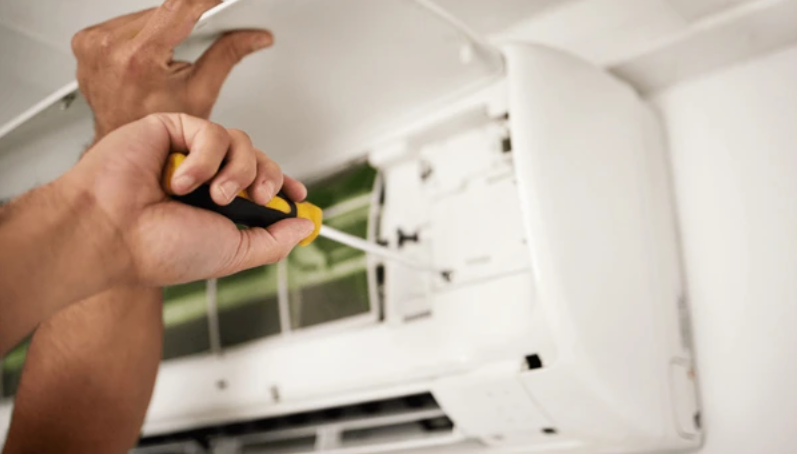
AC Repair in a Heatwave: Why Timing Makes All the Difference
When the temperature spikes, the last thing you want is your AC breaking down. Timing is everything when it comes…
Signs the Heat Island Effect Is Stressing Your AC
You may be dealing with a heat-load problem if:
- The AC runs constantly from mid-afternoon into evening
- The house cools fine in the morning but struggles later
- Upstairs rooms are uncomfortable after sunset
- The thermostat drops slowly after 4 p.m.
- Utility bills spike during heat waves
- The outdoor unit is near pavement or direct afternoon sun
- Rooms near west-facing walls feel hotter
- The attic is extremely hot
- Indoor humidity stays high
- The system is older and cannot recover after hot days
That does not automatically mean you need a new AC.
It means the system should be evaluated as part of the whole house.
What Homeowners Can Safely Check
Before assuming the AC is failing, check the basics.
You can safely check:
- Air filter condition
- Thermostat settings
- Whether the fan is set to AUTO
- Outdoor unit clearance
- Weeds, leaves, or debris around the condenser
- Blocked supply vents
- Blocked return grilles
- Indoor humidity level
- Whether the problem is worse late afternoon
- Whether certain rooms are exposed to afternoon sun
- Whether attic access feels extremely hot around ductwork
You can also walk around the outdoor unit while it is running. Do not open it. Just look.
Make sure it has space to breathe. If hot discharge air is trapped by fencing, walls, shrubs, or stored items, the unit may be working harder than it should.
What Not to DIY
Do not try to fix heat-island AC problems by:
- Oversizing the replacement system yourself
- Spraying water on the condenser as a routine fix
- Building a tight shade cover around the outdoor unit
- Changing blower speeds without testing airflow
- Adding refrigerant without finding a leak
- Closing vents to force air into hot rooms
- Cutting into ductwork
- Bypassing safety switches
Those shortcuts can create bigger problems.
Closing vents, for example, can raise duct pressure and reduce system performance. A shade cover that blocks airflow can trap heat around the condenser. Adding refrigerant to a system that is not low can damage equipment.
The cheaper shortcut is not always harmless.
What a Good Technician Should Inspect
A proper diagnosis should include more than checking whether the AC “blows cold.”
A good technician should inspect:
- Refrigerant charge
- Outdoor coil condition
- Condenser airflow clearance
- Electrical components
- Compressor performance
- Indoor coil condition
- Blower operation
- Static pressure
- Return air capacity
- Duct leakage or restriction
- Attic duct insulation
- Temperature split
- Indoor humidity
- System run time
- Thermostat location
- Whether the system is properly sized for the home
A good technician should be able to explain whether the problem is the AC, the ductwork, the house, the heat exposure, or some combination of those.
Best Ways to Reduce AC Strain in a Heat Island Area
You cannot move your house out of the heat island.
But you can reduce the load.
Start with the practical steps:
- Replace dirty filters regularly
- Keep the outdoor unit clear
- Seal obvious air leaks
- Improve attic insulation
- Seal and insulate attic ducts
- Add curtains or shades on west-facing windows
- Use ceiling fans for comfort, not as a substitute for AC
- Keep thermostat settings steady during extreme heat
- Consider a smart thermostat with humidity awareness
- Address crawlspace moisture if humidity stays high
- Schedule maintenance before peak summer
- Consider shade trees where appropriate and safe for the home
For bigger comfort problems, duct sealing, return-air improvements, attic insulation, and properly sized replacement equipment may matter more than simply buying a larger AC.
Does This Mean Columbia Homes Need Bigger AC Systems Than Lexington Homes?
Not automatically.
This is important.
A Columbia home may have a higher cooling load than a similar home in a greener or less-developed area, but that does not mean the answer is always a bigger system.
The right answer may be:
- Better ductwork
- More return air
- Lower air leakage
- Improved insulation
- Better humidity control
- Variable-speed equipment
- A properly sized heat pump
- A mini-split for one problem room
- Better outdoor unit placement
- A full load calculation before replacement
Oversizing can cause humidity problems.
In Columbia, that matters. An AC that is too large may satisfy the thermostat too quickly and shut off before it removes enough moisture.
That is how you end up with a house that is cool but still sticky.
The Bottom Line
The Midlands Heat Island makes your AC work harder because built-up areas hold and re-release heat.
Compared with greener or less dense areas around Lexington, many Columbia homes face more pavement, rooftops, traffic heat, warmer evenings, hotter attics, and less overnight cooling relief.
That means your AC may run longer, wear harder, and struggle more during late-afternoon and evening heat.
If you only remember one thing, remember this:
Your AC is not just cooling the air inside your home. It is fighting the heat stored around your home.
A good HVAC evaluation should look at the system, the ducts, the attic, the outdoor unit location, the humidity, and the home’s exposure before recommending repair or replacement.
Elite Air & Heat of Columbia can help determine whether your AC is truly undersized or whether the real problem is airflow, ductwork, attic heat, humidity, or the heat load around the home.
The Midlands heat driving up your AC bills?
Keep your home cool with expert AC inspections, maintenance, and repairs. Call today before the next heat wave hits.