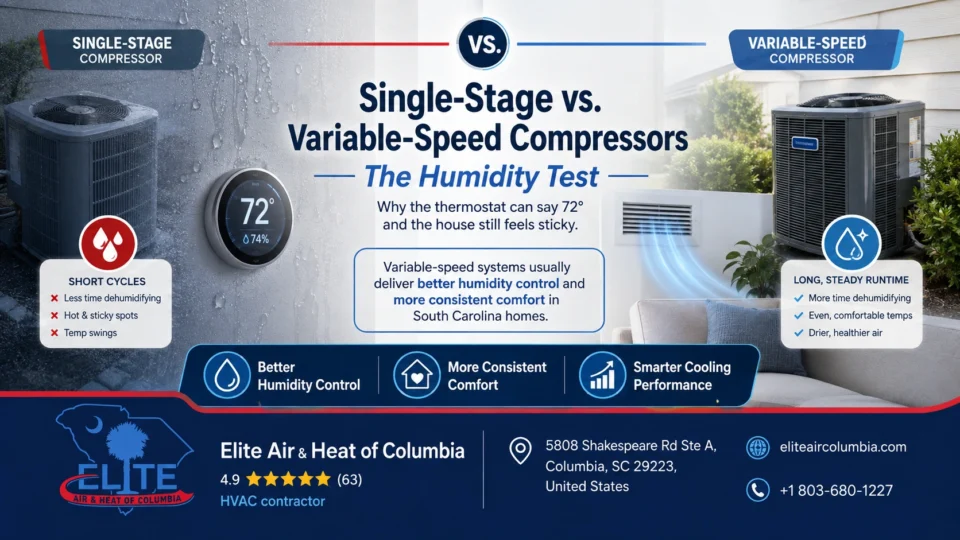

If your Columbia home feels sticky even when the thermostat says 72, the problem may not be the number on the screen.
It may be humidity.
Here’s the plain answer.
The best thermostat for Columbia humidity is not just a thermostat that shows humidity. It is a thermostat that helps your HVAC system run long enough, slow enough, and smart enough to remove moisture from the air.
Fighting 80% humidity indoors?
Upgrade your thermostat for better comfort. Call today for professional recommendations, setup, and reliable support.
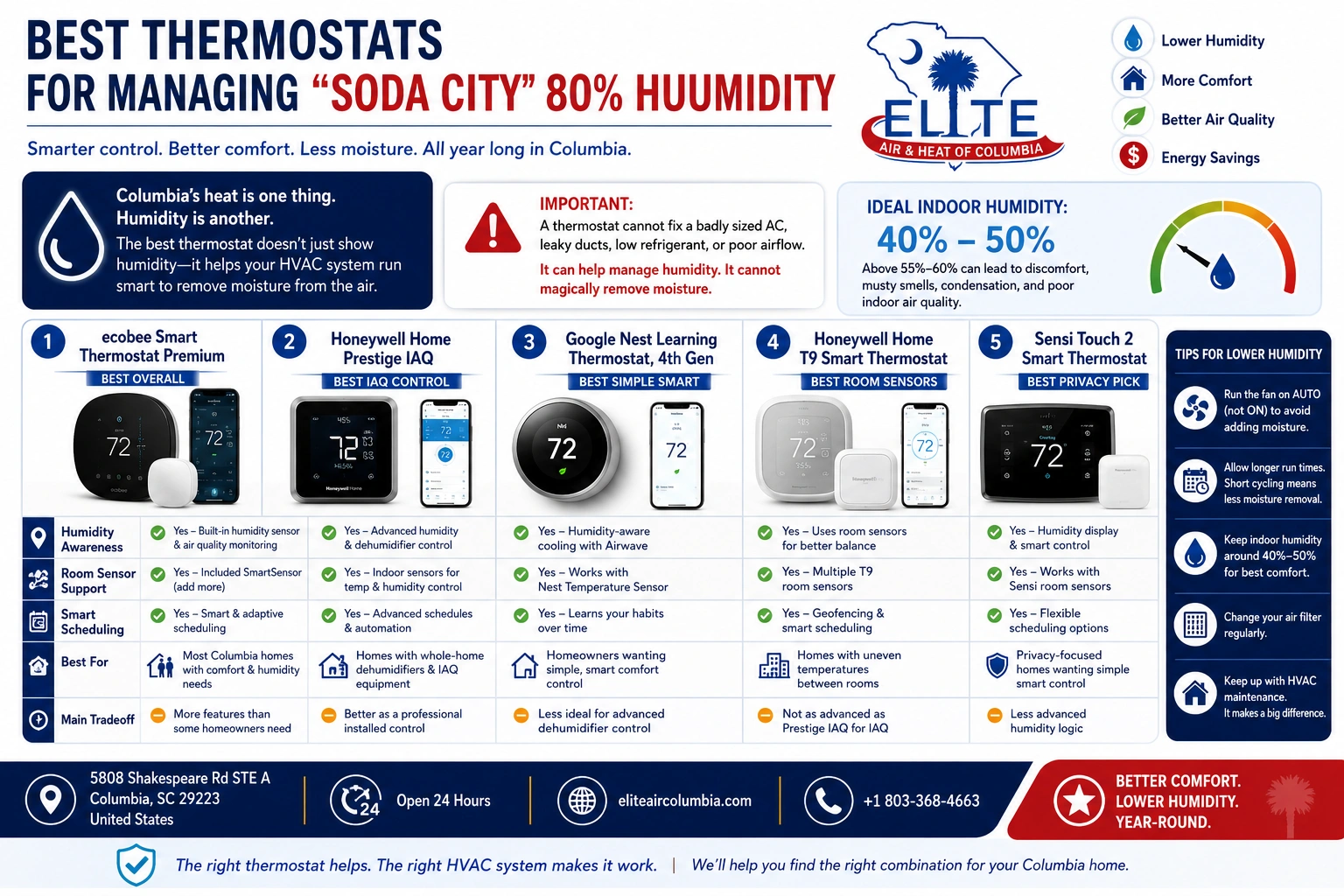
For most Soda City homes, the best thermostat choices in 2026 are:
- ecobee Smart Thermostat Premium — best overall for comfort and humidity awareness
- Honeywell Home Prestige IAQ — best for whole-home dehumidifiers and advanced humidity control
- Google Nest Learning Thermostat, 4th Gen — best for simple smart comfort and learning schedules
- Honeywell Home T9 — best for room sensors and uneven homes
- Sensi Touch 2 — best simple smart thermostat with strong privacy and room sensor support
The important warning is this:
A thermostat cannot fix a badly sized AC, leaky ducts, low refrigerant, or poor airflow by itself.
It can help manage humidity. It cannot magically remove moisture if the HVAC system is not set up to do the job.
ecobee Smart Thermostat Premium
Best overall
Price not available
Honeywell Home Prestige IAQ Thermostat
Best IAQ control
Price not available
Google Nest Learning Thermostat 4th Gen
Best simple smart
Price not available
Honeywell Home T9 Smart Thermostat
Best room sensors
Price not available
Sensi Touch 2 Smart Thermostat
Best privacy pick
Price not available
Why Humidity Is Such a Big Deal in Columbia
Columbia heat is one thing.
Columbia humidity is another.
When indoor humidity gets too high, the house can feel warm and sticky even if the AC is blowing cold air. Many homes feel best around 40% to 50% indoor relative humidity. Once the home stays above about 55% to 60%, comfort problems, musty smells, condensation, and indoor air quality concerns become more likely.
That is why a thermostat matters.
A basic thermostat only says, “The house hit 72 degrees. Shut the AC off.”
A better thermostat can help the system think more carefully:
- Is the home still humid?
- Should the AC run a little longer?
- Are occupied rooms actually comfortable?
- Is the fan setting making humidity worse?
- Is the schedule causing short cycling?
- Is a whole-home dehumidifier needed?
In Columbia’s long cooling season, those details matter.
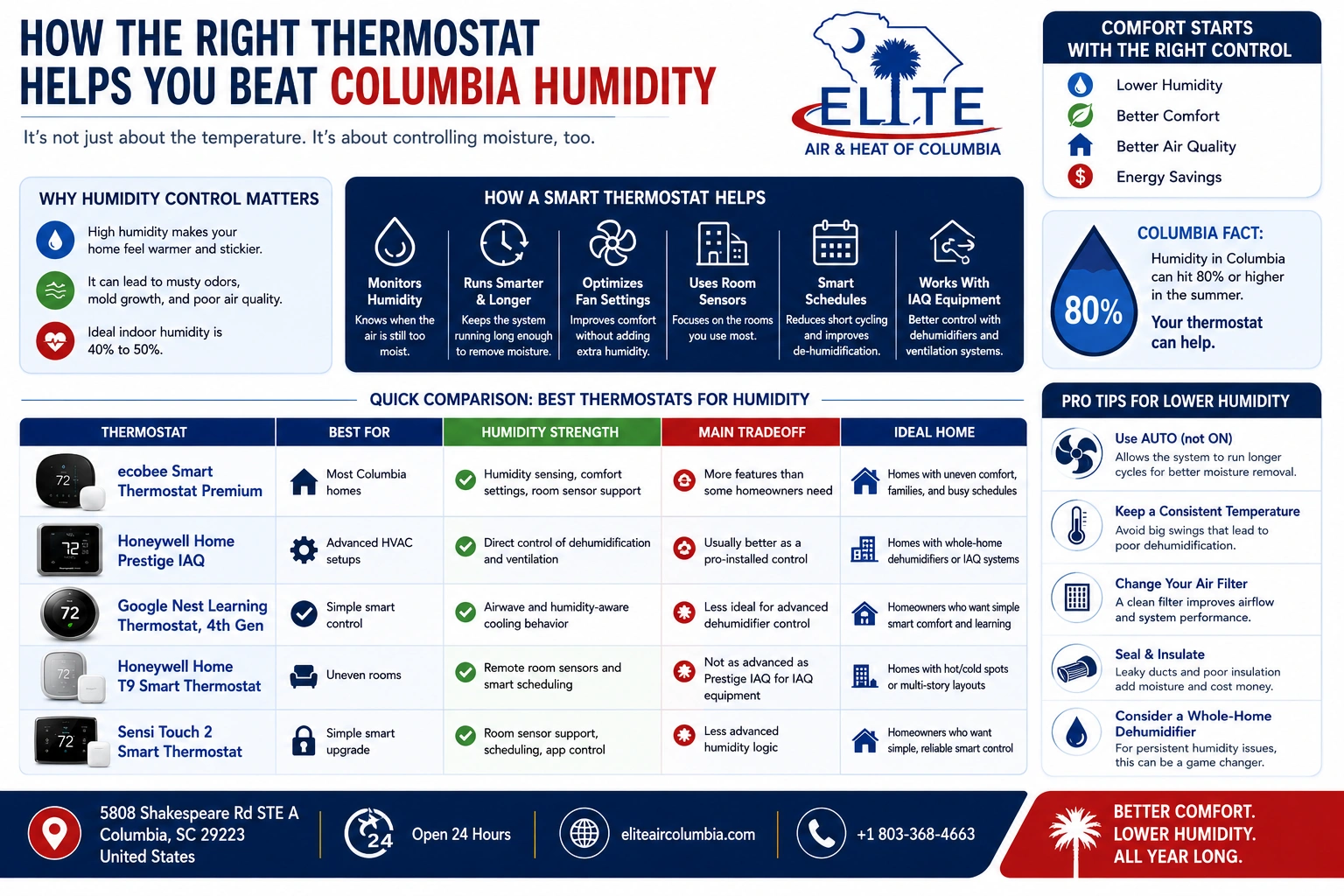
Quick Comparison: Best Thermostats for Humidity
| Thermostat | Best For | Humidity Strength | Main Tradeoff |
| ecobee Smart Thermostat Premium | Most Columbia homes | Humidity sensing, comfort settings, room sensor support | More features than some homeowners need |
| Honeywell Home Prestige IAQ | Advanced HVAC setups | Direct control of dehumidification and ventilation | Usually better as a pro-installed control |
| Google Nest Learning Thermostat | Simple smart control | Airwave and humidity-aware cooling behavior | Less ideal for advanced dehumidifier control |
| Honeywell Home T9 | Uneven rooms | Remote room sensors and smart scheduling | Not as advanced as Prestige IAQ for IAQ equipment |
| Sensi Touch 2 | Simple smart upgrade | Room sensor support, scheduling, app control | Less advanced humidity logic |
1. ecobee Smart Thermostat Premium
Best overall choice for many Columbia homes
The ecobee Smart Thermostat Premium is one of the strongest all-around choices for homeowners who care about comfort, humidity awareness, room sensors, and smart control.
It includes an air quality monitor, occupancy sensing, smart scheduling, and compatibility with remote sensors. ecobee says the Smart Thermostat Premium includes built-in air quality monitoring and can use SmartSensors to help manage comfort in the rooms that matter most.
Why it works well for Columbia:
- It can account for indoor humidity when managing comfort.
- Remote sensors help if bedrooms, upstairs rooms, or home offices feel different from the hallway.
- It works well for homeowners who want more comfort data without needing a commercial-style control.
- It is a good match for many heat pump and central AC systems.
Best fit:
- Homes with uneven comfort
- Homeowners who want app control
- Families that use certain rooms more than others
- Homes where humidity feels worse than the thermostat suggests
Bad fit:
- Homeowners who want the simplest possible thermostat
- Systems with complicated whole-home dehumidifiers that need more dedicated IAQ control
Kitchen-table advice: ecobee is often the best “smart comfort” option. It will not fix a bad duct system, but it gives you better tools to understand what the house is doing.
2. Honeywell Home Prestige IAQ
Best for serious humidity control and whole-home dehumidifiers
If your home has a whole-home dehumidifier, fresh air ventilation, humidifier, or more advanced indoor air quality equipment, the Honeywell Home Prestige IAQ is often the better tool.
Honeywell describes the Prestige IAQ as a thermostat that provides control of temperature, dehumidification, and ventilation. Its technical documentation also notes that remote indoor sensors can be used for humidification and dehumidification control.
This matters because some humidity problems cannot be solved by running the AC a little differently.
Sometimes the house needs dedicated dehumidification.
That can happen when:
- Indoor humidity stays high in spring and fall
- The AC does not run long enough to dry the air
- The home has a sealed or damp crawlspace issue
- The system is oversized
- The homeowner wants tighter humidity control
- There is dedicated IAQ equipment installed
Best fit:
- Homes with whole-home dehumidifiers
- More advanced HVAC systems
- Homeowners who want professional-grade humidity and ventilation control
- Homes with persistent humidity issues
Bad fit:
- Simple DIY thermostat replacement
- Homeowners who only want basic app control
Kitchen-table advice: Prestige IAQ is not the flashiest option, but for real humidity equipment, it is often the more serious control.

Review: Is the Mitsubishi Hyper-Heat worth it for SC winters?
Mitsubishi Hyper-Heat has built its reputation around something traditional heat pumps used to struggle with: producing reliable heat when outdoor…
3. Google Nest Learning Thermostat, 4th Gen
Best for simple smart comfort and automatic scheduling
The Nest Learning Thermostat is a good fit for homeowners who want a clean smart thermostat that learns habits and keeps daily control simple.
For humidity, Nest’s Airwave feature is worth understanding. Google says Airwave can turn off the compressor and keep the fan running when conditions allow, but if indoor humidity is very high, Nest will not use Airwave and will instead run the compressor for the full cooling cycle to help lower humidity and prevent mold.
That is helpful because running just the blower at the wrong time can sometimes put moisture back into the home.
Best fit:
- Homeowners who want a simple smart thermostat
- Homes with fairly normal ductwork and comfort patterns
- People who like automatic schedules
- Google Home users
Bad fit:
- Homes needing direct whole-home dehumidifier control
- Homeowners who want lots of HVAC configuration options
- Systems where a pro thermostat would be more appropriate
Kitchen-table advice: Nest is clean and easy to live with. For basic humidity-aware cooling, it can help. For serious humidity problems, diagnose the system first.
4. Honeywell Home T9
Best for room-by-room comfort problems
The Honeywell Home T9 is a good choice when your main issue is not just humidity, but uneven comfort.
Maybe the hallway thermostat says the home is fine, but the bedroom is sticky. Or the living room is comfortable, but the office feels heavy and warm.
Honeywell describes the T9 as a Wi-Fi thermostat with remote room sensor support, smart scheduling, and ENERGY STAR efficiency, designed to control comfort in specific rooms.
That can help in Columbia homes where:
- Bedrooms stay warmer at night
- Upstairs rooms feel humid
- Additions do not match the rest of the house
- The thermostat location does not represent the rooms people actually use
Best fit:
- Homes with uneven temperatures
- Families that care most about bedrooms at night
- Homeowners who want room sensors without going overly complex
- Homes where thermostat location is part of the problem
Bad fit:
- Homes with severe humidity problems caused by duct leakage or oversized equipment
- Systems needing direct dehumidifier control
Kitchen-table advice: T9 helps the thermostat listen to the rooms you actually live in. That can make comfort better, but it still depends on the HVAC system being able to deliver air there.
5. Sensi Touch 2
Best simple smart thermostat with privacy-friendly controls
The Sensi Touch 2 is a strong option if you want a smart thermostat without feeling like you bought a complicated control panel.
Sensi describes the Touch 2 as a Wi-Fi smart thermostat with comfort control, app access, room sensor compatibility, and data privacy positioning. Its product materials also note compatibility with Sensi Room Sensors and ENERGY STAR certification.
This is a good choice for homeowners who want:
- A clean touchscreen
- App control
- Scheduling
- Room sensor support
- Less complexity
- A privacy-conscious brand position
Best fit:
- Straightforward HVAC systems
- Homeowners who want simple smart features
- Homes without dedicated IAQ equipment
- People who do not want voice assistants built into everything
Bad fit:
- Advanced humidity control setups
- Homes that need whole-home dehumidifier integration
Kitchen-table advice: Sensi Touch 2 is a solid practical thermostat. It is not the most advanced humidity controller, but it is a good smart upgrade for many standard systems.
The Thermostat Setting That Makes Humidity Worse
This one matters.
Check your fan setting.
If the thermostat fan is set to ON, the blower may keep running after the AC compressor shuts off. In a humid climate, that can sometimes blow moisture from the wet indoor coil back into the house.
For many Columbia homes, AUTO is better for humidity control.
AUTO lets the blower run when the AC is actively cooling, then shut off when the cooling cycle ends.
That one setting will not solve every humidity problem, but it is one of the first things to check.
What Features Actually Matter for Soda City Humidity?
Do not buy a thermostat just because the box says “smart.”
For humidity, look for these features:
- Indoor humidity reading
- Adjustable cooling behavior
- Remote room sensors
- Heat pump compatibility
- Multi-stage equipment support
- Dehumidifier control, if you have one
- Fan control settings
- Compressor protection
- Clear app reports
- Professional installation options for advanced systems
ENERGY STAR notes that smart thermostats can help homeowners save energy and stay comfortable, but each product uses different features, so homeowners should choose the model that fits their system and needs.
That last part is important.
A thermostat is not one-size-fits-all.
When a Better Thermostat Will Help
A better thermostat may help if:
- The AC short-cycles because of poor scheduling
- The thermostat is in a bad location
- Bedrooms are uncomfortable at night
- The fan is set incorrectly
- You need better humidity visibility
- You want the system to prioritize occupied rooms
- You have a whole-home dehumidifier that needs proper control
- You want better energy and comfort data
When a Better Thermostat Will Not Fix the Problem
A thermostat will not solve everything.
It probably will not fix:
- An oversized AC
- A dirty evaporator coil
- Low refrigerant
- Leaky return ducts
- Undersized ductwork
- Poor insulation
- Crawlspace moisture
- A clogged drain line
- Weak airflow
- A failing blower motor
This is where homeowners sometimes get into trouble.
They buy a smart thermostat hoping it will solve a comfort problem that is actually mechanical.
If your home stays at 60% indoor humidity or higher, the thermostat may only be showing you the problem. It may not be the cause.
What a Good Technician Should Check Before Recommending a Thermostat
Before recommending a thermostat for humidity control, a technician should check:
- Indoor humidity level
- Thermostat location
- Fan setting
- AC run time
- System size
- Airflow
- Static pressure
- Filter condition
- Evaporator coil condition
- Refrigerant charge
- Drain line condition
- Duct leakage
- Return air capacity
- Whether you have or need dedicated dehumidification
A good technician should not sell a thermostat as a cure-all.
They should explain what the thermostat can control and what the HVAC system itself has to do.
Best Thermostat by Situation
| Situation | Best Pick |
| Best overall humidity-aware smart thermostat | ecobee Smart Thermostat Premium |
| Best for whole-home dehumidifier control | Honeywell Home Prestige IAQ |
| Best simple smart thermostat | Google Nest Learning Thermostat |
| Best for uneven rooms | Honeywell Home T9 |
| Best simple privacy-focused smart thermostat | Sensi Touch 2 |
| Best for serious humidity problems | Thermostat plus system diagnosis |
| Best for homes above 60% humidity | Inspection before thermostat purchase |
The Bottom Line
For managing Soda City humidity, the best thermostat depends on what problem you are trying to solve.
If you want the best all-around smart comfort thermostat, start with ecobee Smart Thermostat Premium.
If you have a whole-home dehumidifier or advanced indoor air quality equipment, look at Honeywell Home Prestige IAQ.
If you want simple smart control, Nest is a good fit.
If your rooms do not feel the same, Honeywell T9 or ecobee with sensors may help.
If you want a simple, privacy-conscious smart thermostat, Sensi Touch 2 is worth considering.
But if you only remember one thing, remember this:
A thermostat can help manage humidity, but the AC still has to remove the moisture.
If your Columbia home feels sticky even when the AC is blowing cold, the next step may be a humidity and airflow diagnosis, not just a new thermostat.
Elite Air & Heat of Columbia can help you figure out whether the issue is the thermostat, the system setup, the ductwork, or the humidity load inside the home.
Need better control over Columbia humidity?
Choose the right thermostat for Soda City’s sticky weather. Call now to schedule service.