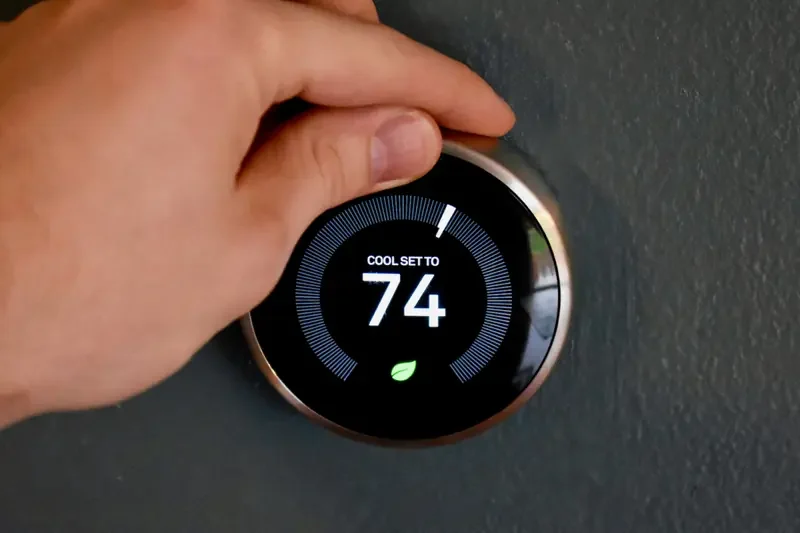
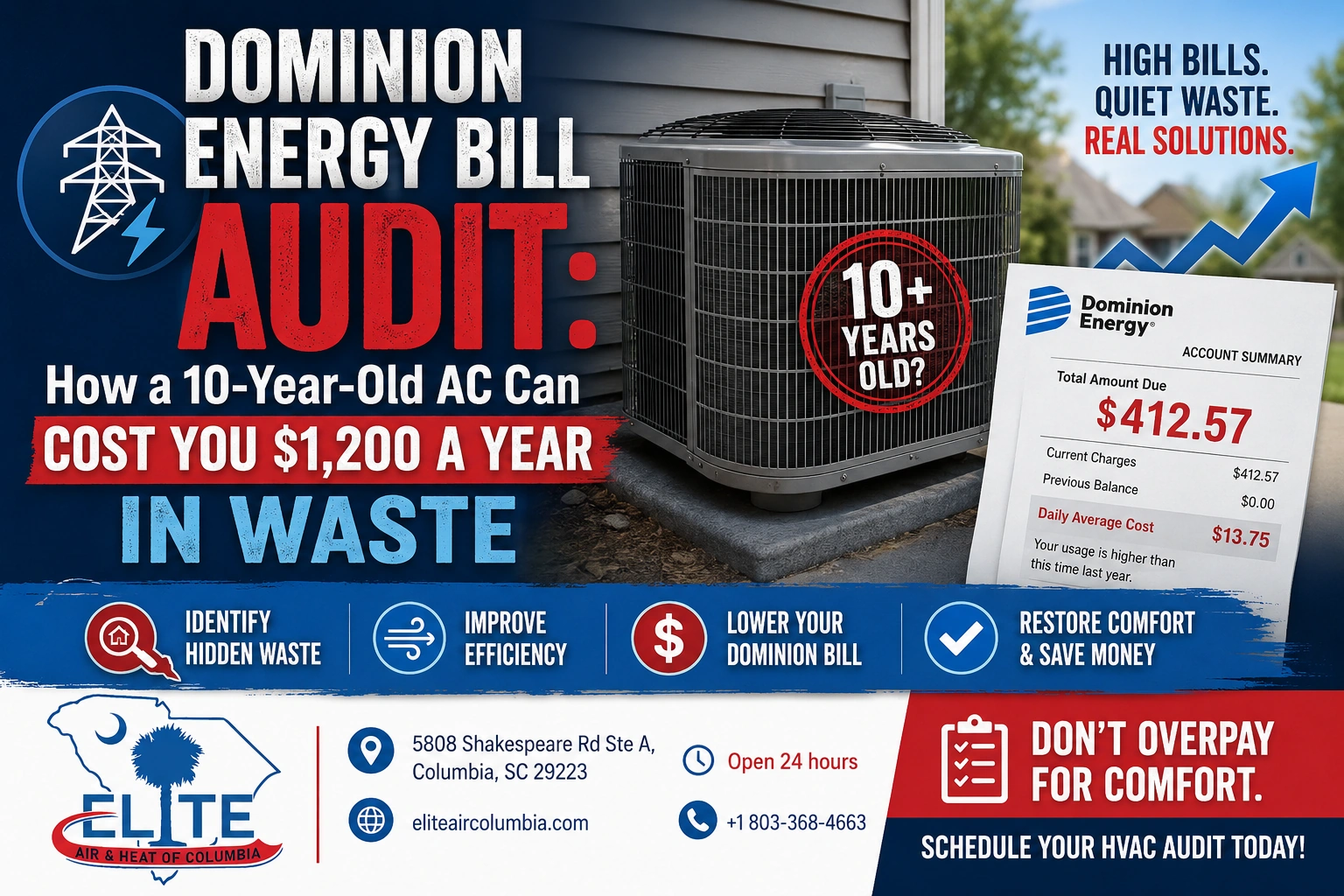

If your Dominion Energy bill keeps climbing every summer, but your AC still technically “works,” you are not alone.
A lot of homeowners assume an air conditioner either works or it does not. But in Columbia’s heat and humidity, there is a large middle ground where an older system still runs while quietly wasting hundreds of dollars every cooling season.
Here’s the plain answer:
A 10-year-old AC system in the Midlands can absolutely waste $1,200 or more per year through declining efficiency, poor airflow, humidity problems, duct leakage, and nonstop runtime during peak summer heat.
That does not automatically mean you need a replacement. But it does mean the system deserves a real audit before you keep feeding it high electric bills every summer.
High Dominion Energy Bills?
A quick HVAC evaluation could reveal why your system is wasting money every month. Book your service now.
Why 10 Years Matters for an AC System
Ten years is usually the point where HVAC systems start entering a different phase of operation.
The equipment may still cool the house. But several things are often happening at once:
- efficiency slowly drops
- parts wear down
- airflow weakens
- coils get dirty internally
- refrigerant performance declines
- duct leakage becomes more noticeable
- humidity control gets worse
- runtime increases during hot afternoons
Most homeowners do not notice the decline all at once because it happens gradually.
You adapt to it.
The house feels “a little warmer.”
The upstairs feels “a little stuffier.”
The system runs “a little longer.”
Then one July arrives where the power bill suddenly feels out of control.
What “Waste” Actually Looks Like on a Dominion Bill
The waste is usually not one catastrophic problem.
It is death by a thousand small inefficiencies.
For example:
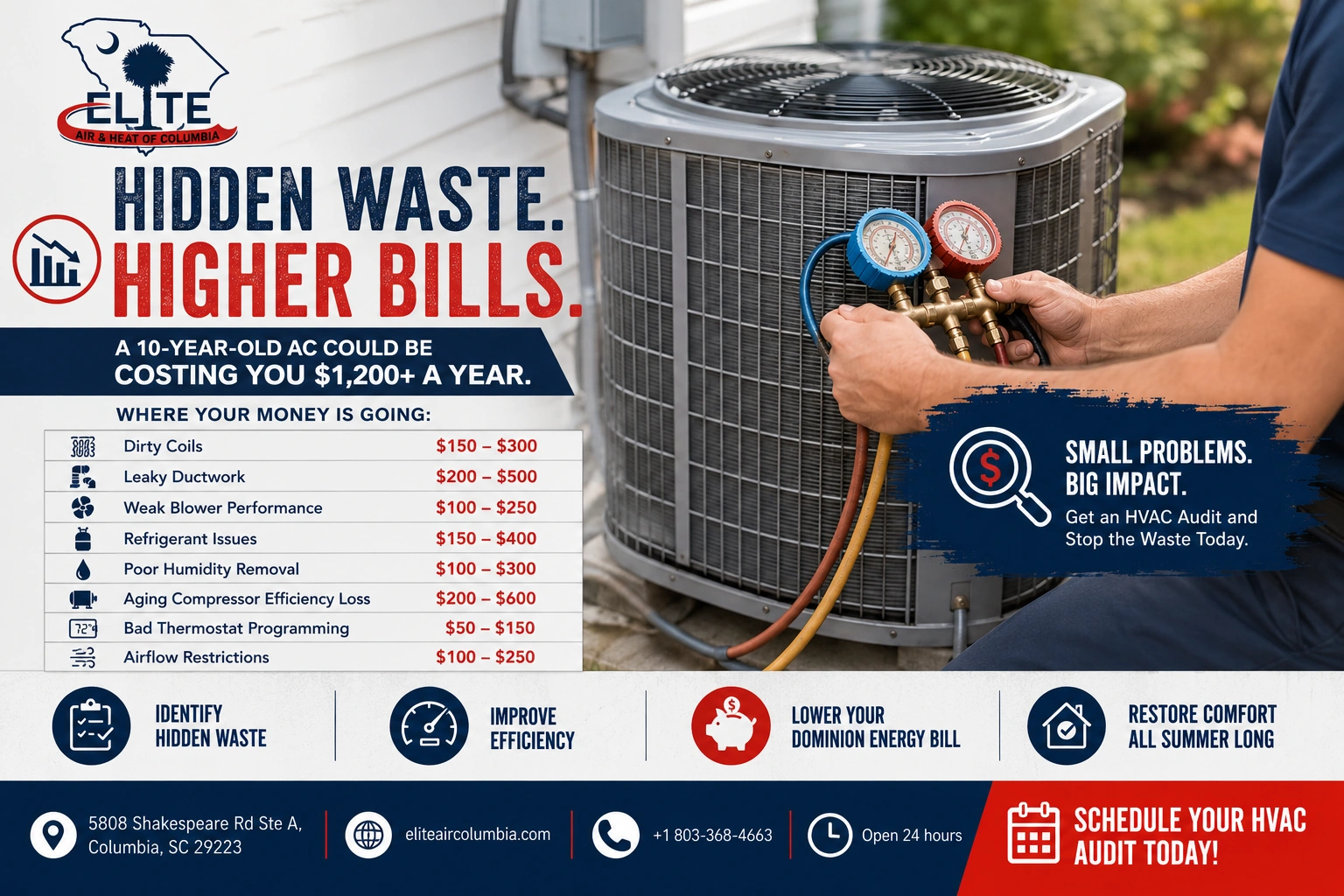
| Problem | Estimated Annual Waste |
| Dirty evaporator/condenser coils | $150–$300 |
| Leaking ductwork | $200–$500 |
| Weak blower performance | $100–$250 |
| Refrigerant charge issues | $150–$400 |
| Poor humidity removal | $100–$300 |
| Aging compressor efficiency loss | $200–$600 |
| Bad thermostat programming | $50–$150 |
| Airflow restrictions | $100–$250 |
Individually, none of these sound devastating.
Together, they can easily create four-figure waste over a South Carolina cooling season.
Especially in homes where the AC runs heavily from May through September.
Columbia’s Climate Makes Older Systems Struggle Faster
In milder climates, homeowners can sometimes stretch AC performance longer without noticing major inefficiency.
Columbia is not a mild climate.
The long cooling season matters.
High humidity matters.
The constant stop-and-start cycling matters.
In Columbia’s heat and humidity, comfort is not just about temperature. Your system also has to remove moisture effectively. Older systems often lose that ability before they completely fail.
That is why many homeowners say things like:
- “The thermostat says 72, but it still feels sticky.”
- “The house never feels fully comfortable anymore.”
- “The AC runs all day.”
- “The upstairs is unbearable after lunch.”
- “The power bill exploded this summer.”
Those are efficiency warnings.
The Biggest Hidden Problem: Runtime
Most electric waste comes from runtime.
A healthy system cools the home, satisfies the thermostat, dehumidifies properly, and shuts off.
An aging system runs longer and longer to achieve the same result.
That extra runtime compounds energy use fast.
For example:
Healthy System
- Runs 10–12 hours spread throughout the day
- Removes humidity effectively
- Cycles normally
Aging 10-Year-Old System
- Runs 16–20+ hours during extreme heat
- Struggles with humidity
- Rarely catches up
- Uses dramatically more electricity
This is where homeowners sometimes get into trouble.
They replace thermostats, add fans, close vents, or lower the temperature setting trying to “help” the system.
That often increases runtime even more.
SEER Ratings Are Only Part of the Story
A lot of homeowners hear terms like:
- 10 SEER
- 14 SEER
- 18 SEER
But real-world efficiency is not just about the rating on the equipment.
A 10-year-old system originally installed at 14 SEER may no longer perform anywhere close to that.
Why?
Because efficiency depends on the entire system working correctly:
- ductwork
- airflow
- refrigerant charge
- blower speed
- insulation
- humidity removal
- static pressure
- coil cleanliness
A neglected 14 SEER system can perform worse than a properly installed modern system with lower advertised numbers.
A good technician should be able to show you where efficiency is being lost instead of simply saying, “You need a new unit.”
Signs Your AC Is Quietly Wasting Money
1. Your bill rises faster than utility rate increases
Most homeowners can feel the difference between:
- normal utility inflation
- abnormal AC energy consumption
If your summer bills jumped dramatically while your usage habits stayed mostly the same, the HVAC system deserves investigation.
2. The system runs almost constantly
Long runtime is one of the biggest warning signs.
Especially if:
- the home never feels fully cool
- humidity stays high
- temperatures drift upward in late afternoon
3. Certain rooms never stay comfortable
This usually points toward:
- airflow imbalance
- duct leakage
- undersized returns
- failing blower performance
Not just “old age.”
4. Your indoor humidity feels worse
Humidity control often declines before cooling capacity fully fails.
The house may technically hit temperature while still feeling damp and uncomfortable.
5. Repairs are becoming seasonal
If you are repairing capacitors, contactors, motors, or refrigerant leaks every summer, the system may still function, but the operating cost is often quietly climbing.
What Makes an Efficient AC System Design for Southern Climates?
When it comes to air conditioning in hot, humid climates, a well-designed system can make all the difference. Southern temperatures…
What a Real HVAC Energy Audit Should Include
A proper evaluation should go beyond:
“Your unit is old.”
A real HVAC efficiency audit should inspect:
- static pressure
- airflow performance
- refrigerant levels
- duct leakage
- insulation conditions
- blower operation
- humidity performance
- coil condition
- electrical draw
- compressor health
- thermostat calibration
- attic heat load
- filter restriction
- return air sizing
This matters because some homes waste far more energy through duct problems than equipment age alone.
The goal is not to buy the biggest repair. The goal is to understand the actual problem.
When Repair Still Makes Sense
Not every 10-year-old AC should be replaced.
Sometimes the smarter move is:
- duct sealing
- airflow correction
- coil cleaning
- blower repair
- thermostat optimization
- attic insulation improvements
- refrigerant correction
If the equipment is mechanically healthy and the efficiency losses are fixable, a repair-focused approach can still make financial sense.
Especially if:
- the compressor is healthy
- refrigerant leaks are minor or nonexistent
- the duct system is salvageable
- repair costs stay reasonable
When Replacement Starts Making Financial Sense
Replacement becomes more reasonable when:
- the system runs excessively
- humidity stays poor
- major components are failing
- refrigerant leaks continue
- repairs keep stacking up
- energy usage stays extremely high
- comfort problems never improve
This is especially true for older systems using R-22 refrigerant, which has become expensive and harder to source.
A newer high-efficiency heat pump or AC system can dramatically reduce runtime in Columbia summers when properly installed and matched to the home.
But this is important:
A new system installed on bad ductwork can still waste energy.
That is one of the most common mistakes homeowners make.
What Dominion Customers Often Miss
Many homeowners focus only on:
“Why is my bill high this month?”
The better question is:
“How much is my HVAC system costing me every year?”
An extra:
- $100/month
- over 5 cooling months
- for several years
becomes thousands of dollars in avoidable operating cost.
And because the decline happens gradually, homeowners often normalize it until the system finally breaks down.
What You Can Safely Check Yourself
Homeowners can safely check:
- filter condition
- blocked vents
- thermostat settings
- obvious ice buildup
- dirty outdoor coils
- unusually long runtime
- hot rooms
- humidity levels
But refrigerant, electrical diagnostics, airflow balancing, and compressor testing are not DIY-safe.
This is where homeowners sometimes spend money replacing parts blindly without solving the actual efficiency problem.
The Bottom Line
A 10-year-old AC system can absolutely cost a Columbia-area homeowner $1,200 or more per year in unnecessary energy waste without fully breaking down.
The issue is usually not one dramatic failure.
It is a combination of:
- declining efficiency
- longer runtime
- humidity problems
- airflow issues
- duct leakage
- aging components
That does not automatically mean replacement is the right answer.
But if your Dominion Energy bills keep climbing while comfort keeps declining, the next step is a full system evaluation instead of guessing.
A good technician should be able to explain:
- where the energy loss is happening
- whether repairs can realistically recover efficiency
- whether ductwork is contributing
- and whether replacement would actually produce meaningful savings
If your system keeps struggling through Columbia’s hottest months, Elite Air & Heat of Columbia can help you understand whether the real problem is the equipment, the airflow, the duct system, or a combination of all three before you spend money on the wrong fix.
Lower Your Energy Costs Today
If your AC is over 10 years old, it may be costing more than you realize. Call now to schedule an inspection.