
If you live in the Columbia area, you already know allergy season here is not just “a few bad days.”
The Midlands gets hit with:
- heavy pine pollen in spring
- ragweed in late summer and fall
- mold spores during humid stretches
- dust and air quality problems year-round
And when pollen levels spike, many homeowners notice:
- constant sneezing
- itchy eyes
- sinus pressure
- nighttime congestion
- dust buildup
- worsening asthma symptoms
- allergy flareups inside the home even with windows closed
That last part is what surprises people.
They assume staying indoors solves the problem.
But in many homes, pollen, dust, and airborne irritants still circulate through:
- ductwork
- return vents
- crawlspace leakage
- dirty filters
- poorly sealed homes
- HVAC systems running continuously
Here’s the plain answer:
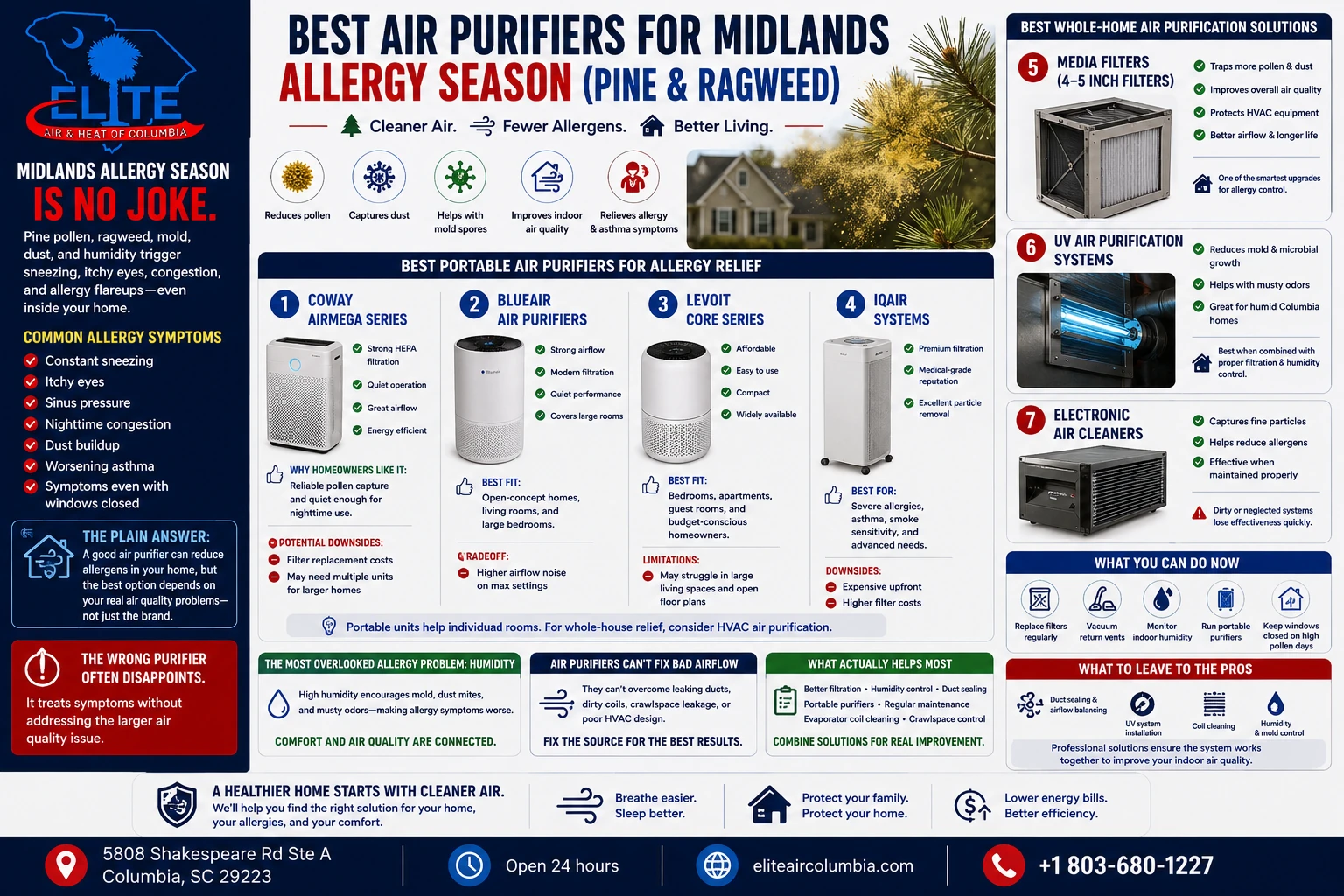
A good air purifier can absolutely help during Midlands allergy season, but the “best” option depends on whether your real problem is pollen, dust, humidity, odors, mold, pet dander, or poor HVAC airflow.
And this is important:
The wrong purifier often disappoints homeowners because it treats symptoms without addressing the larger air quality problem.
Don’t Let Allergies Take Over Your Home
Keep pollen and airborne allergens under control during Midlands allergy season. Call today for professional indoor air solutions.
First: What Makes Midlands Allergy Season So Brutal?
Columbia’s climate creates ideal conditions for airborne allergens.
You are dealing with:
- warm temperatures
- long growing seasons
- high humidity
- heavy tree pollen
- mold growth conditions
- extended HVAC runtime
Pine pollen becomes especially noticeable because it coats:
- cars
- porches
- sidewalks
- outdoor HVAC units
But ragweed is often worse for actual allergy symptoms.
Ragweed pollen can travel long distances and trigger:
- sinus irritation
- headaches
- congestion
- coughing
- asthma flareups
And once allergens enter the home, your HVAC system can circulate them repeatedly.
What an Air Purifier Actually Does
This is where homeowners sometimes get confused.
An air purifier does not:
- completely eliminate allergies
- sterilize the entire house
- solve every air quality issue
What it can do is reduce airborne particles circulating through the home.
That may include:
- pollen
- dust
- pet dander
- smoke particles
- mold spores
- bacteria
- odors depending on the system
The effectiveness depends heavily on:
- filter quality
- room size
- airflow design
- purifier placement
- HVAC performance
- humidity levels
The Best Type of Air Purifier for Pollen and Ragweed
For Midlands allergy season, HEPA filtration is usually the starting point.
A true HEPA filter captures extremely small airborne particles effectively, including many allergy-triggering contaminants.
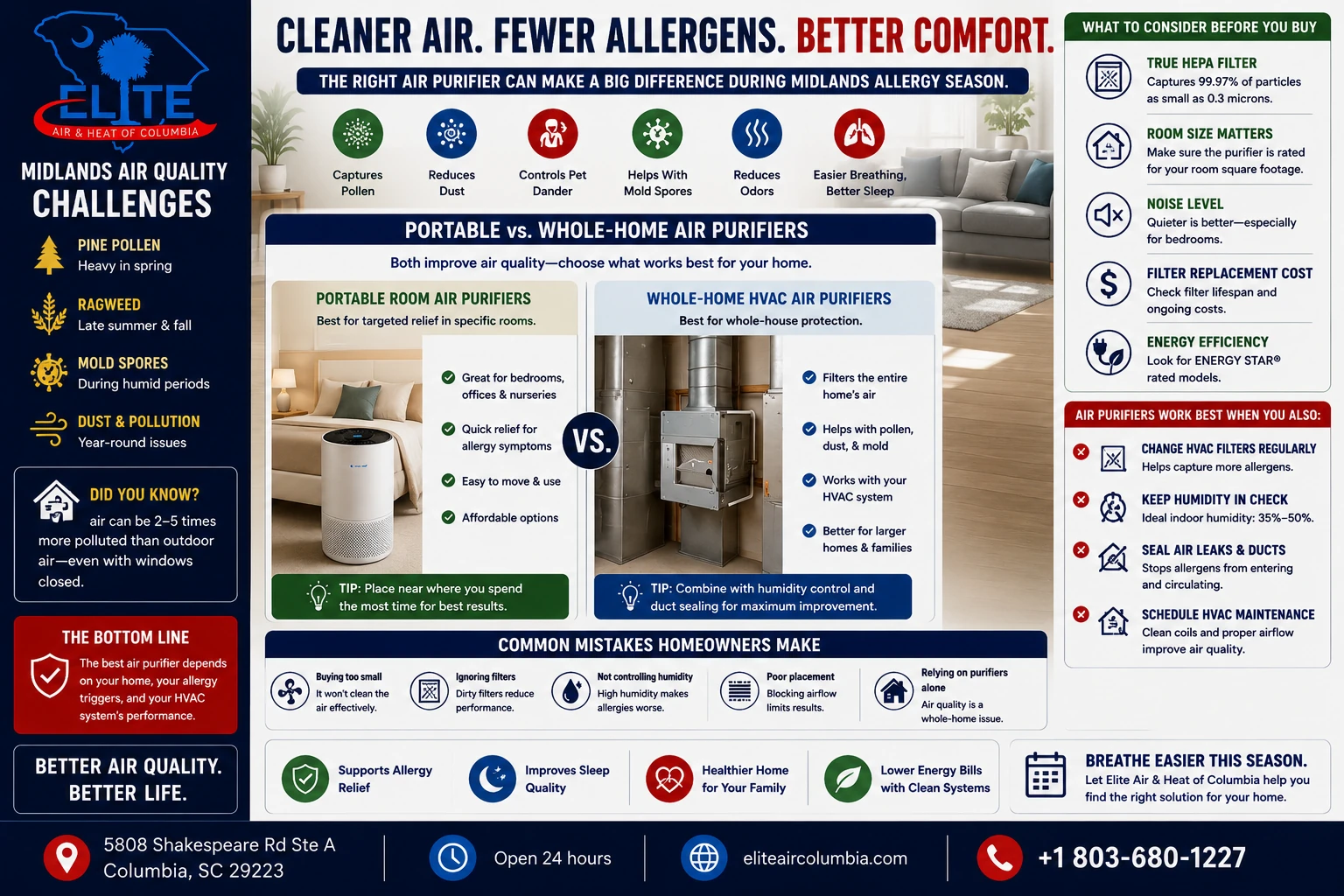
For most homeowners, the best purifier setup usually falls into one of two categories:
Portable Room Air Purifiers
Best for:
- bedrooms
- nurseries
- offices
- smaller homes
- targeted allergy relief
Whole-Home HVAC Air Purification
Best for:
- entire-house filtration
- multiple allergy sufferers
- larger homes
- homes with humidity or airflow issues
The right choice depends on how widespread the problem is.
Best Portable Air Purifiers for Midlands Allergy Season
1. Coway Airmega Series
Coway purifiers are popular because they balance:
- strong HEPA filtration
- quieter operation
- reasonable operating cost
- good airflow
These tend to work well in:
- bedrooms
- living rooms
- medium-sized spaces
Many allergy sufferers like them because they run quietly enough overnight while still moving significant air volume.
Why Homeowners Like Them
- strong filtration
- reliable pollen capture
- energy efficient
- relatively quiet
Potential Downsides
- filter replacement costs
- may need multiple units for larger homes
A single room purifier cannot fully compensate for whole-house duct and airflow problems.
2. Blueair Air Purifiers
Blueair systems are often praised for:
- strong airflow
- modern filtration design
- quiet performance
- large room coverage
These can work especially well in open living spaces common in newer Midlands homes.
Best Fit
- open-concept homes
- large bedrooms
- family rooms
- homes with continuous HVAC runtime
Tradeoffs
Some homeowners are sensitive to the higher airflow noise on maximum settings.
3. Levoit Core Series
Levoit units have become popular because they are:
- affordable
- simple to operate
- compact
- widely available
They are often a good starting point for homeowners wanting bedroom allergy relief without investing in whole-home upgrades.
Best Fit
- apartments
- bedrooms
- guest rooms
- budget-conscious homeowners
Limitations
Smaller portable units may struggle in:
- large living spaces
- open floor plans
- homes with major air leakage issues
4. IQAir Systems
IQAir units are considered premium air purifiers and are often recommended for:
- severe allergy sufferers
- asthma concerns
- smoke sensitivity
- advanced filtration needs
These systems are known for extremely high filtration performance.
Advantages
- excellent filtration capability
- medical-grade reputation
- strong particle removal
Downsides
- expensive upfront
- replacement filters cost more
- physically larger units
The cheaper option is not always wrong, but homeowners with severe allergies sometimes notice meaningful improvement with higher-end filtration systems.
What Happens When Your AC Ignores the Upstairs? The Role of Zoning and Heating Services
Nothing’s more frustrating than walking upstairs and feeling like you’ve stepped into a sauna while downstairs it’s perfectly cool. When…
Best Whole-Home Air Purifier Options
Portable units help individual rooms.
But many Midlands homeowners eventually realize:
“The whole house still feels dusty.”
That is where whole-home HVAC purification becomes important.
5. Media Filters (4–5 Inch Filters)
This is often one of the smartest upgrades for allergy control.
A properly designed media filter cabinet can dramatically improve filtration without overly restricting airflow.
These systems:
- trap more pollen
- reduce dust circulation
- protect the HVAC equipment
- improve overall indoor air quality
And unlike some cheap one-inch filters, larger media filters often provide:
- better airflow
- longer filter life
- stronger filtration performance
A good technician should verify the system can handle the filter resistance properly.
6. UV Air Purification Systems
UV systems do not “filter” pollen directly.
Instead, they help reduce:
- biological growth
- mold
- microbial contamination
inside HVAC systems.
These can be especially helpful in humid Columbia-area homes where:
- evaporator coils stay damp
- mold growth develops
- Dirty Sock Syndrome appears
UV lights are often most effective when combined with proper filtration and humidity control.
7. Electronic Air Cleaners
Some whole-home systems use electronically enhanced filtration.
These can capture smaller airborne particles effectively when maintained correctly.
However, maintenance matters.
Dirty or neglected electronic systems often lose effectiveness quickly.
The Most Overlooked Allergy Problem: Humidity
This is huge in the Midlands.
Many homeowners focus only on filtration while ignoring indoor moisture levels.
But high humidity encourages:
- mold growth
- dust mites
- musty odors
- biological buildup
In Columbia’s heat and humidity, comfort and air quality are closely connected.
An oversized HVAC system that short-cycles may cool the house while leaving humidity too high.
That can make allergy symptoms worse even with a good purifier running.
Air Purifiers Cannot Fully Solve Bad HVAC Airflow
This is one of the most important things homeowners should understand.
A purifier cannot fully overcome:
- leaking ductwork
- dirty evaporator coils
- crawlspace infiltration
- undersized returns
- major humidity imbalance
If the HVAC system itself is constantly pulling contaminated air into circulation, even expensive purifiers may disappoint you.
A good technician should evaluate:
- airflow
- duct leakage
- humidity
- filtration compatibility
- attic or crawlspace infiltration
before recommending expensive purification upgrades.
What Homeowners Can Safely Do Themselves
You can safely:
- replace filters regularly
- vacuum return vents
- monitor indoor humidity
- run portable purifiers
- keep windows closed during high pollen days
But advanced HVAC modifications, UV installation, airflow balancing, and duct sealing should be handled professionally.
What Actually Helps the Most During Midlands Allergy Season
For many Columbia-area homeowners, the best results come from combining:
- better HVAC filtration
- humidity control
- duct sealing
- portable bedroom purification
- regular maintenance
- evaporator coil cleaning
- crawlspace moisture control
Not just buying one expensive machine and hoping it solves everything.
The Bottom Line
The best air purifier for Midlands allergy season depends on what your home is actually fighting:
- pine pollen
- ragweed
- mold spores
- dust
- pet dander
- humidity problems
- poor HVAC airflow
For many homeowners, a combination of:
- HEPA room purification
- upgraded HVAC filtration
- humidity management
creates the biggest improvement.
And sometimes the real issue is not the purifier at all.
It is:
- leaking ducts
- dirty coils
- oversized equipment
- excessive indoor humidity
- poor airflow design
A good HVAC company should be able to explain:
- where allergens are entering the system
- whether airflow is contributing
- whether humidity is worsening symptoms
- and whether whole-home purification would realistically help your home
If allergy symptoms, dust, or humidity problems keep returning in your Columbia-area home, Elite Air & Heat of Columbia can help evaluate whether the issue is filtration, airflow, humidity imbalance, duct leakage, or a combination of indoor air quality problems before you spend money on the wrong solution.
Breathe Easier This Allergy Season
Reduce pine and ragweed allergens in your home with the right air purification solution. Call now for cleaner indoor air.