

When homeowners in Columbia, SC compare a 15-SEER2 HVAC system with a 20-SEER2 system, one of the first questions we hear at Elite Air & Heat Columbia is simple:
“Will the more efficient system actually save enough money to justify the higher price?”
That is exactly the right question to ask.
A 20-SEER2 system can use significantly less electricity for cooling than a 15-SEER2 system under comparable conditions. But higher efficiency usually comes with a higher upfront price. The real question is how long it takes for those monthly energy savings to recover that additional investment.
That is your HVAC break-even point.
What Does SEER2 Actually Tell You?
SEER2 stands for Seasonal Energy Efficiency Ratio 2. It measures the cooling efficiency of an air conditioning system or heat pump under updated testing procedures.
In simple terms, a higher SEER2 rating means the system can provide more cooling for each unit of electricity it consumes.
The U.S. Department of Energy uses SEER2 as the current cooling-efficiency metric for central air conditioners and heat pumps.
That means:
- 15 SEER2: Good baseline efficiency
- 20 SEER2: High-efficiency territory
- Higher SEER2: Generally lower electricity consumption for the same amount of cooling
But a 20-SEER2 system is not automatically the better financial decision for every Columbia homeowner.
How Much More Efficient Is 20 SEER2?
If two properly sized systems produce the same amount of cooling, electricity consumption is roughly inversely related to the SEER2 rating.
Moving from 15 SEER2 to 20 SEER2 therefore represents a substantial theoretical improvement in cooling efficiency.
Using a simplified comparison:
15 ÷ 20 = 0.75
That means the 20-SEER2 system could require roughly 25% less electricity for the same cooling output than the 15-SEER2 system under equivalent rated conditions.
Real homes rarely perform exactly like laboratory calculations, however. Duct leakage, insulation, thermostat settings, equipment sizing, humidity, installation quality, weather, and homeowner habits all influence actual savings.
Why Columbia Makes Efficiency Worth Considering
Here in Columbia, air conditioning is not an occasional luxury.
Our long, hot, humid summers can keep cooling systems working hard for months. That gives higher-efficiency equipment more opportunities to produce savings compared with the same system installed in a mild climate.
The Department of Energy specifically includes South Carolina in its hot-humid/Southeast category for HVAC efficiency calculations. In one DOE example, a 23.5-SEER2 central air conditioner used 5,222 kWh annually compared with 8,074 kWh for a 15.2-SEER2 system under its Southeast assumptions.
Those numbers should not be treated as a prediction for every Columbia home, but they illustrate why efficiency can make a meaningful difference in our climate.
Electricity prices matter too. EnergySage’s July 2026 Columbia data estimates residential electricity costs at roughly $0.16 per kWh among households represented in its marketplace data.
The more your AC runs and the more electricity costs, the greater the potential value of higher efficiency.
Calculating the Break-Even Point
The basic calculation is straightforward:
Additional Cost of 20-SEER2 System ÷ Estimated Annual Energy Savings = Approximate Break-Even Period
Suppose, for illustration, that we have two system options:
15-SEER2 system: $10,000
20-SEER2 system: $13,000
The efficiency upgrade costs an additional $3,000.
Now assume the higher-efficiency system saves approximately $300 per year in cooling costs.
$3,000 ÷ $300 = 10 years
In this simplified example, the homeowner reaches the break-even point at approximately 10 years.
After that point, additional energy savings can represent a net financial benefit, assuming both systems have comparable maintenance and repair costs.
Change the numbers, though, and the decision changes quickly.
If annual savings are $500, a $3,000 premium could be recovered in approximately six years.
If annual savings are only $150, the same premium could take approximately 20 years to recover.
That is why we don’t recommend choosing an HVAC system based on the SEER2 number alone.
The Price Difference Matters More Than People Think
When comparing quotes, look at the incremental cost of upgrading rather than simply looking at the total system price.
For example, imagine your choices are:
| Option | Installed Price | Upgrade Cost |
| 15 SEER2 | $9,500 | Baseline |
| 20 SEER2 | $11,500 | +$2,000 |
A $2,000 efficiency premium can be relatively easy to recover in a home with heavy cooling demand.
But consider this:
| Option | Installed Price | Upgrade Cost |
| 15 SEER2 | $9,500 | Baseline |
| 20 SEER2 | $15,500 | +$6,000 |
Now the economics are very different.
Even if the 20-SEER2 system saves several hundred dollars each year, recovering an additional $6,000 could take a long time.
The SEER2 ratings haven’t changed. The financial equation has.
Your Current Cooling Costs Are Important
A homeowner spending $70 per month on summer cooling has less opportunity to recover a high-efficiency upgrade than someone whose HVAC system contributes several hundred dollars to peak summer electricity bills.
This is why we prefer looking at the actual home rather than making blanket statements such as:
“Always buy the highest SEER2 available.”
That isn’t necessarily good advice.
A larger Columbia home with older insulation, substantial cooling demand, long daily runtime, and high summer electricity consumption may see a much stronger financial case for 20 SEER2.
A smaller, highly insulated home with modest cooling demand may take considerably longer to reach the break-even point.
Efficiency Isn’t the Only Benefit of a 20-SEER2 System
This is where the comparison becomes more interesting.
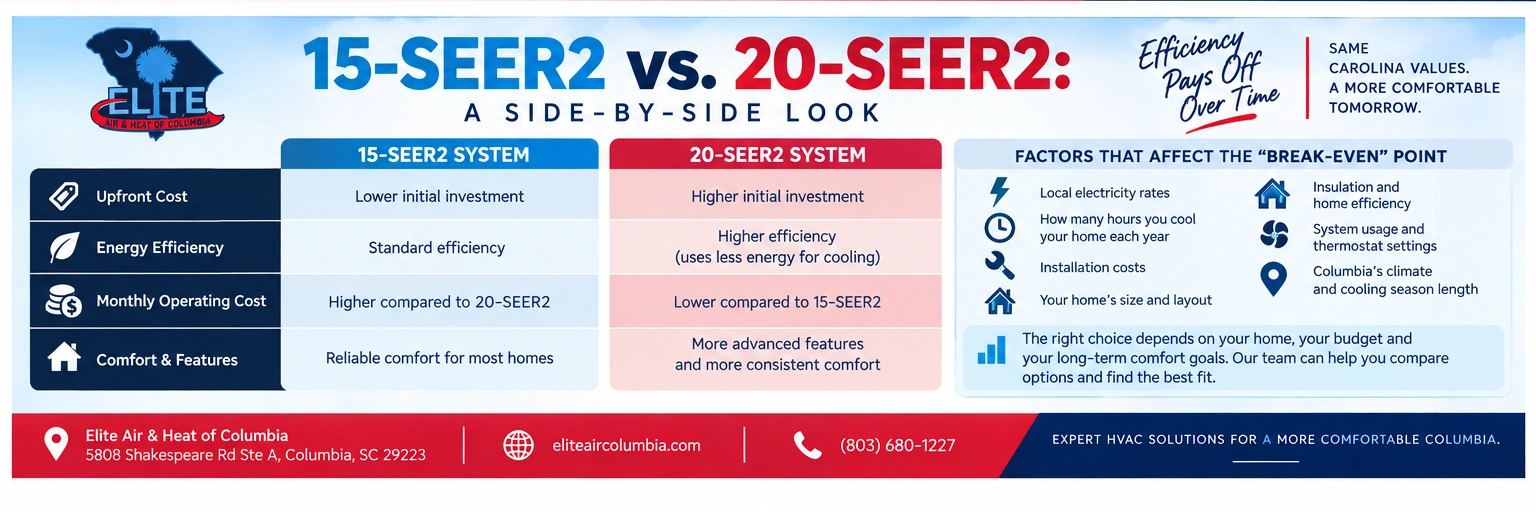
Many 20-SEER2 systems achieve their efficiency through variable-speed or inverter-driven technology. Instead of simply switching on at full capacity and shutting off when the thermostat is satisfied, these systems can adjust their output to match changing cooling demands.
Depending on the equipment selected, that can provide benefits beyond electricity savings.
More Consistent Indoor Temperatures
Variable-capacity equipment can operate for longer periods at lower output. Instead of noticeable temperature swings between cycles, homeowners may experience steadier indoor temperatures.
Better Humidity Management
Humidity is a major comfort factor in Columbia.
Longer, lower-capacity cooling cycles can improve moisture removal compared with equipment that rapidly cycles on and off.
A home at 75°F with controlled humidity can feel considerably more comfortable than a home at the same temperature with excessive moisture in the air.
Quieter Operation
High-efficiency variable-speed equipment can frequently operate below full capacity. Lower operating speeds can mean noticeably quieter operation.
Improved Comfort During Extreme Heat
Instead of repeatedly cycling between full output and off, variable-capacity equipment can continually adjust to changing conditions.
For some homeowners, these comfort improvements are worth paying for even if the mathematical energy-savings break-even point is relatively long.
When Does 20 SEER2 Make the Most Sense?
From our perspective at Elite Air & Heat Columbia, higher-efficiency equipment becomes particularly attractive when several factors line up.
You expect to remain in the home for many years.
Your existing cooling costs are high.
The air conditioner runs heavily throughout Columbia’s cooling season.
Humidity control and consistent temperatures are priorities.
The price premium over the 15-SEER2 option is reasonable.
The home and duct system are in good enough condition to take advantage of the equipment’s efficiency.
If you are planning to move within a few years, paying thousands more solely to achieve long-term utility savings may be difficult to justify.
Don’t Forget the Ductwork
You can purchase an extremely efficient HVAC system and still waste energy through poor ductwork.
Leaks, inadequate return airflow, damaged ducts, improper sizing, and poorly designed distribution systems can reduce real-world performance.
The same applies to the building itself.
Insulation, windows, air leakage, attic temperatures, sun exposure, square footage, ceiling height, thermostat settings, and occupancy patterns all influence how much cooling your home requires.
This is one reason the advertised SEER2 rating should never be treated as a guaranteed percentage reduction in your electricity bill.
A Properly Installed 15-SEER2 System Can Still Be a Great Choice
Higher isn’t automatically better.
For homeowners focused primarily on keeping initial replacement costs reasonable, a properly selected and professionally installed 15-SEER2 system can offer an excellent balance between efficiency, comfort, and affordability.
Installation quality is especially important.
A high-end system that is oversized, improperly charged, connected to inadequate ductwork, or poorly commissioned may never provide the performance the homeowner paid for.
We would rather install the right system correctly than sell someone an efficiency rating they don’t actually need.
So, Where Is the Real Break-Even Point?
There isn’t one universal number.
For one Columbia homeowner, the additional investment in a 20-SEER2 system might make sense within six or seven years. For another, it could take 12, 15, or even 20 years.
The break-even period depends primarily on:
- The installed-price difference between the systems
- Your home’s annual cooling demand
- Local electricity rates
- Equipment size
- Actual system performance
- Duct and building efficiency
- Thermostat habits
- How long you expect to own the home
The DOE’s Southeast calculations reinforce the larger point: high-efficiency equipment can produce substantial lifetime energy savings in hot-humid climates, but the amount it makes sense to pay upfront depends on those expected savings.
Let Elite Air & Heat Columbia Run the Numbers With You
At Elite Air & Heat Columbia, we don’t believe homeowners should pay thousands of dollars more for an HVAC system simply because the number on the efficiency label is higher.
We want to know whether the upgrade actually makes sense for your home, your comfort expectations, and your budget.
When comparing a 15-SEER2 and 20-SEER2 system, we can look beyond the equipment rating and consider your home’s cooling requirements, system size, comfort concerns, expected operating costs, and the price difference between your options.
Sometimes the 20-SEER2 system is the clear winner.
Sometimes the 15-SEER2 system provides the better return.
And sometimes the biggest reason to choose 20 SEER2 isn’t the break-even calculation at all. It’s the quieter operation, humidity control, and consistent comfort that comes with a more advanced system.
Thinking about replacing your HVAC system in Columbia, SC? Contact Elite Air & Heat Columbia to compare your options and find the efficiency level that makes financial and practical sense for your home.