

Smart thermostats have become one of the most popular HVAC upgrades for homeowners, and for good reason. Being able to adjust your thermostat from your phone, create schedules, monitor temperatures, and potentially reduce unnecessary HVAC runtime can make everyday comfort much easier.
But here in South Carolina, choosing a smart thermostat involves more than picking the one with the nicest screen.
Our long cooling seasons, high humidity, heat pumps, auxiliary heat, and different HVAC configurations mean compatibility and proper setup matter. A thermostat that works beautifully in one home may not be the best choice for another.
At Elite Air & Heat Columbia, we frequently see homeowners considering three of the biggest names in smart thermostats: Ecobee, Google Nest, and Honeywell Home. All three can be excellent choices. The better question is: Which one makes the most sense for your South Carolina home and HVAC system?
Here’s how we look at it.
Why Your Smart Thermostat Matters in South Carolina
South Carolina homeowners ask a lot from their air conditioning systems. During the warmer months, your HVAC system isn’t simply lowering the indoor temperature. It also plays an important role in controlling indoor moisture and keeping your home comfortable despite humid outdoor conditions.
That makes thermostat selection especially important.
For many Columbia-area homes, we recommend considering several factors before choosing a thermostat:
- HVAC and heat pump compatibility
- Auxiliary and emergency heat control
- Humidity monitoring
- Multi-stage equipment support
- Remote temperature sensing
- Scheduling capabilities
- Smart-home compatibility
- Proper wiring and power requirements
The thermostat should work with your HVAC equipment, rather than simply turning it on and off.
Ecobee: A Strong Choice for Comfort and Room-by-Room Awareness
Ecobee has built a strong reputation among homeowners who want detailed control over comfort.
One of its biggest advantages is its approach to temperature and occupancy sensing. Depending on the Ecobee model and accessories you choose, remote sensors can help the thermostat account for conditions in different parts of your home rather than relying exclusively on the temperature at the thermostat.
That can be particularly useful in South Carolina homes with upstairs bedrooms, bonus rooms, large open floor plans, or areas that tend to heat up faster than others.
Ecobee’s Smart Thermostat Enhanced, for example, includes temperature, humidity, occupancy, and proximity sensing. Ecobee also lists compatibility with many conventional systems and heat pumps, including multi-stage configurations.
What We Like About Ecobee
Humidity monitoring: This is an important feature in our climate. Indoor temperature doesn’t tell the entire comfort story when humidity is high.
Remote sensor options: Sensors can help address temperature differences between commonly occupied areas.
Heat pump compatibility: Ecobee supports many common heat pump configurations, although the exact thermostat and HVAC equipment should always be checked before installation.
Smart-home flexibility: Ecobee supports platforms including Apple HomeKit, Amazon Alexa, Samsung SmartThings, and others.
Where Ecobee Makes the Most Sense
From our perspective, Ecobee is particularly appealing for homeowners who prioritize comfort management throughout multiple rooms.
If the thermostat is downstairs but you spend most evenings upstairs, for example, remote sensing can be a meaningful feature rather than a gimmick.
Google Nest: A Great Option for Simplicity and Automation
Nest may be the most recognizable smart thermostat brand, and its clean design is only part of its appeal.
Google’s Nest Learning Thermostat is designed to make HVAC control more automated. Depending on the model and configuration, Nest offers features designed around schedules, occupancy, system behavior, and energy efficiency.
Nest also offers features specifically intended for certain HVAC configurations. For heat pumps with auxiliary heat, for example, Google’s Heat Pump Balance is designed to reduce unnecessary use of higher-energy auxiliary heat while maintaining comfort.
That can be especially relevant in homes using heat pumps.
What We Like About Nest
User-friendly operation: Nest thermostats are designed around straightforward everyday control.
Heat pump features: Heat Pump Balance can help manage the relationship between a heat pump and auxiliary heating.
Broad compatibility: The latest Nest Learning Thermostat works with most 24V HVAC systems, including heat pumps, and supports auxiliary and emergency heat.
Humidity sensing: Current Nest thermostats include humidity sensing, giving homeowners another useful measurement for indoor comfort.
One Important Nest Consideration
Don’t assume that every Nest thermostat works with every HVAC system.
Different Nest models support different numbers of heating and cooling stages. Certain heat pump, zoned, dual-fuel, and other advanced systems may also require specific wiring or professional configuration. Google specifically recommends professional installation for some advanced systems, including dual-fuel configurations.
For that reason, we recommend checking the equipment before purchasing based solely on the thermostat’s appearance or features.
Honeywell Home: Familiar HVAC Control With Smart Features
Honeywell thermostats have been used in HVAC systems for decades, and today’s Honeywell Home smart thermostats bring connected features to that familiar HVAC-focused approach.
For homeowners who don’t necessarily want their thermostat to become the center of their smart home, a Honeywell Home model can be an attractive option.
We often think of Honeywell Home as a practical choice for homeowners who want smart scheduling, app-based access, and reliable HVAC controls without putting automation ahead of the heating and cooling equipment itself.
What We Like About Honeywell Home
Familiar operation: Many homeowners are already comfortable with the Honeywell thermostat interface and general approach.
HVAC-focused options: Honeywell Home offers multiple thermostat models, which makes it possible to select a thermostat according to the actual HVAC application.
Smart control without unnecessary complexity: For homeowners mainly interested in remote adjustments and scheduling, Honeywell can provide a straightforward solution.
Where Honeywell Makes Sense
Honeywell Home is worth considering when you value traditional HVAC control with modern connectivity.
It’s also important to remember that “Honeywell smart thermostat” describes several products rather than one thermostat. Features and equipment compatibility vary by model, so we recommend selecting the thermostat based on the HVAC system rather than simply the brand name.
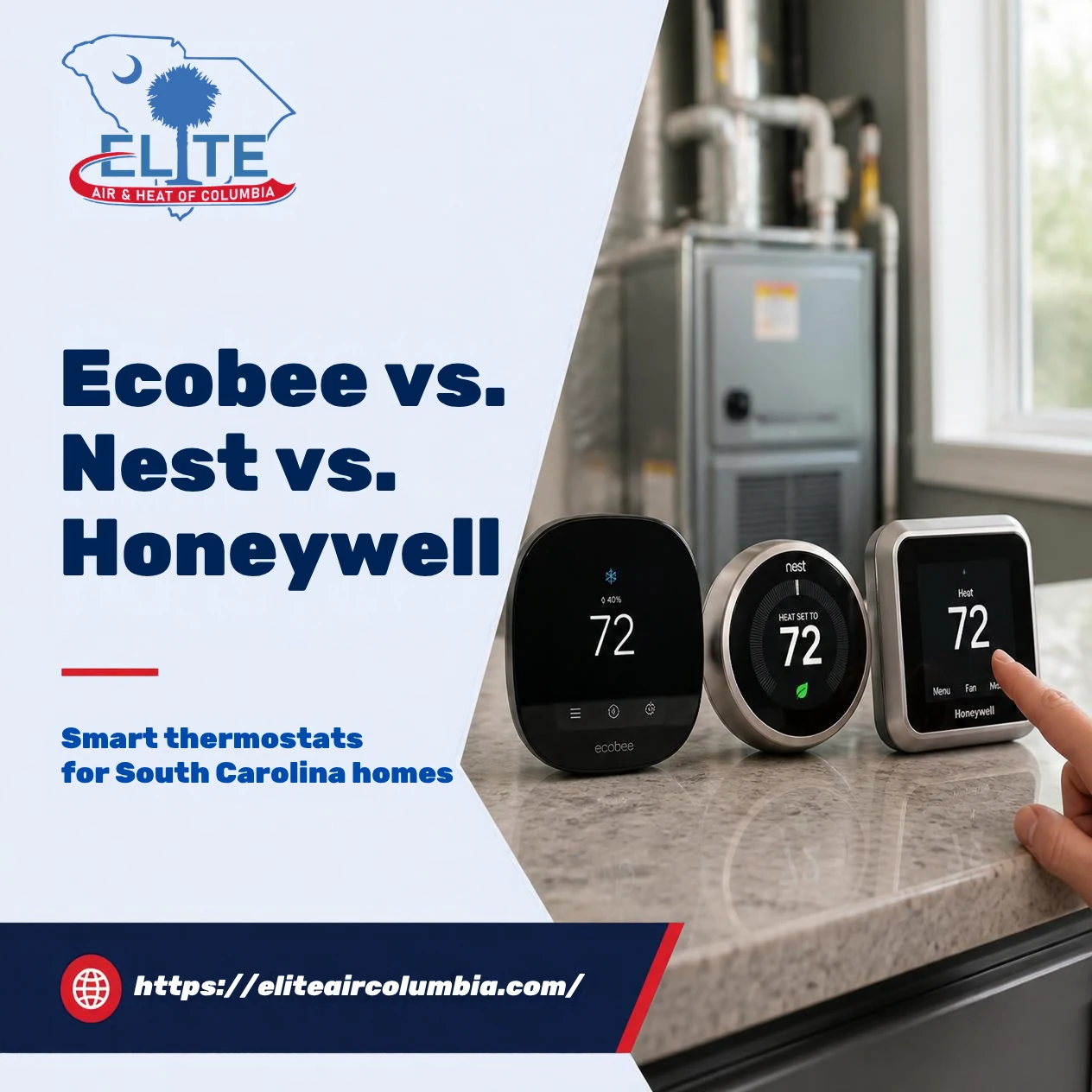
Ecobee vs. Nest vs. Honeywell: Which One Would We Choose?
There isn’t one universal winner.
For a South Carolina homeowner, we’d break it down this way:
Choose Ecobee if:
You want strong room-sensing capabilities, detailed comfort control, humidity awareness, and broad smart-home integration.
Choose Nest if:
You value automation, a simple interface, Google Home integration, and intelligent features for compatible HVAC and heat pump systems.
Choose Honeywell Home if:
You prefer an HVAC-first thermostat with familiar controls, remote access, scheduling, and several equipment-specific thermostat options.
But there’s another factor that’s more important than the logo on the thermostat.
The Best Smart Thermostat Is the One Properly Matched to Your HVAC System
This is where we encourage homeowners to be careful.
You can buy an excellent smart thermostat and still end up with poor performance if it’s incorrectly wired or configured for your HVAC equipment.
For example, a home might have:
- A single-stage heat pump
- A multi-stage heat pump
- Auxiliary electric heat
- A dual-fuel system
- Multiple HVAC zones
- Two-stage cooling
- A whole-home dehumidifier
- Specialized ventilation equipment
Those details matter.
Google, for instance, notes that some Nest installations may require a C wire or Nest Power Connector, while advanced configurations such as dual-fuel systems may warrant professional installation.
The same basic principle applies regardless of brand: compatibility should come before convenience.
Don’t Forget About Humidity
One mistake homeowners sometimes make is focusing exclusively on temperature.
A thermostat might show 74°F, but that doesn’t necessarily mean the house will feel comfortable.
Indoor humidity has a major effect on comfort. When humidity is elevated, the air can feel warmer and stickier. Proper air conditioning operation helps remove moisture as air passes across the evaporator coil.
This is another reason we like having humidity information available through a smart thermostat.
However, a thermostat can’t compensate for every HVAC problem.
If your home consistently feels humid, the underlying issue could involve system sizing, airflow, ductwork, equipment operation, drainage, ventilation, or another HVAC concern. Changing the thermostat may give you better information, but it won’t automatically correct an equipment problem.
What About Smart Thermostat Energy Savings?
Smart thermostats have the potential to reduce wasted heating and cooling by allowing homeowners to adjust temperatures based on schedules and occupancy.
But the biggest advantage is often better control.
Instead of leaving the air conditioner at the same setting around the clock, you can create schedules, make adjustments remotely, and better understand how your home responds throughout the day.
The key is avoiding overly aggressive temperature changes.
During a Columbia summer, dramatically increasing the thermostat setting every time you leave and then forcing the system to recover later isn’t necessarily the ideal strategy. Your HVAC system still has to remove both heat and moisture when you return.
A thoughtful schedule generally makes more sense than constantly chasing the thermostat.
Our Recommendation for Columbia, SC Homeowners
If you’re choosing among Ecobee, Nest, and Honeywell Home, don’t start with the question:
“Which thermostat has the most features?”
Start with:
“Which thermostat works best with my HVAC system?”
Once compatibility is established, then consider the features you’ll actually use.
For many homeowners, Ecobee is an excellent option when room sensing and comfort customization are priorities. Nest is especially attractive for homeowners who want automation and Google Home integration. Honeywell Home remains a strong practical option for people who want familiar HVAC controls combined with modern connectivity.
Any of them can be the right choice.
The important part is making sure your smart thermostat understands what it’s controlling.
Let Elite Air & Heat Columbia Help You Make the Smart Choice
A smart thermostat should make your HVAC system easier to control, not create new problems.
Here at Elite Air & Heat Columbia, we can help determine whether your HVAC system is compatible with the thermostat you’re considering, identify wiring requirements, configure heat pump and auxiliary heat settings, and make sure the thermostat communicates properly with your heating and cooling equipment.
Whether you’re leaning toward Ecobee, Google Nest, Honeywell Home, or another thermostat, we’ll help you choose an option that makes sense for your home and the demands of South Carolina weather.
Thinking about upgrading your thermostat? Contact Elite Air & Heat Columbia today and let our team help you find the smart thermostat that works best with your HVAC system, your comfort preferences, and your home.