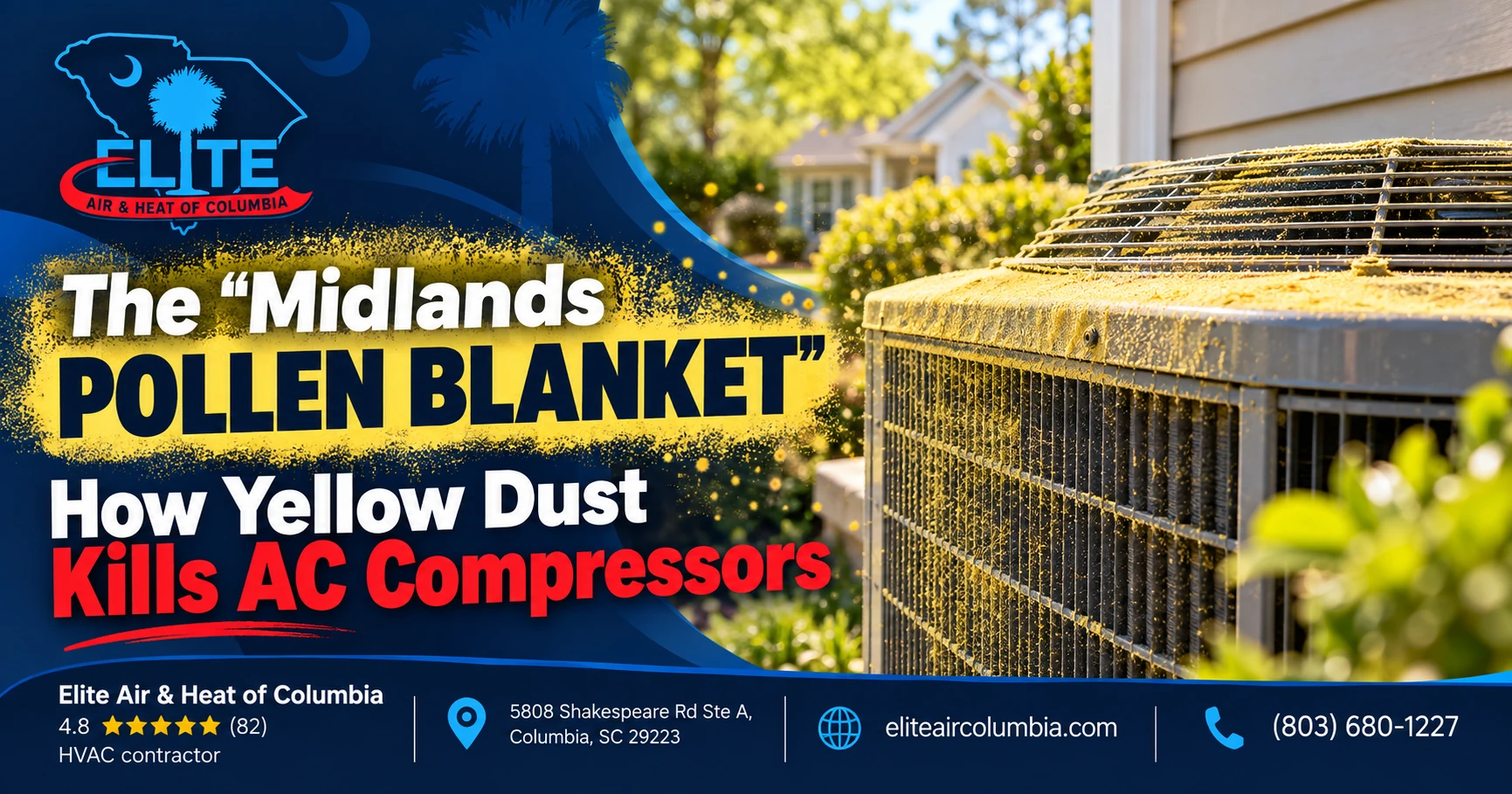

Every spring in Columbia and across the Midlands, the same yellow coating appears on cars, driveways, porches, patio furniture, and almost anything else left outside. Your outdoor air conditioner is getting covered, too.
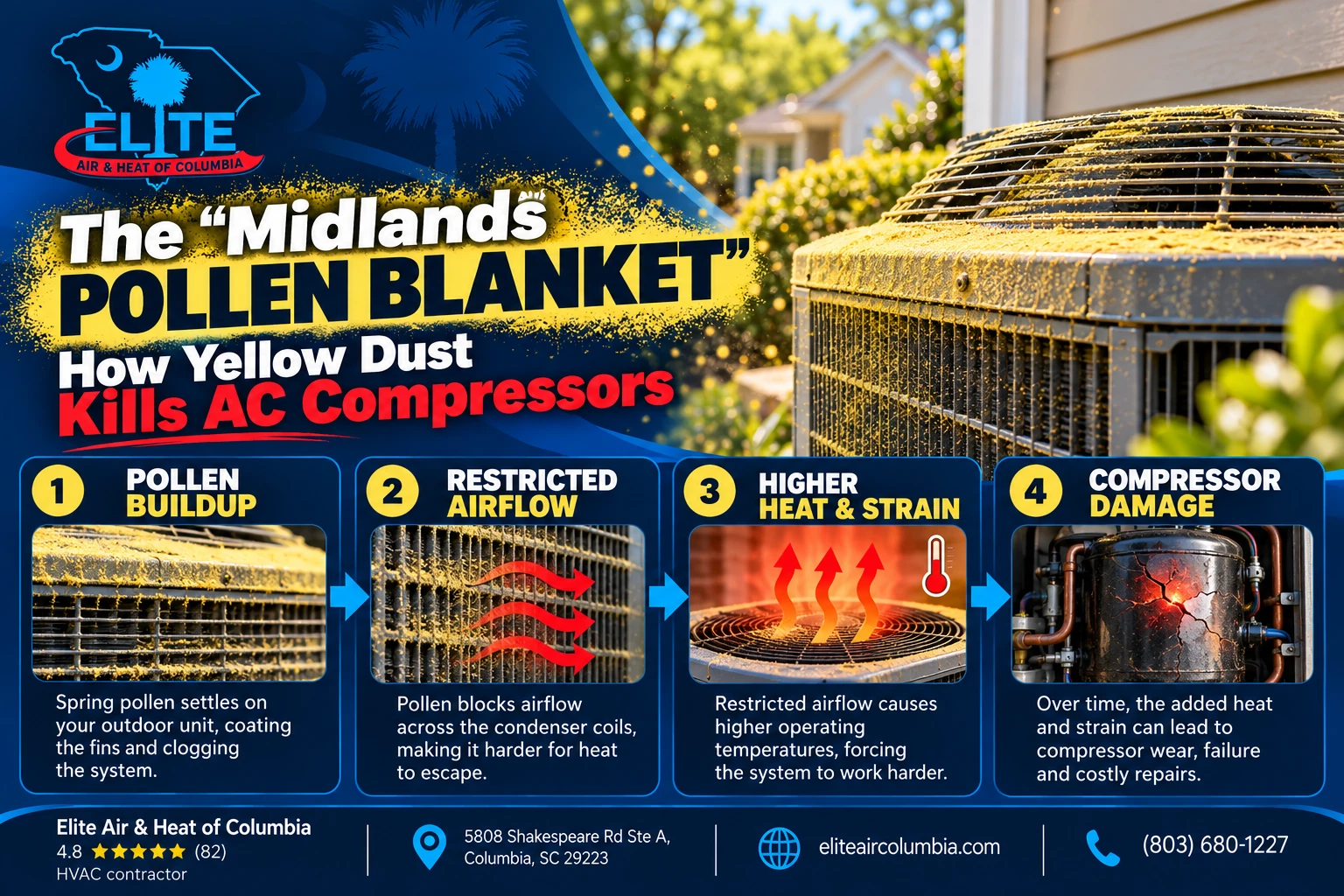
That yellow dust does not directly “kill” an AC compressor overnight. The problem develops when pollen, dirt, grass clippings, and other debris build up across the outdoor condenser coil and restrict the airflow your system needs to release heat. A heavily clogged condenser can make the air conditioner run hotter and harder, increasing stress on the compressor and potentially contributing to an expensive failure. HVAC manufacturers specifically warn that dirty or blocked condenser coils can reduce efficiency and, in severe cases, damage the compressor.
At Elite Air & Heat of Columbia, we see why spring maintenance matters so much in our part of South Carolina. The yellow pollen blanket may look harmless, but ignoring what collects on your outdoor AC unit can create problems just as temperatures begin climbing.
Don't Let Pollen Destroy Your AC!
Heavy pollen buildup can strain your cooling system. Schedule professional AC maintenance today to prevent expensive breakdowns.
What Is That Yellow Dust Covering Everything in the Midlands?
Much of the highly visible yellow-green material that coats outdoor surfaces across South Carolina during spring comes from pine trees. Clemson Cooperative Extension notes that several pine species are common throughout South Carolina, and reports on South Carolina’s spring pollen season have identified pine pollen as the source of much of the obvious yellow coating residents see on cars, mailboxes, furniture, and other surfaces.
Pine pollen is especially noticeable because trees produce it in enormous quantities.
On a dry day, it can blow through neighborhoods and settle everywhere. Then rain, dew, lawn irrigation, or general outdoor moisture can help that debris cling to surfaces.
Your condenser happens to be particularly vulnerable.
Unlike your car hood, an operating condenser actively moves large volumes of outdoor air through a tightly spaced coil. Anything floating in that air has an opportunity to end up on or around the unit.
That includes:
- Pine pollen
- Dust
- Grass clippings
- Leaves
- Seeds
- Cottony plant debris
- Soil particles
- Pet hair
- Landscaping debris
Over time, those materials can form a layer across the condenser coil.
And that is where a cosmetic spring nuisance becomes an HVAC problem.
Why Your Outdoor AC Unit Needs So Much Air
To understand why pollen matters, it helps to understand what the outdoor part of your air conditioner actually does.
Your AC does not technically “make cold air.” It moves heat.
The indoor evaporator coil absorbs heat from the air inside your home. Refrigerant carries that heat outside, where the condenser coil releases it into the outdoor air.
The compressor is essential to this refrigeration cycle.
It compresses refrigerant and keeps it moving through the system so heat can be transferred from inside the house to outside.
For the process to work correctly, the condenser needs airflow.
A fan inside the outdoor unit pulls air across the condenser coil. Those coils are surrounded by thin metal fins that create a large surface area for heat transfer.
When those fins are relatively clean, outdoor air can move through them effectively.
When they become coated or clogged, heat becomes harder to reject.
The U.S. Department of Energy notes that dirt and debris accumulating in condenser fins can lower coil effectiveness, raise condensing temperature, and reduce cooling efficiency.
That extra heat has consequences for the rest of the system.
How the “Pollen Blanket” Starts Restricting the Condenser
A few grains of pollen are not going to destroy your AC.
The issue is accumulation.
Imagine placing a clean window screen outside during pollen season. At first, air moves through easily. As dust, pollen, grass, and debris collect, the openings gradually become restricted.
A condenser coil can experience something similar.
The difference is that the coil is responsible for getting rid of the heat your AC just removed from your home.
When debris begins clogging the coil:
- Less outdoor air moves across the coil.
- Heat transfer becomes less effective.
- The condenser operates at higher temperatures and pressures.
- The compressor has to operate under more demanding conditions.
- Cooling efficiency can decline.
- The AC may run longer to satisfy the thermostat.
This does not necessarily produce an immediate breakdown.
In fact, that is part of the problem.
A dirty condenser may continue operating for quite a while.
The homeowner simply notices that the AC seems to be running longer, the second floor feels warmer, the afternoon temperature is harder to maintain, or the electric bill is creeping higher.
Meanwhile, the system is operating under conditions that are less favorable than they should be.
Does Pollen Really Kill AC Compressors?
Not directly.
Pollen does not enter the compressor and poison it.
The more accurate explanation is that heavy condenser fouling can contribute to operating conditions that place additional stress on the compressor.
Carrier notes that dirt, grass, and other airborne debris can clog condenser fins. The manufacturer warns that a dirty condenser can result in reduced efficiency and insufficient cooling and, in extreme cases, compressor damage.
That distinction matters.
Compressors fail for many reasons, including:
- Electrical problems
- Refrigerant-related issues
- Age and normal wear
- Installation problems
- Contamination
- Failed capacitors or other components
- Excessive operating temperatures
- Repeated system stress
A pollen-covered coil is therefore not automatically the sole cause when a compressor fails.
But allowing the outdoor coil to become severely clogged is still an unnecessary source of stress.
And because a compressor is one of the most significant components in your air conditioning system, protecting its operating conditions makes sense.
What Happens to AC Pressure When the Coil Cannot Release Heat?
This is where the problem becomes more serious than a dirty-looking piece of equipment.
The refrigerant entering the condenser has absorbed heat from inside your home plus heat generated during compression.
That heat must be released outdoors.
If adequate air cannot move across the condenser coil, heat rejection becomes more difficult. Condensing temperatures can rise, and system operating pressures may increase.
The Department of Energy specifically notes that condenser obstructions can elevate condensing temperature.
Your compressor is now working in a harsher environment.
Think of the difference between jogging outside on a mild day and jogging in extreme heat while wearing an extra layer of clothing.
You might technically still be able to do it.
But the workload is different.
That is why the condition of the outdoor coil matters most when your AC is already under heavy demand.
Why Midlands Summers Make a Dirty Condenser Worse
Spring pollen arrives just before Columbia’s air conditioners enter their busiest part of the year.
That timing matters.
A condenser may accumulate debris during spring and then head into summer without ever being cleaned.
Now the air conditioner is being asked to remove heat for hours at a time while outdoor temperatures are high.
A clean condenser already has a significant amount of heat to reject under those conditions.
A dirty one has the same job, but with restricted airflow.
That can lead to:
- Longer cooling cycles
- Higher equipment temperatures
- Reduced capacity
- Increased electrical consumption
- More wear on system components
- Difficulty maintaining the thermostat setting
ENERGY STAR recommends cleaning AC condenser coils as part of HVAC maintenance because dirty coils reduce cooling ability, increase runtime and energy costs, and can shorten equipment life.
This is why we would rather address a dirty coil in spring than receive an emergency call after the system struggles during peak summer weather.
The Warning Signs Your Condenser May Be Clogged
You do not need to dismantle your AC to notice possible signs of a dirty outdoor coil.
Homeowners may start seeing symptoms such as:
The AC Runs Longer Than It Used To
Longer operating cycles can have many causes, but reduced condenser performance is one possibility.
If the system cannot release heat efficiently, it may take longer to bring the house to the thermostat setting.

AC Service and Home Value: Why Regular Maintenance Could Be a Game-Changer in Real Estate
When discussing home value and real estate, many factors come into play, from location to the home's condition and even…
Your House Struggles to Cool During the Afternoon
An AC that performs adequately early in the day but falls behind when outdoor temperatures climb deserves attention.
A dirty condenser is not the only possible cause, but it should be inspected.
Cooling Costs Increase
Your electric bill naturally changes with weather and usage.
However, an air conditioner that must run longer because of poor heat transfer can consume more electricity.
The Outdoor Unit Looks Matted With Debris
Take a visual look without removing panels or reaching inside.
If the outside of the condenser is visibly coated with pollen, grass, fuzz, leaves, or dirt, airflow may be restricted.
The System Shuts Down or Stops Cooling
Severe condenser problems can eventually contribute to system shutdowns.
At this point, you should have the equipment professionally diagnosed rather than simply washing it and assuming the problem is solved.
Do Not Confuse the Condenser With Your Indoor Air Filter
One common misconception is that replacing the indoor air filter protects the outdoor condenser from pollen.
They are separate issues.
Your air filter primarily helps protect the indoor side of the HVAC system by filtering air circulating through the return system.
The condenser is outside.
It uses outdoor air directly.
That outdoor air does not first pass through your household HVAC filter.
So you can have a brand-new indoor air filter and still have an outdoor condenser covered in pollen and landscaping debris.
Both areas need attention, but for different reasons.
Should You Hose Pollen Off Your AC Yourself?
Homeowners can help keep the area around an outdoor unit clear, but cleaning the condenser requires some care.
First, never attack the coil with a pressure washer.
The thin condenser fins can bend easily. Once they are flattened, airflow can become even more restricted.
Trane and Carrier both caution homeowners against high-pressure washing and recommend gentle cleaning methods around condenser fins.
A gentle garden-hose rinse may remove some loose surface material on certain systems, provided the equipment is off and the manufacturer’s maintenance instructions allow it.
However, spraying the exterior does not always remove debris packed deeper inside the coil.
Some condenser designs also have multiple coil surfaces or panels that need to be accessed correctly for thorough cleaning.
There are also electrical components inside the outdoor cabinet.
If you are unsure what you are doing, professional maintenance is the safer option.
Keep Lawn Crews Away From the Condenser
Pollen is only part of the spring and summer debris problem.
Grass clippings can be particularly troublesome because they can stick across the outside of the condenser coil.
If your outdoor unit sits beside a lawn, make sure mower discharge is directed away from it.
The same applies when using:
- Leaf blowers
- String trimmers
- Mulch blowers
- Hedge trimmers
- Pressure washers
Blowing yard debris directly toward the condenser is essentially feeding material into the surface it needs for airflow.
DOE maintenance guidance specifically identifies lawn mowing, falling leaves, and nearby debris as potential sources of condenser fouling.
Give the Outdoor Unit Room to Breathe
Landscaping can restrict an AC just as effectively as pollen.
Shrubs that looked well spaced when they were planted can eventually grow into the condenser.
Plants can also catch pollen and loose debris right beside the coil.
As a general maintenance guideline, HVAC manufacturers recommend maintaining adequate clearance around the unit. Carrier recommends keeping roughly two to three feet around the condenser clear of foliage and debris, while Trane recommends at least two feet around the sides.
The exact clearance required for your equipment should follow its manufacturer’s installation instructions.
Do not build a tight decorative enclosure around the condenser just because you do not like looking at it.
The unit needs airflow more than it needs camouflage.
Why Spring Is the Right Time for an AC Tune-Up
There is a practical reason we encourage homeowners to have their cooling systems checked before the hardest part of summer.
Spring maintenance allows us to inspect the equipment after months of outdoor exposure and before long cooling cycles become the daily routine.
At Elite Air & Heat of Columbia, our AC maintenance includes inspecting and cleaning important components such as coils while also checking refrigerant performance, electrical connections, and overall system operation. Our published AC tune-up service includes a 53-point inspection, and we currently recommend routine cooling-system maintenance before peak summer demand.
Cleaning is only one part of the visit.
A technician can also look for problems that a yellow condenser might be hiding.
For example, poor cooling might involve dirt buildup, but it could also involve an electrical problem, weak capacitor, refrigerant issue, failing motor, or another fault.
Proper testing helps separate a simple maintenance issue from something requiring repair.
What Homeowners Can Do During Pollen Season
You do not need to obsess over your condenser every time yellow dust appears.
A few habits go a long way:
- Look at the outdoor unit periodically.
- Remove loose leaves and sticks around it.
- Keep weeds and shrubs trimmed back.
- Direct lawn-mower discharge away from the condenser.
- Avoid stacking tools, hoses, furniture, or decorations next to it.
- Never cover an operating unit.
- Do not use a pressure washer on the fins.
- Keep up with professional AC maintenance.
If the coil becomes heavily coated again shortly after maintenance because of an unusually intense pollen season or surrounding landscaping, have it evaluated.
Homes surrounded by pines, dusty areas, heavy landscaping, or frequent lawn activity may require more attention than properties with less debris exposure.
A Dirty Coil Is Cheaper to Address Than a Failed Compressor
Preventive maintenance does not guarantee that a compressor will never fail.
No legitimate HVAC company should make that promise.
But there is little benefit in making the compressor work harder because its condenser cannot breathe properly.
Cleaning a fouled condenser and correcting airflow problems are routine maintenance tasks.
Compressor replacement is not.
Depending on system age, refrigerant type, warranty coverage, and equipment condition, a major compressor failure can sometimes force homeowners to consider whether repairing the existing system still makes financial sense.
That is a decision most people would rather postpone.
Keeping the condenser clean is one of the simpler ways to give the system better operating conditions.
Don’t Let the Midlands Pollen Blanket Follow Your AC Into Summer
The yellow layer covering Columbia every spring eventually disappears from our cars and driveways.
The buildup inside an outdoor condenser does not necessarily disappear with it.
Pollen, dirt, grass, and other debris can remain packed against the coil long after the visible pollen season has passed. Then, just as summer arrives, your AC may be trying to reject heat through a condenser that has already lost some of its airflow.
At Elite Air & Heat of Columbia, we help homeowners throughout Columbia and the surrounding Midlands prepare their cooling systems before summer puts them to the test.
If your outdoor AC unit is covered in yellow pollen, your system is running longer than usual, or it has been a while since the condenser was professionally inspected and cleaned, now is a good time to address it.
Call Elite Air & Heat of Columbia at (803) 368-4663 or schedule your AC tune-up online. We can inspect the condenser, clean the system where needed, check operating performance, and identify problems before a dirty spring coil has a chance to become a much more expensive summer repair.
Is Yellow Pollen Choking Your AC?
Protect your AC compressor from pollen buildup. Call now for professional AC cleaning and inspection before costly repairs begin.