
If you have pets, you have probably noticed something most homeowners discover sooner or later:
No matter how often you vacuum, pet hair seems to find its way everywhere.
It collects under furniture, drifts into corners, sticks to vents, and eventually ends up inside your HVAC system.
In homes with dogs or cats, your air conditioning and heating system is constantly moving pet-related particles through the house. That includes:
- Pet hair
- Pet dander
- Dust
- Outdoor allergens
- Pollen
- Microscopic skin particles
For homeowners in Forest Acres and throughout the Columbia area, this creates a common question:
What’s the best HVAC filter for a home with pets?
Here’s the plain answer.
Most pet owners benefit from upgrading to a quality pleated filter with a MERV rating between 8 and 13, but the “best” filter depends on your HVAC system, number of pets, allergy concerns, and airflow requirements. The highest-rated filter is not automatically the best choice.
This is where homeowners sometimes get into trouble.
Many assume buying the most expensive filter available will create the cleanest air.
Sometimes it does.
Sometimes it creates airflow problems that can make the HVAC system work harder than necessary.
The goal is not to buy the strongest filter.
The goal is to find the right balance between filtration and airflow.
Why Pets Put Extra Stress on HVAC Filters
Even clean pets create airborne particles.
Every day, dogs and cats naturally shed:
- Hair
- Dander
- Dust trapped in fur
- Outdoor contaminants carried indoors
Your HVAC system continuously circulates those particles.
Without adequate filtration, they can accumulate on:
- Evaporator coils
- Blower motors
- Ductwork
- Supply vents
- Return grilles
Over time, that buildup can reduce system efficiency and contribute to indoor air quality concerns.
In Columbia’s climate, HVAC systems already work hard during long cooling seasons. Additional debris from pets increases the importance of proper filtration.
What Is Pet Dander?
Many homeowners think pet allergies are caused by pet hair.
That’s not entirely true.
Pet dander consists of tiny skin flakes shed by animals.
These particles are extremely small and lightweight.
Unlike pet hair, dander can remain suspended in the air for long periods before eventually passing through your HVAC system.
Because dander is so small, filter selection matters.
Some filters capture pet hair well but struggle with microscopic particles.
Others are designed specifically to capture smaller airborne contaminants.
Understanding MERV Ratings
When shopping for filters, you’ll encounter something called a MERV rating.
MERV stands for:
Minimum Efficiency Reporting Value
The rating measures how effectively a filter captures airborne particles.
Higher numbers generally mean better filtration.
However, higher is not always better.
A filter that captures more particles may also restrict more airflow.
That’s why choosing the correct rating is important.
MERV 1–4: Usually Too Basic for Pet Homes
These inexpensive fiberglass filters are common because they’re cheap.
Advantages:
- Low cost
- Minimal airflow restriction
Disadvantages:
- Poor dander capture
- Limited dust filtration
- Weak allergy protection
For most homes with pets, these filters are not ideal.
Their primary purpose is protecting HVAC equipment rather than improving indoor air quality.
MERV 5–8: Good for Many Pet Owners
This is often where filtration starts becoming useful.
A quality MERV 8 filter can capture:
- Pet hair
- Dust
- Lint
- Larger airborne particles
Advantages:
- Affordable
- Good airflow
- Better equipment protection
- Improved cleanliness
For homes with one or two pets and no major allergy concerns, MERV 8 is often a practical choice.
MERV 11–13: Often the Sweet Spot
For many Forest Acres homeowners with pets, this range offers the best balance.
MERV 11–13 filters can capture:
- Pet dander
- Pollen
- Mold spores
- Fine dust
- Many airborne allergens
Advantages:
- Strong indoor air quality improvement
- Better allergy support
- Improved dander removal
This is often the range HVAC professionals recommend when homeowners want cleaner indoor air without excessive airflow restriction.
A good technician should confirm your system can handle the filter properly.
MERV 14+ and HEPA Filters: Not Always Better
This surprises many homeowners.
HEPA filters provide exceptional filtration.
They are commonly used in:
- Hospitals
- Laboratories
- Medical environments
However, most residential HVAC systems are not designed to operate with true HEPA filtration.
Installing an overly restrictive filter can lead to:
- Reduced airflow
- Higher energy consumption
- Increased equipment strain
- Reduced cooling performance
- Frozen evaporator coils
That does not automatically mean HEPA filtration is impossible.
It simply means specialized design modifications may be required.
The Best HVAC Filters for Homes With Pets
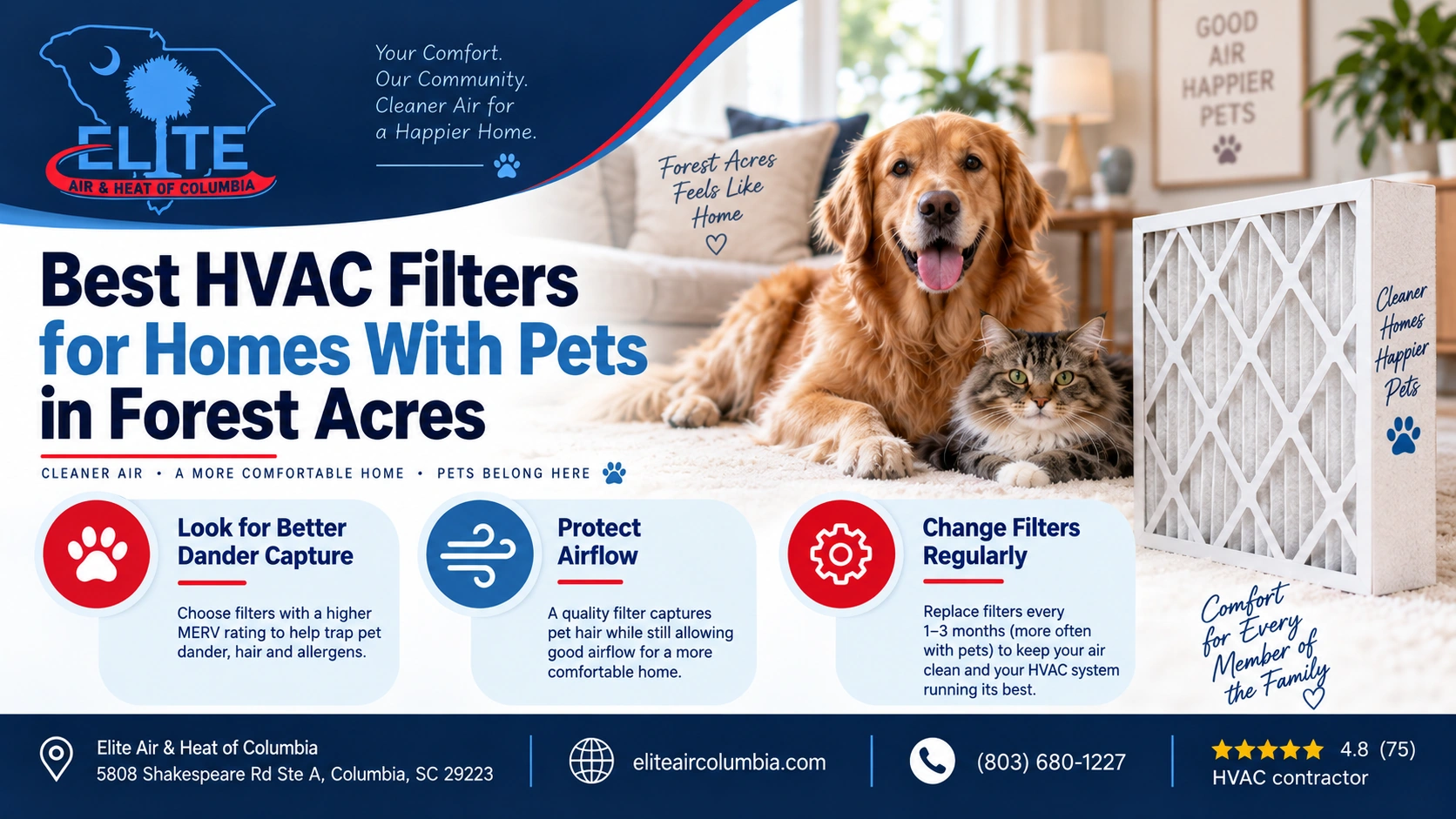
While every home is different, these general recommendations work well for many pet owners.
Best Overall Choice
MERV 11–13 Pleated Filter
Best for:
- Multiple pets
- Allergy sufferers
- Homes with significant pet dander
- Families wanting better air quality
Advantages:
- Excellent particle capture
- Strong balance of filtration and airflow
- Widely available
Best Budget-Friendly Choice
MERV 8 Pleated Filter
Best for:
- One or two pets
- Minimal allergy concerns
- Budget-conscious homeowners
Advantages:
- Lower cost
- Good airflow
- Better than basic fiberglass filters
Best for Severe Allergies
Whole-Home Air Cleaner Combined With MERV Filter
Best for:
- Significant pet allergies
- Multiple pets
- Indoor air quality concerns
In many cases, upgrading filtration alone is not enough.
Additional air-cleaning equipment may provide greater benefits.
How Often Should Pet Owners Change Filters?
Pet homes usually require more frequent filter changes.
General guidelines:
| Number of Pets | Recommended Filter Check |
| No Pets | Every 2–3 Months |
| One Pet | Every 30–60 Days |
| Two Pets | Every 30–45 Days |
| Multiple Pets | Monthly |
These are guidelines, not rules.
The actual schedule depends on:
- Filter type
- Indoor air quality
- Shedding levels
- HVAC usage
A heavily loaded filter restricts airflow regardless of its original quality.
Signs Your Filter Is Not Keeping Up
Watch for:
Excessive Dust
If surfaces become dusty quickly, filtration may be inadequate.
Increased Allergy Symptoms
Persistent sneezing, congestion, or irritation may indicate poor particle capture.
Weak Airflow
Restricted airflow can signal a clogged filter.
Rising Utility Bills
A struggling HVAC system often works harder and longer.
More Pet Odors
Filtration alone won’t eliminate odors, but poor filtration can contribute to lingering smells.
What About Washable Filters?
Many homeowners ask about reusable filters.
While they sound appealing, they often present tradeoffs.
Advantages:
- Reusable
- Lower long-term cost
- Less waste
Disadvantages:
- Variable filtration quality
- Frequent cleaning requirements
- Performance differences between brands
For many pet owners, a quality disposable pleated filter remains the simplest and most reliable option.
Why the HVAC System Matters Too
This is important.
The best filter in the world cannot solve every indoor air quality issue.
A good HVAC professional should also evaluate:
Ductwork Condition
Leaky ducts can introduce contaminants.
Humidity Levels
In Columbia’s humid climate, moisture affects indoor air quality significantly.
Return Air Design
Insufficient return airflow can affect filtration effectiveness.
Equipment Maintenance
Dirty coils and blower components reduce system performance.
Filtration works best when the entire system is functioning properly.
What a Good Technician Should Ask
Before recommending a filter, a technician should understand:
- How many pets live in the home?
- Are there allergy sufferers?
- Is excessive dust a concern?
- Does the system have airflow issues?
- Has the system experienced freezing or airflow problems before?
The recommendation should fit both the homeowner and the equipment.
Common Filter Mistakes Pet Owners Make
Buying the Highest MERV Rating Available
More filtration is not always better.
The filter must match the HVAC system.
Waiting Too Long to Replace Filters
Pet hair accumulates quickly.
Even premium filters lose effectiveness when overloaded.
Ignoring Airflow Problems
A filter cannot compensate for damaged ductwork or improper system design.
Assuming Filtration Solves Odors
Pet odors often require additional solutions such as:
- Humidity control
- Air purification
- Source cleaning
- Ventilation improvements
If You Only Remember One Thing
For most homes with pets in Forest Acres, a quality MERV 11–13 pleated filter provides the best balance of pet dander removal, airflow, equipment protection, and indoor air quality. Homes with fewer pets or limited allergy concerns may do perfectly well with a MERV 8 filter.
The goal is not to install the most restrictive filter available. The goal is to improve air quality while allowing your HVAC system to operate properly. If pet hair, dander, odors, or allergy symptoms continue to be a problem, a professional HVAC evaluation can help determine whether filtration alone is enough or whether additional indoor air quality improvements would provide better results.