
If you’ve been dealing with dust buildup, allergy symptoms, musty odors, or rooms that never seem to feel quite right, you’ve probably seen two common HVAC recommendations:
- Duct cleaning
- Duct sealing
At first glance, they sound similar.
Both involve your ductwork.
Both are often advertised as ways to improve indoor air quality.
Both can cost hundreds or even thousands of dollars.
But here’s the question many homeowners never get a clear answer to:
Which one actually improves air quality?
Here’s the plain answer:
In many homes, duct sealing has a greater long-term impact on air quality than duct cleaning.
That doesn’t mean duct cleaning is a waste of money.
There are situations where cleaning makes sense.
However, many homeowners spend money cleaning ductwork when the real problem is that the duct system is leaking, pulling contaminants into the airflow, or distributing unfiltered air throughout the house.
The goal is not to automatically clean your ducts.
The goal is to understand what is actually causing the air quality problem.
A good HVAC contractor should be able to explain the difference before recommending either service.
What’s the Difference Between Duct Cleaning and Duct Sealing?
Before comparing the two, it’s important to understand what each service actually does.
Duct Cleaning
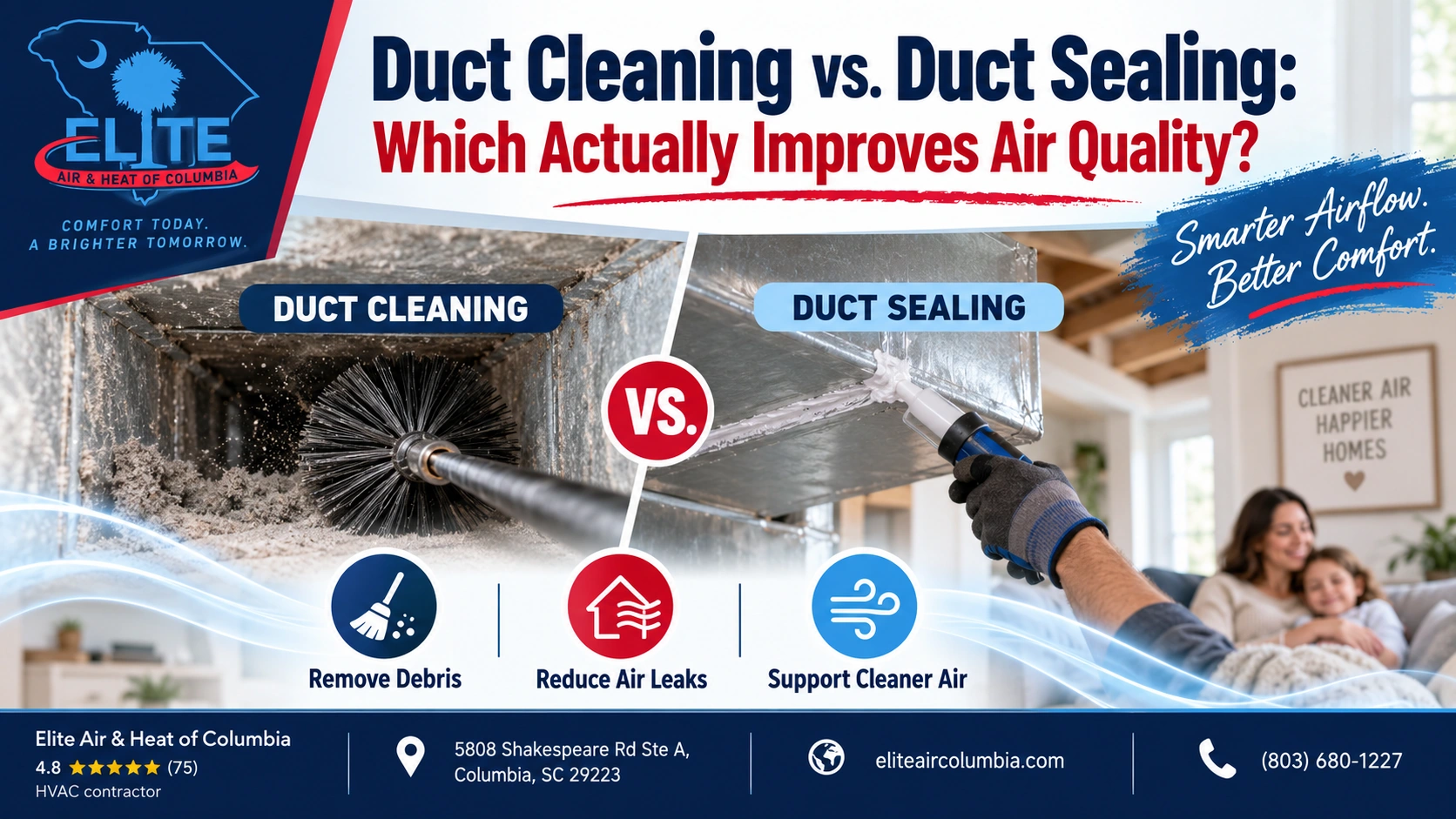
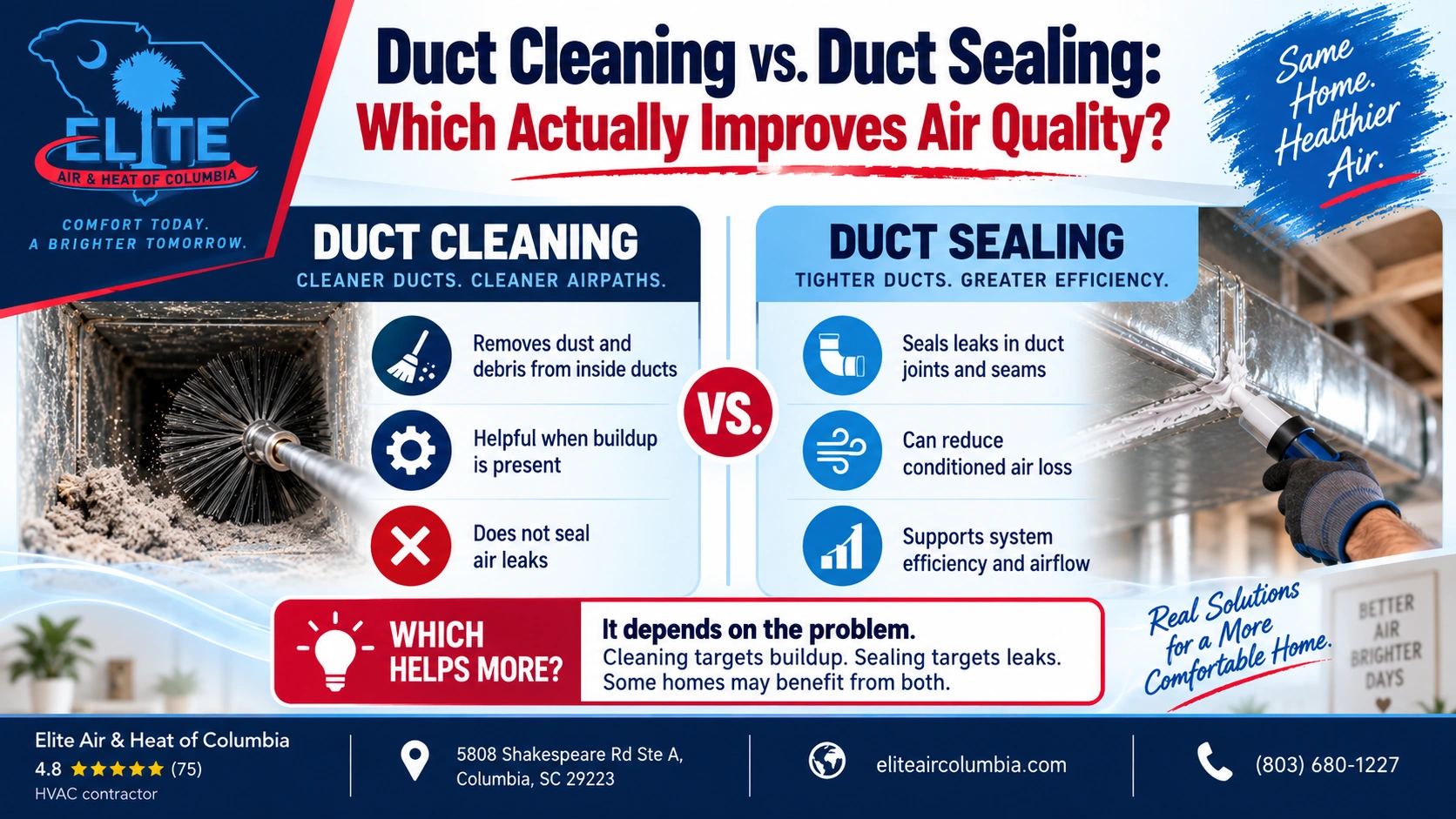
Duct cleaning focuses on removing debris from inside the duct system.
This may include:
- Dust
- Dirt
- Construction debris
- Pet hair
- Pollen
- Insect remains
- Other accumulated particles
Specialized equipment is used to loosen debris and remove it through powerful vacuum systems.
The purpose is to clean contaminants that already exist inside the ductwork.
Duct Sealing
Duct sealing addresses air leaks within the duct system.
Technicians identify and seal openings where air escapes or enters the ducts.
These leaks often occur at:
- Duct joints
- Connections
- Boots
- Plenums
- Attic ductwork
- Crawl space ductwork
The purpose is to stop unwanted air from entering the HVAC system and prevent conditioned air from escaping.
One service removes contamination.
The other helps prevent contamination from entering in the first place.
That’s a significant difference.
Why Duct Sealing Often Has a Bigger Impact on Air Quality
Many homeowners are surprised to learn that their ductwork may be pulling air from places they never intended.
For example:
If return ducts have leaks in an attic, crawl space, or garage, the HVAC system may pull air from those areas into the home.
That air can contain:
- Dust
- Insulation particles
- Mold spores
- Humidity
- Odors
- Outdoor pollutants
Every time the system runs, those contaminants may be circulated throughout the house.
This is where homeowners sometimes get into trouble.
They pay for duct cleaning, but the leaks remain.
The ducts are clean today.
The contamination source remains tomorrow.
As a result, air quality issues often return.
The Hidden Problem Most Homeowners Never See
Many duct systems leak far more than homeowners realize.
Studies across the HVAC industry have repeatedly shown that duct leakage is common, especially in older homes.
Leaks may develop because of:
- Aging duct materials
- Poor installation
- Attic heat exposure
- Renovations
- Vibration
- Improper connections
The problem is that these leaks are usually hidden.
You can’t see them from inside the living space.
Meanwhile, the HVAC system may continuously draw contaminants into the airflow.
A properly sealed duct system helps ensure that the air moving through your home is actually passing through the filtration system as intended.
That’s one reason duct sealing often provides broader air-quality benefits than cleaning alone.
When Duct Cleaning Actually Makes Sense
Despite what some advertisements suggest, not every home needs routine duct cleaning.
However, there are situations where cleaning can be beneficial.
After Major Renovations
Construction projects often introduce:
- Drywall dust
- Sawdust
- Debris
- Insulation particles
If duct openings were exposed during remodeling, cleaning may be worthwhile.
Visible Debris in Ductwork
If significant dust or contamination is clearly visible inside the ducts, cleaning may be appropriate.
Pest Infestations
Rodents and insects can contaminate duct systems.
Cleaning is often recommended after the infestation is fully addressed.
Smoke Damage
Fire and smoke events can introduce odors and contaminants into ductwork.
Cleaning may become part of the restoration process.
Mold Confirmation
If microbial growth is confirmed inside duct components, cleaning and corrective measures may be necessary.
The important word here is confirmed.
A good contractor should be able to show you evidence rather than relying on scare tactics.
When Duct Cleaning Probably Won’t Solve the Problem
Many homeowners schedule duct cleaning hoping to solve issues like:
- Excessive dust
- Allergies
- Uneven temperatures
- Poor airflow
- High humidity
In many cases, those symptoms originate elsewhere.
For example:
Dust Problems
Dust may be entering through:
- Duct leaks
- Attic bypasses
- Air leaks around windows and doors
- Poor filtration
Cleaning ducts without fixing the source often produces disappointing results.
Allergy Symptoms
Indoor air quality involves far more than duct cleanliness.
Contributing factors may include:
- Humidity levels
- Filtration quality
- Outdoor allergens
- Pet dander
- Ventilation issues
A clean duct system alone may not significantly change symptoms.
Poor Airflow
Airflow issues are usually caused by:
- Duct design
- Restrictions
- Improper sizing
- Static pressure problems
Cleaning rarely fixes those underlying conditions.
What Happens When Duct Leaks Go Unaddressed?
Let’s look at a common example.
Imagine a return duct located in a hot attic.
The return develops several leaks.
Every time the system runs:
- Hot attic air enters the ductwork.
- Dust enters the ductwork.
- Insulation fibers enter the ductwork.
- Humid air enters the ductwork.
The HVAC system now has to condition air it was never intended to handle.
The result may include:
- More dust
- Poorer air quality
- Reduced efficiency
- Longer runtimes
- Increased humidity
In this situation, cleaning the ducts may temporarily remove accumulated debris.
But unless the leaks are sealed, contamination continues entering the system.
This is why duct sealing often produces more lasting results.
Can Duct Sealing Improve More Than Air Quality?
Absolutely.
One reason HVAC professionals often prioritize duct sealing is that it affects multiple areas of performance.
Potential benefits include:
Better Indoor Air Quality
Contaminants have fewer entry points.
Improved Comfort
More conditioned air reaches intended rooms.
Lower Energy Waste
Less conditioned air escapes into attics or crawl spaces.
Better Humidity Control
Reduced infiltration of humid outdoor air.
Reduced Dust Accumulation
Fewer contaminants enter the system.
In Columbia’s climate, comfort is not just about temperature.
Humidity and air quality play a major role as well.
Duct leakage often affects all three.
What About Homes With Flexible Ductwork?
Many newer homes use flexible duct systems.
These systems can perform well when installed properly.
However, they can also develop issues such as:
- Loose connections
- Compression
- Sagging
- Tears
Duct sealing may be particularly beneficial when these conditions are identified.
A thorough inspection should evaluate the entire duct system rather than focusing solely on cleanliness.
How Do You Know Which Service You Need?
This is where a professional evaluation becomes important.
A good HVAC contractor should investigate:
Air Leakage
How much conditioned air is being lost?
Return Leakage
Is the system pulling contaminated air from unconditioned spaces?
Duct Condition
Are ducts damaged or deteriorating?
Contamination Levels
Is significant debris actually present?
Airflow Performance
Are comfort problems linked to airflow restrictions?
The recommendation should be based on findings—not assumptions.
What a Good Contractor Should Never Do
Be cautious of anyone who immediately recommends expensive duct cleaning without first understanding the problem.
You should be wary if the explanation relies heavily on:
- Fear
- Vague contamination claims
- Scare photos unrelated to your home
- Pressure tactics
A good technician should be able to show you:
- Where contamination exists
- Where leaks exist
- Why they’re recommending a specific solution
The cheaper option is not always wrong, but it should make sense.
Can You Benefit From Both Services?
Sometimes.
In certain homes, the best approach may involve both cleaning and sealing.
For example:
A duct system that contains significant debris and substantial leakage may benefit from:
- Cleaning existing contamination
- Sealing leaks to prevent future contamination
The sequence matters.
Cleaning without sealing often produces temporary results.
Sealing without addressing severe contamination may leave existing debris in place.
The right solution depends on the condition of the system.
The Better Question Isn’t “Which Service Is Better?”
It’s:
“What’s causing my air quality problem?”
That’s the question homeowners should focus on.
If contaminants are actively entering the duct system through leaks, sealing may provide the greatest benefit.
If contamination already exists inside the ductwork, cleaning may be appropriate.
Sometimes the answer is both.
Sometimes it’s neither.
The goal is to identify the actual source before spending money.
Before You Pay for Cleaner Ducts, Make Sure the System Isn’t Pulling Dirty Air
Many homeowners assume dirty ducts are the root cause of poor indoor air quality.
In reality, leaky ducts are often the bigger problem.
A clean duct system that continuously pulls dusty attic air into the home won’t stay clean for long.
That’s why understanding airflow, leakage, filtration, and contamination together is so important.
Solve the Source of the Air Quality Issue—Not Just the Symptoms
If you’re considering duct cleaning or duct sealing, start with a thorough evaluation of the entire HVAC system rather than focusing on a single service.
Elite Air & Heat of Columbia helps homeowners identify whether dust, allergens, humidity, airflow problems, or duct leakage are contributing to indoor air quality concerns so you can invest in solutions that address the actual cause—not just the symptoms.