


Older homes in Cottontown have a different HVAC problem than newer homes in the suburbs.
It is not just, “What size AC do I need?”
It is:
How do you make an older home comfortable without tearing it apart?
Here’s the plain answer.
For many historic Cottontown homes, ductless mini-splits are often the easier way to add comfort to specific rooms, additions, upstairs spaces, sunrooms, detached offices, or areas where ductwork is weak or missing.
But central AC is usually better when the home already has decent ductwork, the goal is whole-home comfort, and the existing layout can support proper airflow.
The best answer is often not one or the other. In many older homes, the best setup is a hybrid approach: central AC for the main living areas and ductless mini-splits for the rooms the central system cannot serve well.
Cottontown, also known historically as the Bellevue Historic District, includes early planned residential development and is protected as an architectural conservation district by the City of Columbia. Historic Columbia describes it as one of Columbia’s earliest planned suburbs, and state records note its concentration of early twentieth-century residential architecture.
That matters because HVAC work in a home like this is not just mechanical. It affects walls, ceilings, crawlspaces, attics, exterior equipment placement, and sometimes historic appearance.
Historic Home, Modern Cooling Problems?
Get professional help comparing central AC and ductless mini-splits for lasting comfort. Call now to find the right solution.
The Quick Comparison
| Question | Central AC | Ductless Mini-Splits |
| Best for whole-home comfort? | Usually yes | Sometimes, but may require several indoor heads |
| Best for homes without ducts? | Usually no | Usually yes |
| Least visible indoors? | Usually yes, if ducts already exist | No, indoor heads are visible |
| Least invasive install? | If ductwork exists | Often, especially for isolated rooms |
| Best for humidity control? | Good if sized and installed correctly | Good in zones, but setup matters |
| Best for room-by-room control? | Limited unless zoned | Very strong |
| Best for preserving old plaster and trim? | Depends on duct path | Often better |
| Best for resale familiarity? | Usually central AC | Depends on buyer preference |
If you only remember one thing, remember this:
Central AC works best when the duct system is good. Mini-splits work best when the duct system is the problem.
Why Historic Cottontown Homes Make HVAC Decisions Harder
Many Cottontown homes were not originally built around modern air conditioning.
That can mean:
- Tight attic access
- Limited crawlspace room
- Old plaster walls
- Tall ceilings
- Original hardwood floors
- Multiple additions over time
- Closed-off room layouts
- Fireplaces and chimneys
- Limited closet space for duct chases
- Older electrical systems
- Rooms that heat and cool unevenly
This is where homeowners sometimes get into trouble.
They replace the central AC equipment and expect the whole house to feel new. But if the ductwork is undersized, leaky, poorly routed, or missing sections of the home, new equipment may not solve the comfort problem.
A new AC can only move air through the duct system it is connected to.

When Central AC Makes More Sense
Central AC is usually the better fit when the home already has a usable duct system.
It may make sense if:
- The existing ducts are properly sized
- Most rooms already get decent airflow
- The attic or crawlspace allows duct repair
- You want one main thermostat
- You want fewer visible indoor units
- You want a more traditional HVAC setup
- The home’s layout is open enough for good air movement
- You are replacing an existing central system that worked well
A well-designed central AC system can be comfortable, quiet, and familiar.
It can also do a better job of making the home feel consistent from room to room when the ducts are right.
The problem is that many older homes do not have “right” ductwork.
They have ductwork that was added later, squeezed into tight spaces, patched after renovations, or designed around whatever route was easiest at the time.
When Central AC Becomes a Problem
Central AC can become expensive or disappointing when the ductwork is not ready for it.
Warning signs include:
- One room is always hotter
- Upstairs never cools well
- The system runs constantly
- Some vents barely move air
- The return air is undersized
- Ducts are crushed or disconnected
- The home feels humid even when cool
- Utility bills are high
- The system is noisy
- The AC freezes up
- The crawlspace or attic ducts are poorly insulated
In Columbia’s humidity, duct problems are not just comfort problems. Leaky return ducts can pull hot, humid attic or crawlspace air into the system. That forces the AC to fight extra moisture all summer.
If a contractor recommends a central AC replacement for a historic home, they should inspect the ducts before quoting the equipment.
Not just the outdoor unit.
Not just the age of the system.
The ducts matter.
When Ductless Mini-Splits Make More Sense
Ductless mini-splits are often a strong option for older homes because they do not need traditional ductwork.
A mini-split uses an outdoor unit connected to one or more indoor units. Each indoor unit serves a specific room or zone.
Mini-splits may make sense for:
- Upstairs bedrooms
- Finished attics
- Home offices
- Sunrooms
- Additions
- Detached studios
- Garage apartments
- Rooms far from the main system
- Homes with no existing ducts
- Homes where duct installation would damage historic finishes
For Cottontown homes with original plaster, trim, hardwoods, and tight framing, avoiding large duct runs can be a major advantage.
Instead of opening walls and ceilings, a mini-split may only need a small wall penetration for refrigerant lines, wiring, and drainage.
That does not mean it is always simple. But it is often less invasive than building a full duct system into a home that was never designed for one.
The Tradeoff: Mini-Splits Are Visible
Mini-splits solve a lot of problems, but they create one obvious tradeoff.
You can see the indoor units.
Some homeowners do not mind. Others dislike the look, especially in historic rooms with original character.
There are different indoor unit styles, including wall-mounted units, floor-mounted units, ceiling cassettes, and concealed ducted mini-split options. But not every style fits every home, and some require more carpentry or ceiling space.
For a historic home, appearance matters.
So does outdoor placement. The City of Columbia’s historic district resources explain that certain exterior changes and site improvements may fall under design review, depending on the district and scope of work.
That does not mean you cannot install HVAC equipment. It means the placement should be thought through.
A good contractor should consider where outdoor units, line sets, covers, and drains will be visible from the street or public view.
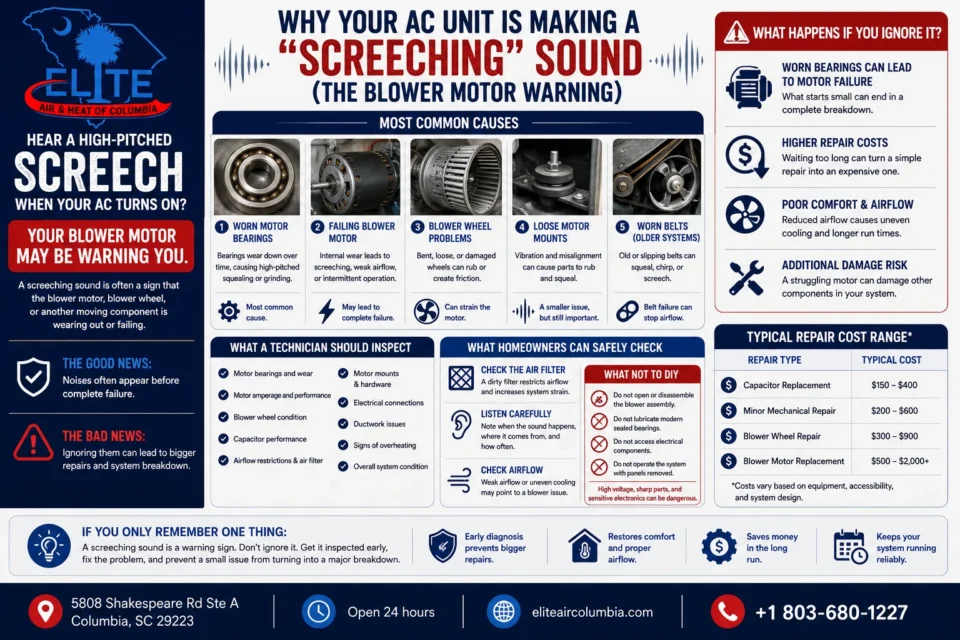
Why Your AC Unit Is Making a “Screeching” Sound (The Blower Motor Warning)
You turn on your air conditioner and hear it. A high-pitched screech. Maybe it sounds like metal rubbing against metal.…
Mini-Splits and Historic Preservation
For historic homes, the mechanical work should respect the structure.
That means thinking about:
- Where line sets will run
- Whether exterior line covers are visible
- Where the outdoor unit sits
- How condensate will drain
- Whether brick, siding, or trim must be penetrated
- Whether indoor units disrupt important rooms
- Whether electrical upgrades are needed
- Whether the project needs review or approval
Cottontown’s neighborhood preservation information notes that properties within the local preservation overlay may be subject to restrictions on renovations and exterior changes.
This is why HVAC planning should happen before equipment is ordered.
The cheapest installation path may not be the best path for a historic home.
What About Humidity?
This is a big one in Columbia.
Both central AC and ductless mini-splits can control humidity, but only when they are sized, installed, and set up correctly.
Central AC may struggle with humidity if:
- The system is oversized
- The ductwork leaks
- Airflow is too high
- The coil is dirty
- The system short-cycles
- Return ducts pull humid air from the crawlspace or attic
Mini-splits may struggle with humidity if:
- The unit is oversized for the room
- The fan runs constantly in the wrong mode
- The drain is poorly installed
- The system does not run long enough
- Doors stay closed and zones do not communicate
- The home has crawlspace moisture issues
A mini-split is not automatically better for humidity.
A central AC system is not automatically better either.
The question is whether the system runs long enough, moves the right amount of air, and removes moisture instead of just dropping the temperature.
Cost: Which Is More Expensive?
It depends on how much of the home you are trying to condition.
A single-zone ductless mini-split for one problem room may cost much less than reworking an entire duct system.
But using mini-splits for the whole house can get expensive if you need several indoor heads, multiple outdoor units, electrical work, and careful line-set routing.
Here is the practical way to look at it:
| Project Type | Typical Cost Direction |
| Replace existing central AC with decent ducts | Often the most straightforward |
| Replace central AC plus major duct repairs | More expensive |
| Add one mini-split to a problem room | Often cost-effective |
| Condition the whole home with several mini-splits | Can become expensive |
| Install new full duct system in an older home | Often invasive and costly |
| Hybrid central AC plus mini-split zones | Often best value for difficult homes |
A good quote should explain whether you are paying for equipment, duct correction, electrical work, carpentry access, preservation-friendly routing, or all of the above.
The Hybrid Approach Often Wins
For many Cottontown homes, the best answer is a hybrid system.
That may look like:
- Central AC for the main floor
- Mini-split for upstairs bedrooms
- Mini-split for a back addition
- Mini-split for a finished attic
- Mini-split for a detached office
- Duct repairs to improve the main system
- Better returns to reduce humidity and pressure problems
This approach avoids forcing one system to solve every problem.
It also lets you preserve more of the home.
If the central AC handles most of the house well, keep it. If one room has never been comfortable because the duct run is too long or too tight, a mini-split may solve that specific problem better than oversized central equipment.
The goal is not to buy the most complicated system.
The goal is to fix the actual comfort problem with the least unnecessary disruption.
What a Good Technician Should Inspect
Before recommending central AC, ductless, or a hybrid setup, a technician should inspect:
- Existing duct size and condition
- Return air capacity
- Crawlspace or attic access
- Room-by-room airflow
- Insulation levels
- Window exposure
- Ceiling height
- Existing electrical capacity
- Drainage options
- Outdoor unit placement
- Line-set routing
- Historic exterior visibility
- Humidity complaints
- Which rooms are actually uncomfortable
A good technician should be able to show you why one option fits better than another.
Not just say, “Mini-splits are better.”
Not just say, “Central is better.”
Older homes need more careful thinking than that.
When Central AC Is the Better Choice
Central AC is usually the better choice when:
- The home already has good ductwork
- You want whole-home comfort from one system
- You prefer hidden air distribution
- The ducts can be sealed or improved without major damage
- The layout allows balanced airflow
- You want a familiar resale-friendly setup
When Ductless Mini-Splits Are the Better Choice
Mini-splits are usually the better choice when:
- The home has no ducts
- Duct installation would damage historic finishes
- One room or zone is the real problem
- An addition is not connected well to the main system
- Upstairs comfort is poor
- You want room-by-room control
- You want to avoid major wall or ceiling work
When Neither Option Alone Is Enough
Sometimes the HVAC system is not the only issue.
Comfort problems in historic homes can also come from:
- Poor attic insulation
- Unsealed crawlspaces
- Air leaks
- Old windows
- Undersized returns
- Damp crawlspace air
- Poor drainage around the home
- Rooms added without proper HVAC planning
If those issues are ignored, even good equipment can disappoint.
This is where homeowners sometimes spend money twice: first on a new system, then later on the building problems the system was trying to overcome.
A good technician should tell you when HVAC equipment is only part of the answer.
The Bottom Line
For historic Cottontown homes, central AC wins when the ductwork is already good enough to support whole-home comfort.
Ductless mini-splits win when ductwork is missing, weak, invasive, or only one part of the home needs help.
For many older homes, the best solution is a hybrid: central AC where it works, ductless where it solves a specific problem.
If you only remember one thing, remember this:
Do not choose the system first. Diagnose the house first.
Older Columbia homes need HVAC planning that respects the structure, the humidity, the duct limitations, and the way the rooms are actually used.
Elite Air & Heat of Columbia can help evaluate whether central AC, ductless mini-splits, or a hybrid setup makes the most sense before you spend money on equipment that may not solve the real problem.
Choosing the Right AC for Your Historic Cottontown Home?
Get expert guidance on central AC and ductless mini-split options. Call today for comfortable, efficient cooling that fits your home’s character.