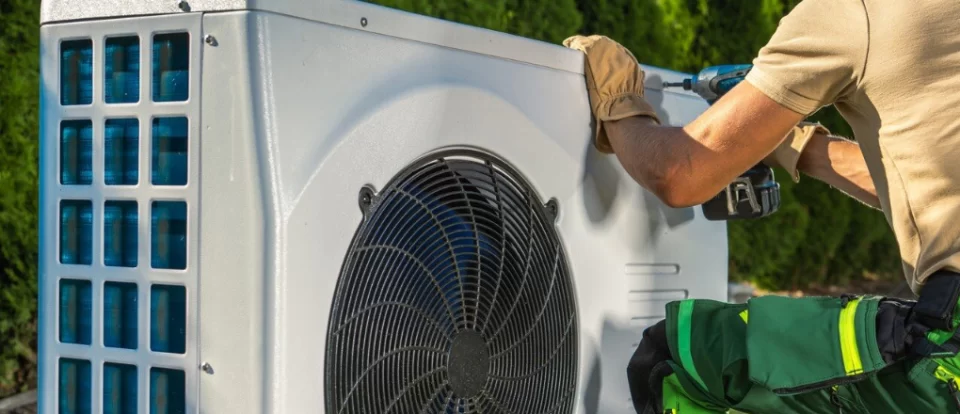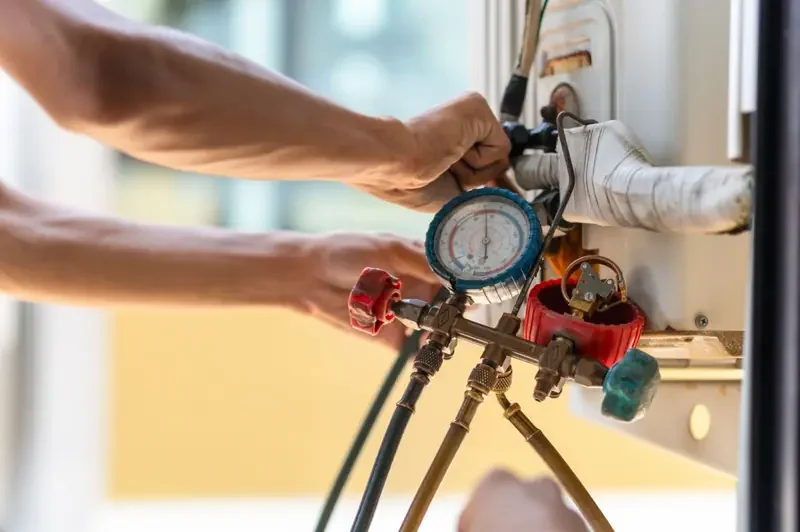


If you are replacing your HVAC system in Columbia, one of the biggest questions is whether to stay with a heat pump or install a gas furnace.
Here’s the plain answer.
For most Columbia-area homes, a modern heat pump is usually the better fit for our mild winters because it handles both cooling and heating, runs efficiently in moderate cold, and matches the way Midlands homes actually use HVAC most of the year.
But that does not mean gas furnaces are bad.
A gas furnace may still make sense if your home already has natural gas, you prefer hotter supply air, your house has comfort issues during cold snaps, or you are building a dual-fuel system that uses a heat pump most of the time and gas backup when temperatures drop.
The winner depends on the house, not just the equipment.
Choosing Between a Heat Pump and Gas Furnace?
Get expert insight on heating efficiency, upfront pricing, and comfort advantages to help you make the best investment for your home.
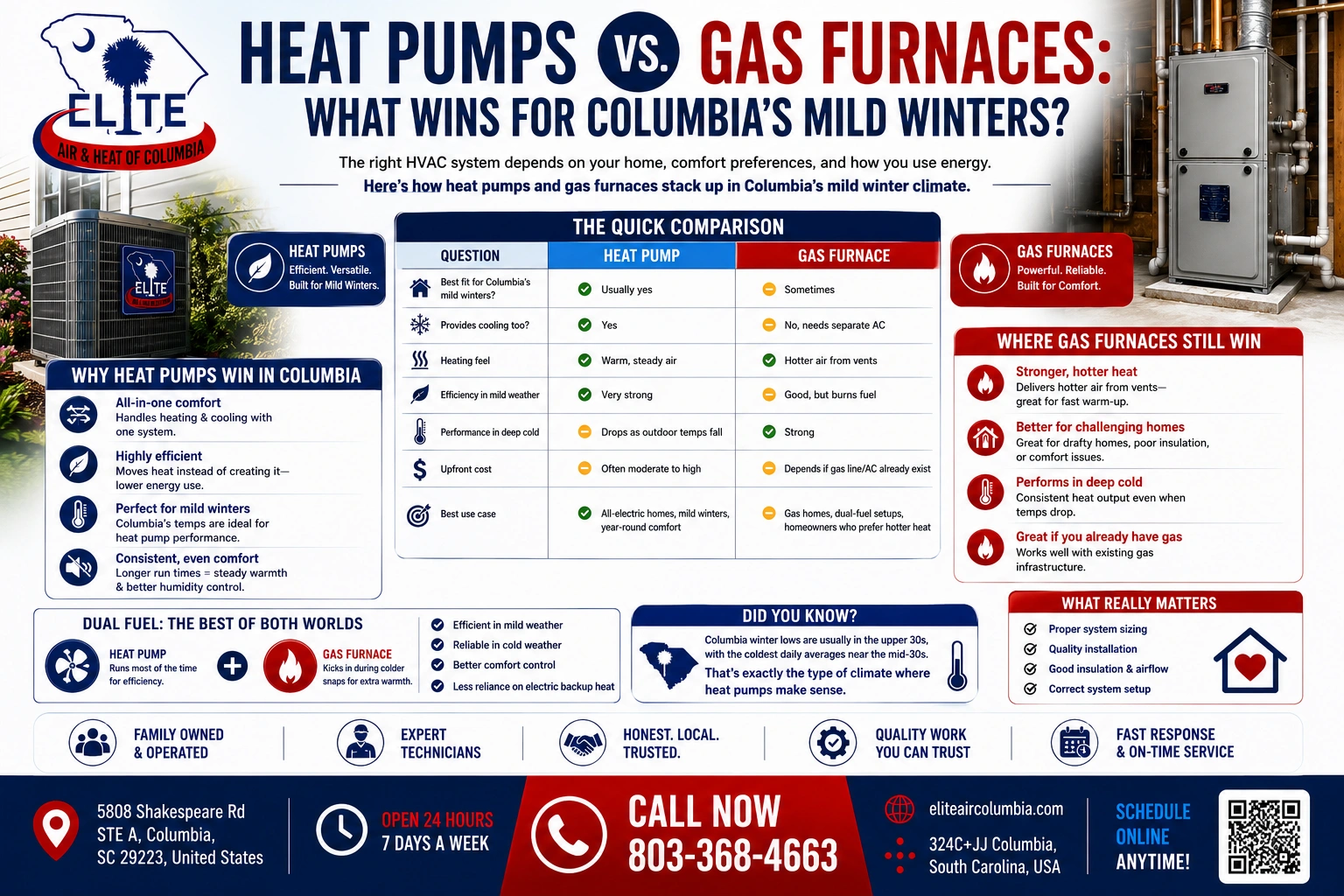
The Quick Comparison
| Question | Heat Pump | Gas Furnace |
| Best fit for Columbia’s mild winters? | Usually yes | Sometimes |
| Provides cooling too? | Yes | No, needs separate AC |
| Heating feel | Warm, steady air | Hotter air from vents |
| Efficiency in mild weather | Very strong | Good, but burns fuel |
| Performance in deep cold | Drops as outdoor temps fall | Strong |
| Upfront cost | Often moderate to high | Depends if gas line/AC already exist |
| Best use case | All-electric homes, mild winters, year-round comfort | Gas homes, dual-fuel setups, homeowners who prefer hotter heat |
Columbia winter lows are usually not extreme. Average winter low temperatures are around the upper 30s, with the coldest daily averages near the mid-30s. That is exactly the type of climate where heat pumps tend to make sense.
Why Heat Pumps Usually Win in Columbia
A heat pump works like an air conditioner that can run in reverse.
In summer, it moves heat out of your home.
In winter, it pulls heat from outdoor air and moves it inside.
That sounds strange, but even cool outdoor air still contains heat. Modern heat pumps are designed to extract that heat efficiently, especially in climates like South Carolina where long freezes are not the normal winter pattern. ENERGY STAR’s current heat pump criteria also recognize cold-climate heat pump performance, which shows how far the technology has come beyond the old “heat pumps do not work when it is cold” reputation.
For Columbia homeowners, the practical benefit is simple:
You use one system for both cooling and heating, and the system is especially well matched to mild winter weather.
That matters because our HVAC systems spend much of the year in cooling mode. If you are already replacing the outdoor AC equipment, choosing a heat pump often gives you heating capability without building the whole comfort system around gas heat.
Where Gas Furnaces Still Win
A gas furnace produces hotter supply air than a heat pump.
That is the main comfort difference homeowners notice.
A heat pump may blow air that feels warm but not hot. A gas furnace tends to deliver stronger, hotter-feeling heat from the vents.
That can matter if:
- You dislike the feel of heat pump air
- Your home is drafty
- You have poor insulation
- Your ductwork is not ideal
- You want fast warm-up on cold mornings
- You already have natural gas service
- You are replacing an existing gas furnace and AC together
Gas furnaces also perform consistently during colder outdoor temperatures. A heat pump’s efficiency and heating capacity drop as temperatures fall, while a gas furnace is not affected the same way by outdoor temperature.
That said, Columbia does not have the kind of long, severe winter that makes gas heat the automatic winner.
What About Dual Fuel?
For many homeowners, the best answer is not heat pump or gas furnace.
It is both.
A dual-fuel system uses a heat pump for most heating and cooling needs, then switches to a gas furnace during colder conditions or when gas heat becomes more practical.
This can be a strong option if you already have gas service and want:
- Efficient heat pump operation in mild weather
- Strong gas heat during colder snaps
- Backup flexibility
- Better comfort control
- Less reliance on electric heat strips
Dual fuel usually costs more upfront than a basic single-fuel system, but it can be a smart setup for homeowners who want comfort and flexibility.
The key is making sure the controls are set correctly. A dual-fuel system should not switch to gas too early or too late without a reason.
Is Furnace Replacement Really Necessary? Here’s What Experts Say
A reliable furnace is crucial for keeping your home warm, safe, and comfortable during the coldest months. But as your…
The Big Mistake: Comparing Furnace Heat to Heat Pump Heat by Feel Alone
This is where homeowners sometimes get into trouble.
They stand near a vent and say, “This heat pump does not feel as warm.”
That may be true.
But vent temperature is not the whole story.
A gas furnace often sends hotter air in shorter bursts. A heat pump usually provides gentler, steadier heat over a longer run time. That can feel different, especially if you are used to gas.
Different does not automatically mean worse.
The real questions are:
- Does the home reach temperature?
- Does it hold temperature?
- Are rooms balanced?
- Is the system running constantly?
- Are electric heat strips coming on too often?
- Are utility bills reasonable?
- Does the home feel drafty or uneven?
A properly sized heat pump in a well-set-up home can be very comfortable in Columbia. But a poorly installed or poorly sized heat pump can feel disappointing.
Operating Cost: Which Is Cheaper to Run?
There is no honest one-line answer because operating cost depends on utility rates, equipment efficiency, system setup, and how the home is built.
South Carolina electricity prices in 2026 are reported around the mid-teens per kWh, while natural gas rates vary by utility and month. Current energy data sources show South Carolina residential electricity averaging around 15.71 cents per kWh, and South Carolina residential natural gas data has shown monthly prices that can move significantly.
Here is the practical version:
A heat pump often does very well in Columbia because it is moving heat rather than creating it from resistance heat. In mild weather, that can be very efficient.
A gas furnace may be cheaper to run during colder periods if natural gas rates are favorable and the furnace is efficient.
Electric heat strips are the wild card. If a heat pump relies too much on auxiliary electric heat, winter electric bills can jump.
A good technician should check whether your system is using heat strips as backup occasionally or leaning on them too much because of a sizing, airflow, thermostat, or equipment problem.
Comfort in Columbia’s Real Winter Conditions
Columbia winters are usually mild, but they are not nothing.
We get chilly mornings, damp cold days, and the occasional hard freeze. The home may not need extreme heating capacity every day, but it still needs steady comfort when temperatures dip.
For most homes:
Heat pump wins when the home is reasonably insulated, the ducts are in decent shape, and the system is sized and installed correctly.
Gas furnace wins when the homeowner wants hotter heat, already has gas infrastructure, or the home has comfort weaknesses that make steady lower-temperature heat less satisfying.
Dual fuel wins when the homeowner wants heat pump efficiency most of the winter with gas backup for colder conditions.
Upfront Cost: What Changes the Price?
A heat pump installation may cost more than a straight AC replacement, but it may avoid needing a separate heating system in all-electric homes.
A gas furnace setup may be attractive if the house already has gas, venting, and a furnace location. But if the home does not already have natural gas service, the cost and complexity can rise.
Cost depends on:
- Existing equipment type
- Ductwork condition
- Gas line availability
- Venting requirements
- Electrical requirements
- System size
- Efficiency level
- Single-stage vs two-stage vs variable-speed equipment
- Thermostat and control setup
- Whether you are installing AC, furnace, or both
A quote should not just say “heat pump” or “gas furnace.” It should show what equipment is being installed, what is being reused, what needs correction, and what the system is expected to solve.
Maintenance Differences
Both systems need maintenance.
A heat pump works in both summer and winter, so it runs more months of the year. That means regular maintenance matters. Coils, refrigerant charge, airflow, defrost operation, electrical components, and drain systems all need attention.
A gas furnace has combustion-related maintenance. That means burners, flame sensor, heat exchanger condition, gas pressure, venting, and carbon monoxide safety all matter.
Do not skip furnace maintenance just because the system still heats. Gas equipment should be checked for safe operation.
Do not skip heat pump maintenance just because it runs quietly. Heat pumps work hard through Columbia’s long cooling season and still need to perform in winter.
When a Heat Pump Is the Better Choice
A heat pump is usually the better choice when:
- Your home is all-electric
- Your current system is already a heat pump
- You want one system for heating and cooling
- Your winters are mild
- Your ductwork is in good shape
- You want efficient heating most of the season
- You are replacing aging AC equipment anyway
- You want to avoid adding gas service
For many Columbia homes, this is the most practical path.
When a Gas Furnace Is the Better Choice
A gas furnace may be the better choice when:
- Your home already has natural gas
- You strongly prefer hotter supply air
- Your current furnace and AC setup has served the home well
- Your home is drafty or poorly insulated
- You want strong backup heat
- You are considering dual fuel
- Your utility rates make gas especially attractive
Gas heat is not outdated. It is just not always necessary in a mild-winter market.
What a Good Technician Should Check Before Recommending Either One
A good recommendation should be based on the house, not just personal preference.
Before recommending a heat pump, gas furnace, or dual-fuel system, a technician should look at:
- Current system type
- Ductwork size and leakage
- Return air capacity
- Home insulation
- Window exposure
- Comfort complaints
- Existing gas service
- Electrical panel capacity
- Thermostat setup
- Heat strip usage
- Utility bill history
- System age and repair history
- Whether rooms heat and cool evenly
A good technician should be able to explain why one setup fits your home better than the other.
Not just say, “Heat pumps are better” or “Gas is better.”
The Bottom Line
For Columbia’s mild winters, a modern heat pump usually wins for most homes.
It matches the climate, handles cooling and heating, and performs well when properly sized and installed.
But a gas furnace still has a place. It delivers hotter heat, performs strongly during cold snaps, and can be a good fit for homes already set up for gas.
The best overall setup for some homeowners is dual fuel: heat pump most of the winter, gas furnace when it makes sense.
If you only remember one thing, remember this:
Do not choose based only on the equipment label. Choose based on your home, ductwork, utility setup, comfort expectations, and how the system will be installed.
Elite Air & Heat of Columbia can help you compare heat pump, gas furnace, and dual-fuel options clearly before you approve a replacement.
Thinking About Switching Your Heating System?
Find out whether a heat pump or gas furnace is the smarter choice for Columbia’s mild winters, including energy savings, comfort, and long-term costs.