
If you have a finished room over your garage that never seems comfortable, you’re not alone.
Many homeowners use these spaces as bedrooms, home offices, bonus rooms, game rooms, or guest suites. Yet they often become the hottest room in the house during summer and one of the coldest during winter.
Eventually, many homeowners start asking the same question:
“How much would it cost to install a ductless mini-split in my FROG?”
Here’s the plain answer.
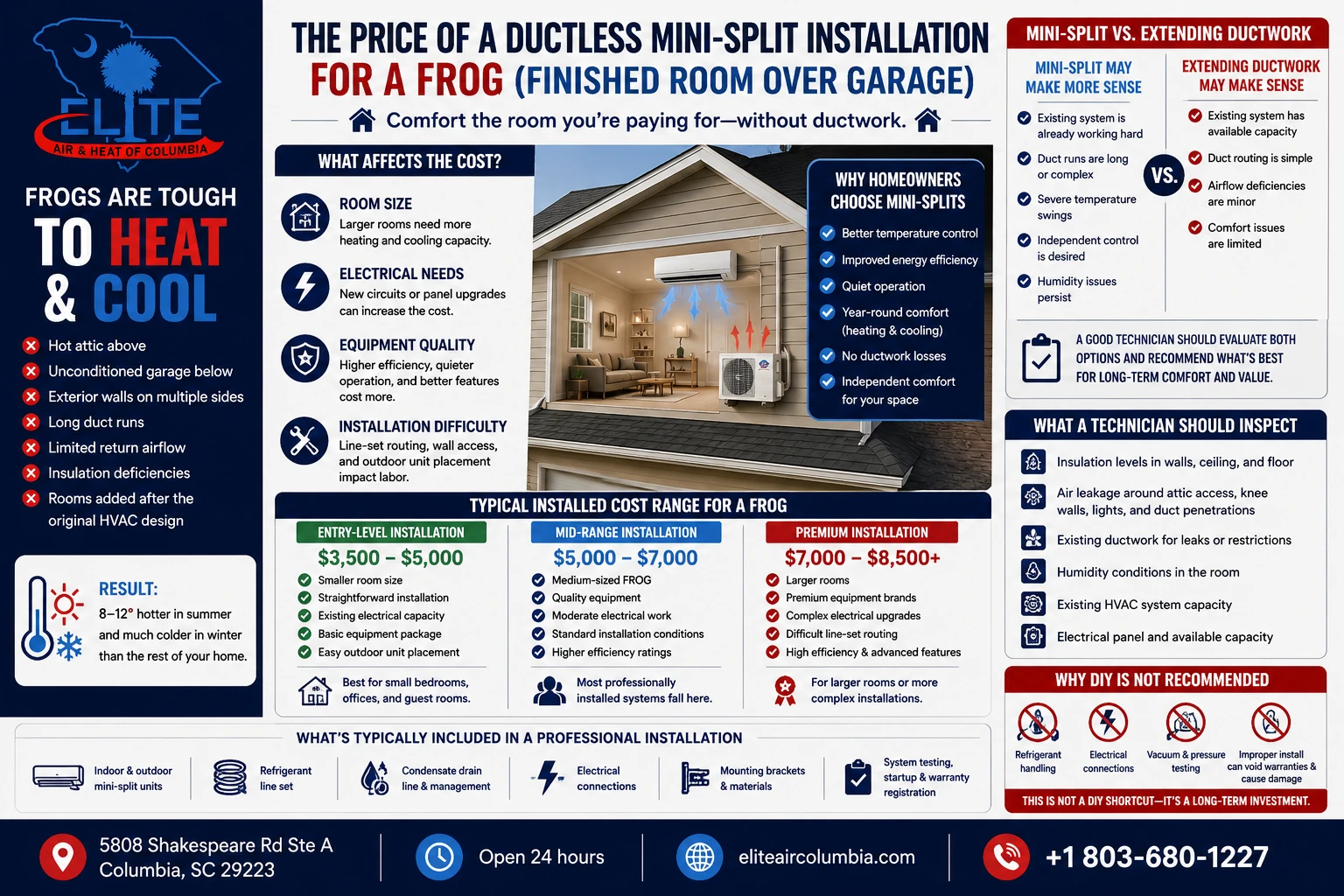
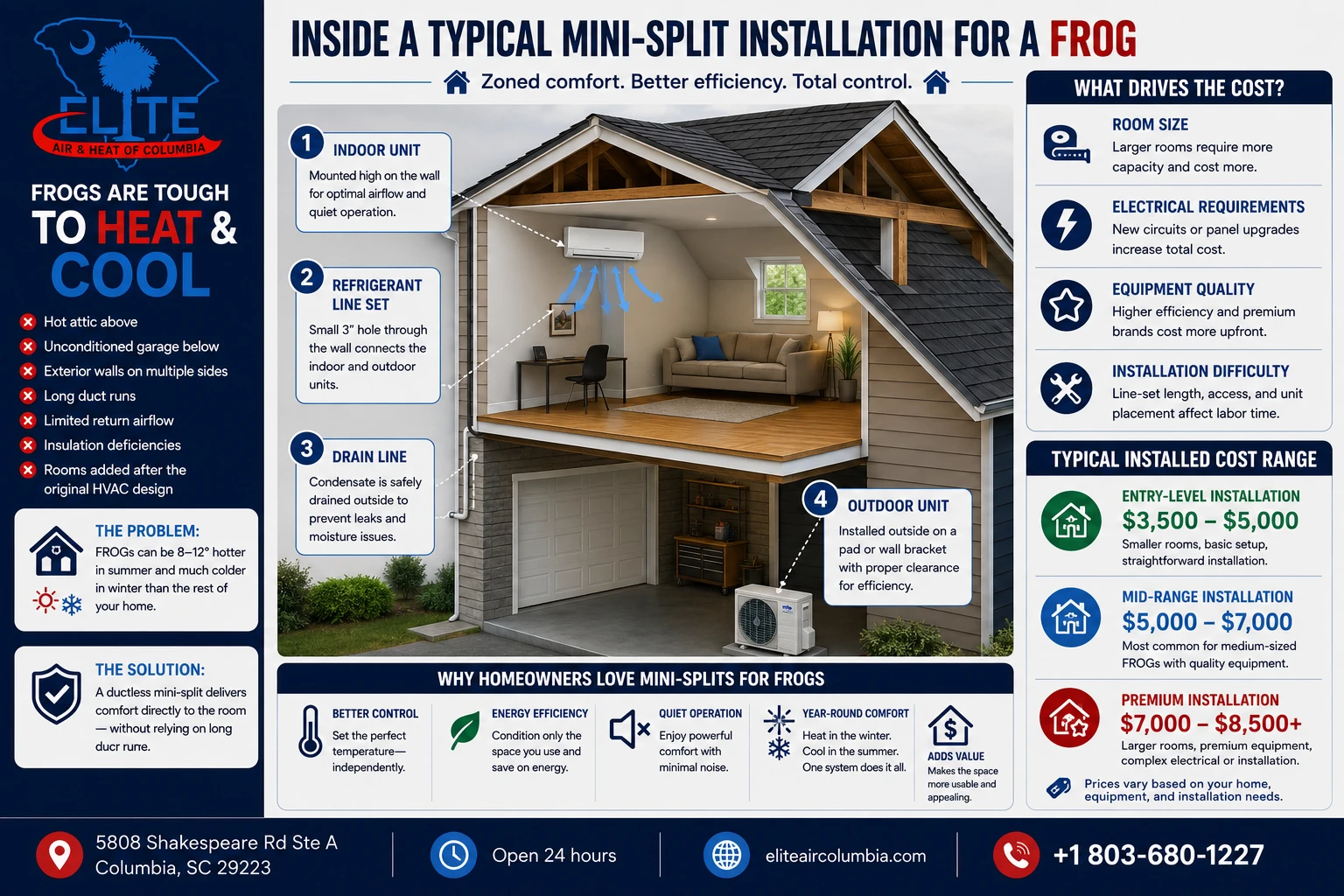
Most ductless mini-split installations for a FROG cost between $3,500 and $8,500, depending on the size of the room, electrical requirements, equipment quality, and installation complexity. Some projects come in below that range, while larger or more complicated installations can exceed it.
The bigger question is whether a mini-split is actually the right solution for your comfort problem.
A good HVAC contractor should help you answer that before discussing equipment brands or financing options.
Ready to Make Your FROG Comfortable?
Get a clear price for a ductless mini-split installation. Call today for an estimate.
Why FROGs Are So Difficult to Heat and Cool
A FROG—short for Finished Room Over Garage—is one of the most common comfort challenges in residential HVAC.
The issue is not usually the room itself.
The issue is how the room is built.
Many FROGs have:
- Hot attic space above
- Unconditioned garage below
- Exterior walls on multiple sides
- Long duct runs
- Limited return airflow
- Insulation deficiencies
- Rooms added after the original HVAC design
In Columbia’s heat and humidity, these conditions create a perfect recipe for temperature swings.
A room may be:
- 8 to 12 degrees hotter than the rest of the home in summer
- Noticeably colder in winter
- Difficult to keep comfortable regardless of thermostat settings
This is where homeowners sometimes get into trouble.
Many assume they need a larger central HVAC system.
In reality, the existing system may be working exactly as designed. The problem may be that the FROG was never receiving enough conditioned air in the first place.
Why Homeowners Choose Mini-Splits for FROGs
A ductless mini-split creates a separate heating and cooling zone for the room.
Instead of relying on long ductwork connected to the main HVAC system, the mini-split delivers conditioned air directly into the space.
This approach solves several common problems:
Better Temperature Control
You can set the room’s temperature independently from the rest of the house.
That means:
- Cooler sleeping temperatures
- Comfortable home office conditions
- Better guest room comfort
- Reduced family thermostat battles
Improved Energy Efficiency
You are not forcing your entire HVAC system to work harder just to cool one difficult room.
This often reduces unnecessary runtime on the main system.
Quiet Operation
Modern mini-splits are remarkably quiet.
Many homeowners are surprised by how little noise they produce compared to traditional systems.
Year-Round Comfort
Most modern mini-splits provide both heating and cooling.
That means one system can solve comfort problems throughout the year.
What Does a FROG Mini-Split Installation Cost?
The total cost depends on several factors.
Entry-Level Installation: $3,500–$5,000
This typically includes:
- Smaller room size
- Straightforward installation
- Existing electrical capacity
- Basic equipment package
- Easy outdoor unit placement
These projects are often found in:
- Small bonus rooms
- Home offices
- Guest bedrooms
Mid-Range Installation: $5,000–$7,000
This is where many homeowners land.
Typical factors include:
- Medium-sized FROG
- Quality equipment
- Moderate electrical work
- Standard installation conditions
- Higher efficiency ratings
Most professionally installed systems fall into this category.
Premium Installation: $7,000–$8,500+
Higher-end projects often involve:
- Larger rooms
- Premium equipment brands
- Advanced filtration features
- Complex electrical upgrades
- Difficult line-set routing
- Higher efficiency systems
The price increases because labor and installation complexity increase—not simply because the equipment costs more.
What Actually Drives the Cost?
Many homeowners receive multiple estimates and wonder why the numbers vary so much.
A good contractor should explain exactly what is driving the difference.
Room Size
A larger FROG requires more heating and cooling capacity.
Oversizing and undersizing are both problems.
A system that is too small struggles.
A system that is too large can create humidity issues.
A proper load calculation helps determine the correct size.
Electrical Requirements
Some homes already have available electrical capacity.
Others require:
- New circuits
- Breaker upgrades
- Electrical panel work
These upgrades can significantly affect installation costs.
Equipment Quality
Not all mini-splits are built the same.
Higher-end systems often provide:
- Better efficiency
- Quieter operation
- Longer warranties
- Improved humidity control
- Better cold-weather performance
The cheapest equipment is not always wrong, but it should make sense.
Installation Difficulty
A straightforward installation is less expensive than one requiring:
- Long refrigerant line runs
- Attic access challenges
- Complex wall penetrations
- Difficult outdoor unit placement
Labor often plays a larger role than homeowners realize.
Why Some Quotes Are Thousands Less Than Others
This is one of the most important questions homeowners can ask.
When comparing mini-split estimates, make sure you understand whether each quote includes:
- Equipment
- Refrigerant lines
- Electrical work
- Permit costs
- Mounting hardware
- Condensate drainage
- Startup procedures
- Warranty registration
A lower quote may leave out important items.
That does not automatically make it a bad quote.
However, a good contractor should clearly explain what is included and what is not.

5 Signs Your “Soda City” Home Has Dirty Sock Syndrome (Moldy AC Coils)
If your house smells musty every time the AC kicks on, especially during Columbia’s humid summers, you may be dealing…
Can a Mini-Split Increase Home Value?
Sometimes.
A mini-split can make a difficult room significantly more usable.
Potential benefits include:
- More comfortable guest space
- Better work-from-home functionality
- Improved resale appeal
- Better year-round comfort
Most homeowners do not install a mini-split solely for resale value.
They install it because they are tired of avoiding a room they already own.
Is a Mini-Split Better Than Extending Existing Ductwork?
Sometimes yes. Sometimes no.
A good technician should evaluate both options.
Extending Ductwork May Make Sense When:
- Existing system has available capacity
- Duct routing is simple
- Airflow deficiencies are minor
- Room comfort issues are limited
A Mini-Split May Make More Sense When:
- Existing system is already working hard
- Duct runs are excessively long
- Temperature swings are severe
- Independent control is desired
- Humidity issues persist
The goal is not to sell a mini-split.
The goal is to identify the actual cause of the comfort problem.
What a Technician Should Inspect Before Recommending a Mini-Split
Before recommending any equipment, a thorough HVAC evaluation should include:
Insulation Levels
Poor insulation can create comfort problems regardless of HVAC equipment.
Air Leakage
Many FROGs suffer from hidden air leaks.
These often occur around:
- Attic access points
- Knee walls
- Recessed lighting
- Duct penetrations
Existing Ductwork
Sometimes the issue is not a lack of cooling.
Sometimes conditioned air is leaking into the attic before reaching the room.
Humidity Conditions
In Columbia’s climate, humidity matters nearly as much as temperature.
A room can feel uncomfortable even when the thermostat reading looks correct.
Equipment Capacity
A technician should determine whether the existing HVAC system can reasonably handle the room before recommending additional equipment.
What Homeowners Can Safely Check
Before scheduling an installation consultation, you can gather useful information.
Check:
- Room dimensions
- Existing supply vents
- Existing return vents
- Seasonal temperature differences
- Signs of insulation problems
- Utility bill trends
This information helps the contractor understand the scope of the issue.
When DIY Installation Is Not a Good Idea
Mini-split systems may appear simple online.
However, professional installation typically involves:
- Refrigerant handling
- Electrical connections
- Vacuum testing
- Pressure testing
- Condensate drainage
- Equipment commissioning
Improper installation can lead to:
- Efficiency losses
- Warranty issues
- Water leaks
- Equipment damage
- Premature failure
This is one area where DIY shortcuts often become expensive later.
If You Only Remember One Thing
A ductless mini-split can be one of the most effective solutions for an uncomfortable FROG, but only if the room’s underlying issues are properly evaluated first.
Most installations fall between $3,500 and $8,500, but the right price depends on room size, electrical requirements, installation complexity, and equipment quality.
That does not automatically mean a mini-split is your only option.
A good HVAC technician should be able to explain why the room is uncomfortable, what solutions are available, and whether a mini-split truly provides the best long-term value. If your FROG remains too hot in summer, too cold in winter, or uncomfortable year-round, a professional evaluation can help identify the actual cause before you spend money on equipment that may not solve the problem.
Stop Overpaying to Heat and Cool Your FROG
A mini-split system can deliver targeted comfort without extending your existing ductwork. Call now.