
When homeowners compare air conditioning systems, the conversation usually revolves around efficiency ratings, monthly utility bills, or installation costs.
Those factors matter.
But in much of South Carolina, especially during long stretches of summer heat and humidity, there’s another question that often matters more:
Which system actually keeps the house comfortable?
Because here’s a situation many homeowners know all too well.
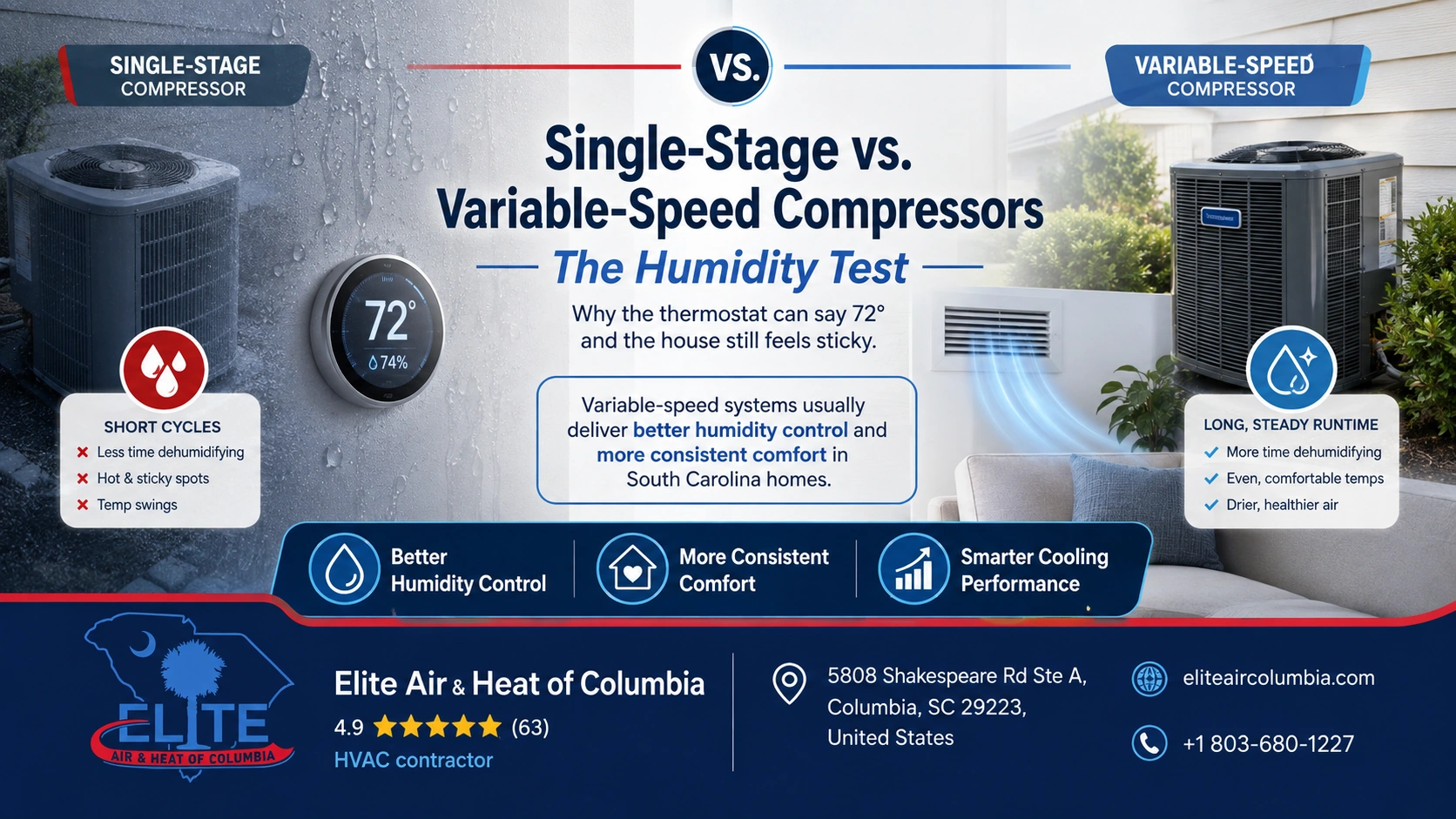
The thermostat says 72 degrees.
The AC is running.
Yet the house still feels sticky.
The air feels heavy.
You lower the thermostat again.
Nothing improves.
If that sounds familiar, the issue may not be temperature at all.
Still Fighting Indoor Humidity?
Upgrade to better moisture control and lasting comfort. Call now to explore your options.
It may be humidity.
And when it comes to controlling indoor humidity, one of the biggest differences between HVAC systems often comes down to the compressor.
Specifically:
Single-stage vs. variable-speed compressors.
Here’s the plain answer:
If humidity control is one of your biggest comfort concerns, variable-speed systems generally outperform single-stage systems by a significant margin.
That doesn’t automatically mean everyone needs a variable-speed system.
But understanding how each type of compressor handles humidity can help you avoid buying a system that solves the wrong problem.
The goal is not to buy the most expensive equipment.
The goal is to understand what creates comfort inside your home.
Why Humidity Matters More Than Most Homeowners Realize
Many people think comfort is determined by temperature alone.
It isn’t.
Humidity plays a major role in how your home feels.
For example:
- 72 degrees with low humidity often feels comfortable.
- 72 degrees with high humidity can feel warm and sticky.
That’s because your body cools itself through evaporation.
When indoor humidity rises, sweat evaporates less effectively.
The air feels heavier.
Rooms feel muggy.
Comfort decreases even when the thermostat setting stays exactly the same.
In Columbia’s climate, comfort is not just about temperature.
It’s about temperature and moisture working together.
How Air Conditioners Remove Humidity
Before comparing compressor types, it helps to understand how humidity removal works.
Every air conditioner does two jobs:
- Removes heat
- Removes moisture
As warm indoor air passes across the cold evaporator coil, moisture condenses on the coil surface and drains away.
This process is called latent heat removal.
In simple terms:
The longer air moves across a cold coil, the more moisture the system can remove.
That’s where compressor design becomes important.
What Is a Single-Stage Compressor?
A single-stage compressor has one operating speed:
100% output.
When cooling is needed, the system turns on at full capacity.
When the thermostat is satisfied, it shuts off completely.
There is no middle ground.
Think of it like a light switch.
It’s either:
- On
- Off
Because the system always operates at maximum capacity, it cools the house relatively quickly.
At first, that sounds like a good thing.
But there can be a downside.
The Humidity Challenge With Single-Stage Systems
Air conditioners remove the most moisture after they’ve been running for a while.
The first few minutes of operation are largely spent cooling the coil and stabilizing system conditions.
When a single-stage system cools the house quickly, the thermostat may be satisfied before substantial moisture removal occurs.
The result:
- Temperature drops quickly
- Humidity remains elevated
Homeowners often describe this as:
- Sticky air
- Clammy rooms
- Damp-feeling comfort
The system technically cools the house.
But comfort may still suffer.
This is where homeowners sometimes get into trouble.
They assume the system isn’t large enough.
In reality, the issue may be that it cools too quickly.
What Is a Variable-Speed Compressor?
A variable-speed compressor operates very differently.
Instead of one speed, it can adjust output across a wide range.
Rather than running at 100% capacity all the time, it may operate at:
- 30%
- 45%
- 60%
- 75%
- 100%
depending on cooling demand.
Think of it like a vehicle.
A single-stage system is a car that only drives at highway speed.
A variable-speed system adjusts smoothly based on conditions.
This allows the system to run longer at lower capacity.
And that’s where humidity control improves dramatically.
Why Longer Run Times Matter
Many homeowners assume longer run times are inefficient.
In reality, controlled longer run times are often beneficial.
Because the evaporator coil stays cold longer, moisture removal becomes more effective.
Instead of blasting cold air for short periods, the system steadily removes heat and humidity over time.
The result is often:
- More stable temperatures
- Lower indoor humidity
- Improved comfort
- Fewer hot and cold spots
A home with lower humidity frequently feels cooler even when the thermostat setting remains unchanged.
The Real Humidity Test
Let’s compare two identical homes on a typical humid summer day.
Home A: Single-Stage Compressor
The temperature rises.
The thermostat calls for cooling.
The system starts at full capacity.
After a relatively short cycle:
- Temperature reaches setpoint
- System shuts off
Humidity removal occurs, but runtime is limited.
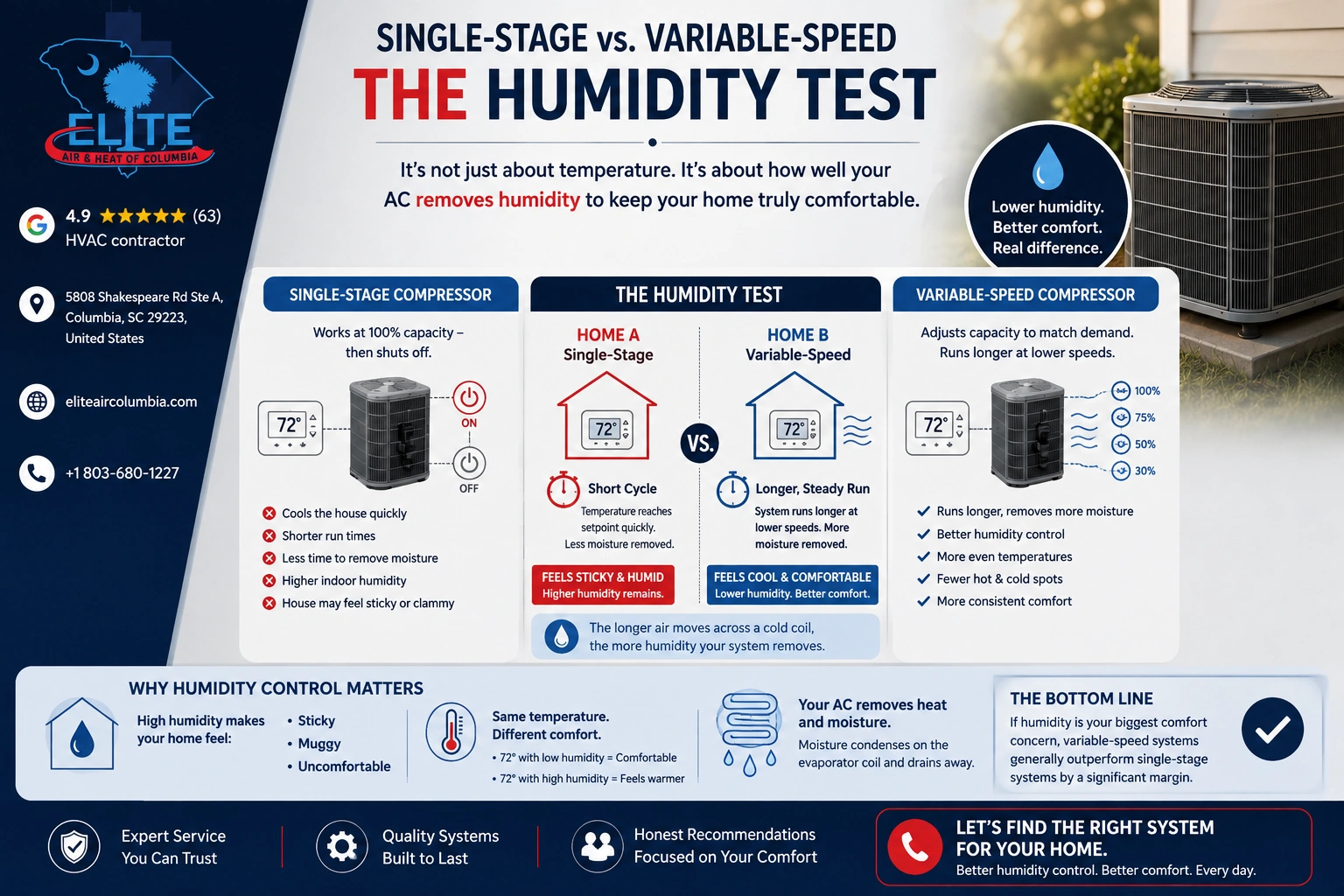
Indoor moisture levels often remain higher.
Home B: Variable-Speed Compressor
The temperature rises.
The system ramps up gradually.
Rather than immediately operating at maximum output, it adjusts capacity to match demand.
The system runs longer.
The evaporator coil remains cold longer.
More moisture is removed.
The house often feels:
- Drier
- More comfortable
- Less sticky
Even when both thermostats display the same temperature.
That’s the humidity test.
And it’s one of the biggest reasons homeowners notice a comfort difference after upgrading.

Winter Air Conditioning Check: A Little-Known Strategy for Year-Round Efficiency
Air conditioning might not be top of mind during winter, but that’s exactly why it’s the perfect time for a…
How Much Better Is Variable-Speed Humidity Control?
Every home is different.
However, properly installed variable-speed systems frequently maintain indoor humidity levels more consistently than single-stage equipment.
That consistency can make a significant difference during:
- Rainy periods
- High humidity days
- Mild but damp weather
- Shoulder seasons
Many homeowners report that they stop constantly adjusting the thermostat after switching to variable-speed equipment.
Not because the home is colder.
Because the home feels better.
Does This Mean Single-Stage Systems Are Bad?
Not at all.
Single-stage systems still serve many homeowners well.
They offer several advantages:
Lower Upfront Cost
Single-stage equipment is generally less expensive to purchase and install.
Simpler Design
Fewer advanced components can mean easier troubleshooting in some situations.
Reliable Cooling
A properly sized single-stage system can still cool a home effectively.
That does not automatically mean it’s the wrong choice.
The better question is whether humidity control is a major concern for your household.
When Variable-Speed Systems Make the Most Sense
Variable-speed equipment tends to provide the greatest value when:
Humidity Is a Frequent Complaint
If rooms constantly feel sticky, a variable-speed system may provide noticeable improvement.
Comfort Matters More Than Lowest Initial Cost
Some homeowners prioritize long-term comfort over minimum installation cost.
The Home Has Multiple Comfort Challenges
Variable-speed systems often help with:
- Uneven temperatures
- Hot spots
- Cold spots
- Airflow consistency
The Existing System Short Cycles
If the current system cools rapidly but leaves humidity behind, variable-speed operation can help address the root issue.
Why Oversized Systems Often Make Humidity Worse
Here’s a mistake many homeowners make.
They assume:
“If bigger cools faster, bigger must be better.”
Unfortunately, oversized systems often create humidity problems.
Because they satisfy the thermostat so quickly, runtime decreases.
Shorter cycles mean:
- Less moisture removal
- Higher indoor humidity
- Reduced comfort
This happens with both single-stage and variable-speed systems.
Proper sizing matters.
A good technician should perform load calculations rather than simply matching the old equipment size.
Bigger is not always better.
What a Good HVAC Contractor Should Evaluate
If humidity is a concern, the compressor is only part of the equation.
A thorough evaluation should also include:
- System sizing
- Duct design
- Airflow measurements
- Static pressure testing
- Insulation levels
- Air leakage
- Indoor humidity measurements
If the issue keeps coming back, replacing equipment blindly usually is not the answer.
A larger system, newer system, or more expensive system will not automatically solve humidity problems if other underlying issues remain.
Can Variable-Speed Systems Lower Utility Bills?
Often, yes.
Because they operate at reduced capacity much of the time, variable-speed systems can improve efficiency.
However, utility savings vary based on:
- Home size
- Usage patterns
- Existing equipment
- Insulation
- Local climate
The comfort improvement is usually more noticeable than the utility savings.
Many homeowners buy variable-speed equipment for humidity control and comfort rather than energy reduction alone.
The Better Question Isn’t “Which Compressor Is Best?”
It’s:
“What problem am I trying to solve?”
If your current system cools effectively and humidity isn’t a concern, a single-stage system may be perfectly adequate.
If your biggest complaint is:
- Sticky air
- Uneven comfort
- Constant thermostat adjustments
- High indoor humidity
then variable-speed technology deserves serious consideration.
The right answer depends on the home, the equipment, and your comfort priorities.
Before You Compare Price Tags, Compare Comfort
When homeowners shop for HVAC systems, it’s easy to focus entirely on installation cost.
But two systems that produce the same temperature can create completely different comfort experiences.
Humidity control is often the difference.
A lower-cost single-stage system may cool the home successfully.
A variable-speed system may create a more comfortable indoor environment by removing moisture more effectively throughout the day.
Choose the System That Solves the Problem You’re Actually Experiencing
If your home feels humid even when the thermostat says everything is fine, the issue may not be temperature at all.
Understanding how compressor technology affects moisture removal can help you make a much smarter HVAC decision.
Elite Air & Heat of Columbia helps homeowners compare single-stage, two-stage, and variable-speed systems based on real-world comfort, humidity control, energy performance, and long-term value so you can choose equipment that actually addresses the problems you’re experiencing not just the number on the thermostat.
Your Compressor Could Be the Problem
Get the right system for better humidity control and comfort. Call today for professional service.