
In Columbia, SC, humidity is not just an outdoor problem. It can follow you inside, settle into basements and crawlspace-adjacent areas, and make an otherwise comfortable home feel damp, sticky, and harder to cool.
At Elite Air & Heat Columbia, we regularly see homeowners focus on temperature when the real comfort problem is moisture.
You can set your thermostat to 72°F and still feel uncomfortable if the indoor humidity is too high.
That is where a whole-home dehumidifier can make a noticeable difference.
But how much does whole-home dehumidification cost? And does a Columbia home really need it?
The answer depends on your home’s size, moisture levels, HVAC setup, drainage options, and whether you have a basement or another lower-level space that tends to hold humidity.
Why Humidity Is Such a Problem in Columbia, SC
Columbia has a warm, humid climate for a large portion of the year.
When hot outdoor air contains large amounts of moisture, that humidity can enter a home through open doors, air leaks, duct leakage, basement walls, crawlspaces, and everyday activities such as cooking and showering.
Air conditioners remove some moisture while they cool, but they are not always able to control humidity on their own.
This becomes especially noticeable during:
- Mild but humid weather
- Rainy periods
- Overnight hours
- Spring and fall
- Days when the AC does not run for long periods
- Homes with oversized cooling systems
- Houses with basement or crawlspace moisture issues
If your AC reaches the thermostat setting quickly, it may shut off before it has had enough runtime to remove sufficient moisture.
The result can be a home that is technically cool but still feels clammy.
Why Basements Can Be Especially Humid
Basements naturally tend to be cooler than the floors above them.
That can create a moisture problem.
Warm, humid air can move into the basement and encounter cooler walls, floors, ductwork, pipes, and other surfaces. As the air cools, its relative humidity rises.
This means a basement can feel damp even when there is no visible water leak.
Other moisture sources can make the problem worse, including:
Ground Moisture
Concrete and masonry are not completely moisture-proof.
Depending on the home’s construction and waterproofing, moisture from the surrounding soil can migrate through basement walls or floors.
Foundation Cracks
Even small foundation issues can allow water or moisture to enter during heavy rain.
Poor Drainage
Improper grading, clogged gutters, short downspouts, or groundwater problems can increase moisture around the foundation.
HVAC Ductwork
If ducts run through humid areas and are poorly sealed or insulated, condensation and moisture problems can develop.
Air Leakage
Humid outdoor air can enter through gaps around windows, doors, rim joists, utility penetrations, and other openings.
Once humidity becomes trapped in a cooler basement environment, it may remain elevated for long periods.
What Is a Whole-Home Dehumidifier?
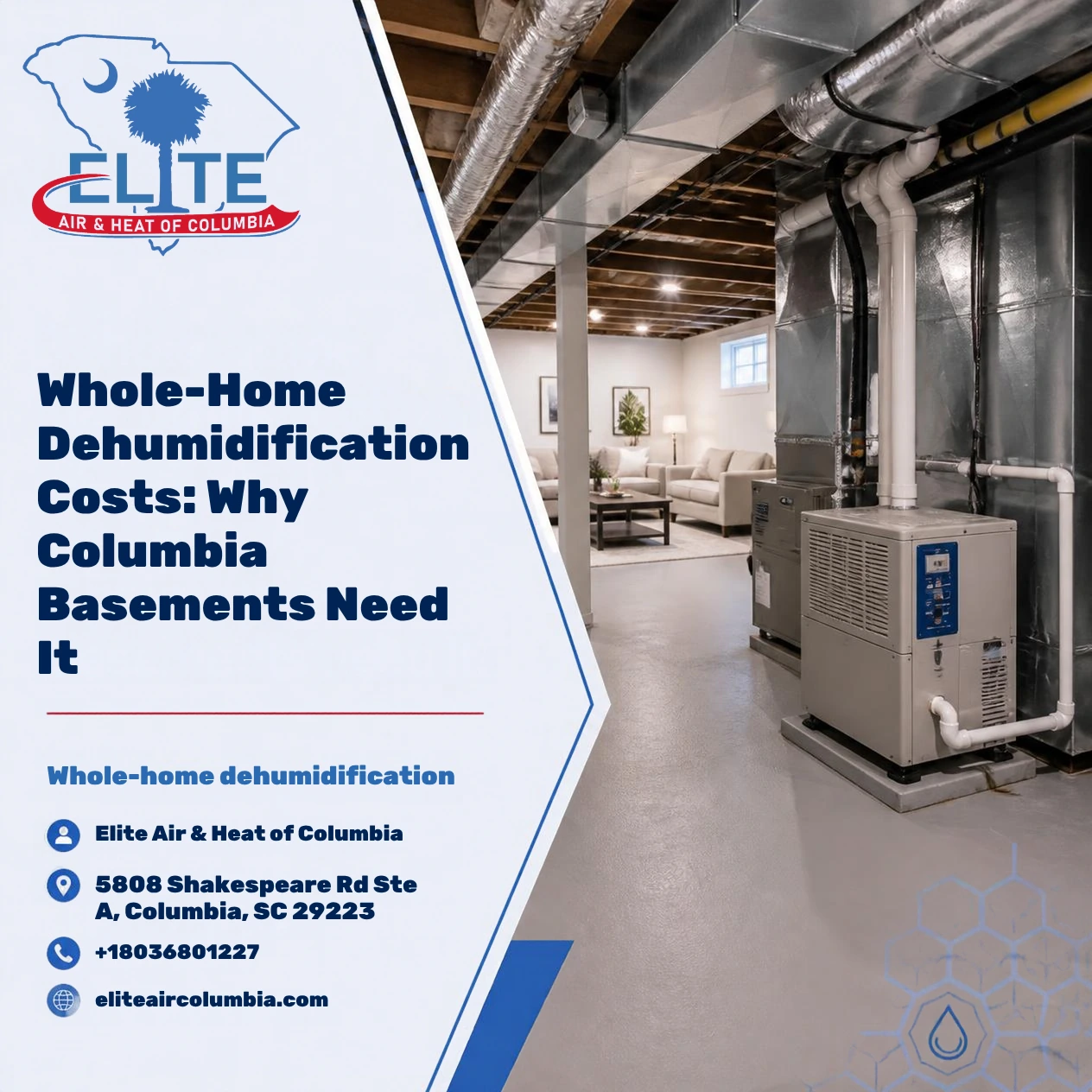
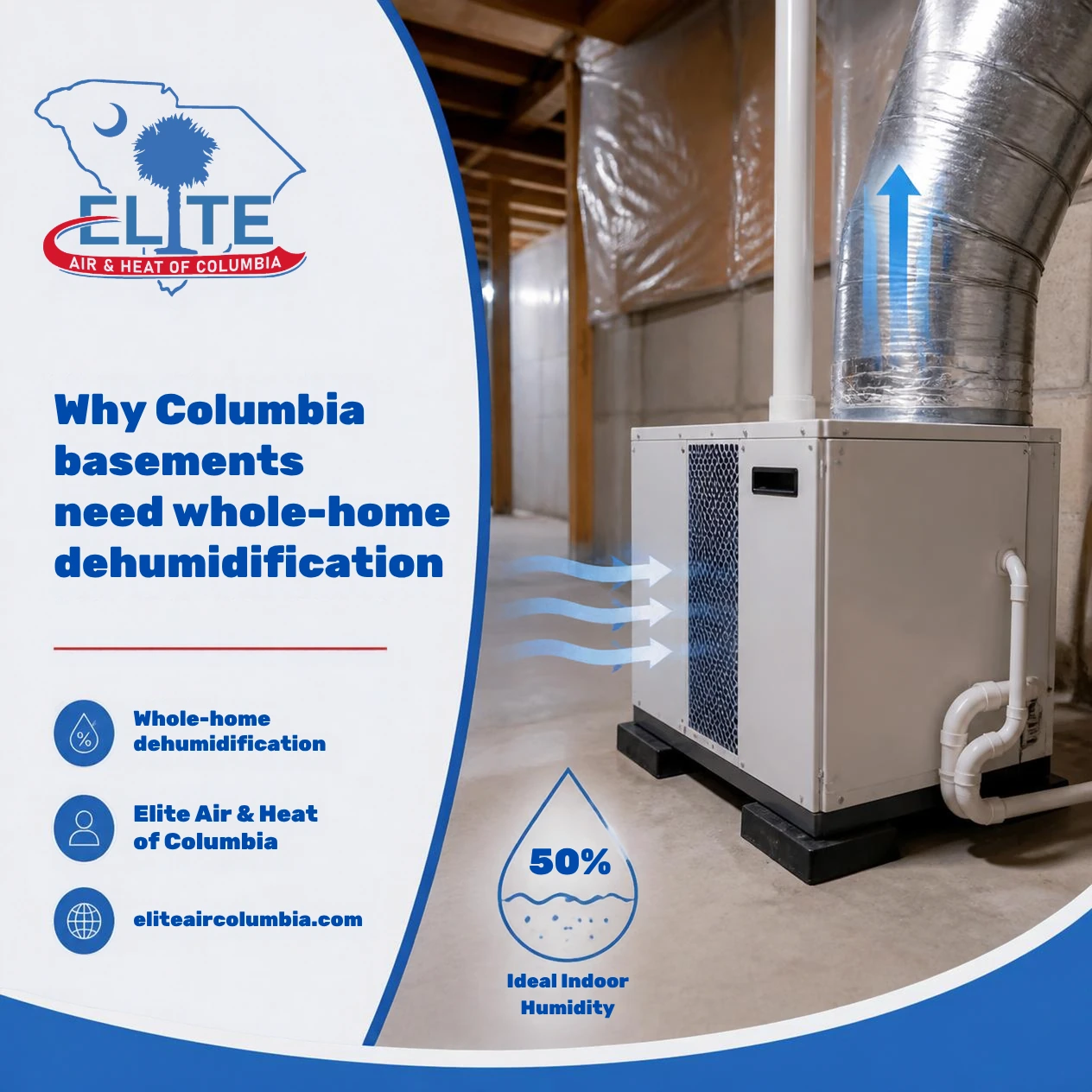
A whole-home dehumidifier is designed to remove excess moisture from the air throughout a larger portion of the house.
Unlike a small portable dehumidifier sitting in one room, a whole-home system can often be integrated with the home’s HVAC system or installed with dedicated ductwork.
The unit pulls humid air across a cold coil.
Moisture condenses out of the air and drains away while the drier air is returned to the home.
The system monitors humidity rather than simply temperature.
If indoor humidity rises above your chosen level, the dehumidifier can operate even when the air conditioner does not need to run.
That independent humidity control is one of its biggest advantages.
How Much Does Whole-Home Dehumidification Cost?
There is no single installed price for every Columbia home.
Whole-home dehumidifier costs vary depending on several factors:
- Equipment capacity
- Home square footage
- HVAC configuration
- Installation complexity
- Duct modifications
- Drainage requirements
- Electrical work
- Installation location
- Controls and accessories
- Whether dedicated return or supply ducting is needed
A simpler installation may cost significantly less than one requiring extensive ductwork or modifications.
Instead of focusing only on the equipment price, we recommend looking at the complete installed system.
The best dehumidifier in the world will not perform correctly if it is undersized, installed poorly, or connected to an inadequate drainage setup.
Why Portable Dehumidifiers Are Not Always Enough
Portable dehumidifiers can absolutely help with isolated moisture problems.
If one basement room becomes damp occasionally, a portable unit may be enough.
But portable units have limitations.
They generally treat only the immediate area around them. Doors, walls, airflow patterns, and floorplans can make it difficult for one small unit to control humidity throughout an entire basement or home.
They also require homeowners to deal with water collection unless the unit is connected to continuous drainage.
Whole-home systems are designed for a more permanent approach.
They can provide broader humidity control without requiring someone to constantly empty a reservoir or move equipment from room to room.
What Humidity Level Should Your Home Have?
Many homeowners are comfortable when indoor relative humidity stays somewhere around 40% to 55%, although the ideal target depends on the season and individual comfort preferences.
Once indoor humidity remains around 60% or higher for extended periods, moisture-related problems become more likely.
You may begin noticing:
- Musty smells
- Condensation
- Damp surfaces
- Sticky indoor air
- Increased mold concerns
- Swelling wood
- Warped flooring
- Difficulty maintaining comfort
- Increased dust mite activity
A hygrometer is an inexpensive way to see what is actually happening inside your home.
We often recommend measuring humidity before assuming that temperature alone is causing a comfort problem.
The Hidden Cost of Excess Humidity
When homeowners ask us about dehumidifier costs, it is worth comparing the installation cost with the potential cost of ignoring chronic moisture.
High humidity can affect far more than comfort.
Mold and Mildew
Persistent moisture creates conditions where mold and mildew can become a concern.
Once mold develops behind walls, under flooring, around ductwork, or inside stored belongings, remediation can become expensive.
Wood Damage
Wood absorbs moisture.
High humidity can contribute to swelling, warping, and deterioration in flooring, trim, doors, furniture, structural materials, and stored items.
Odors
That familiar basement smell often has more to do with moisture than age.
Reducing humidity can help eliminate the conditions that allow musty odors to persist.
HVAC Workload
Many people respond to high humidity by lowering the thermostat.
If 74°F feels uncomfortable, they try 72°F.
Then 70°F.
The temperature keeps dropping because they are trying to solve a humidity problem with additional cooling.
That can increase energy consumption without fully addressing the actual issue.
Can a Dehumidifier Lower Your Cooling Costs?
Potentially.
It depends on how you use your HVAC system.
Dry air often feels more comfortable than humid air at the same temperature.
If improved humidity control allows you to keep your thermostat slightly higher while remaining comfortable, your air conditioner may run less.
That does not mean every homeowner will automatically see dramatic electricity savings.
A whole-home dehumidifier consumes electricity too.
The benefit is that you are separating temperature control from humidity control instead of relying entirely on your air conditioner to perform both jobs.
For Columbia homeowners who regularly lower their thermostat because the house feels sticky, that distinction can be important.
Do All Columbia Homes Need Whole-Home Dehumidification?
No.
We do not believe in recommending equipment simply because it exists.
Some homes already maintain excellent indoor humidity through proper HVAC sizing, air sealing, insulation, ventilation, and drainage.
Others need additional moisture control.
A whole-home dehumidifier tends to make more sense when homeowners experience persistent humidity despite having a properly functioning air conditioning system.
It may also be worth considering if you have:
- A consistently damp basement
- A musty lower level
- Indoor humidity frequently above 60%
- Condensation problems
- A tightly sealed home with humidity issues
- An oversized air conditioner that short-cycles
- Significant indoor comfort problems during humid but mild weather
- Valuable belongings stored in a basement
- Finished basement living areas
The goal should always be to identify why the humidity is high before deciding how to correct it.
Dehumidification Does Not Replace Waterproofing
This is an important distinction.
A dehumidifier controls moisture in the air.
It does not fix water entering through a foundation.
If your basement experiences standing water, active leaks, wet foundation walls, drainage failures, or flooding, those issues need to be addressed directly.
Installing a larger dehumidifier while ignoring water intrusion is not a complete solution.
Sometimes the correct approach includes a combination of:
- Improving exterior drainage
- Repairing foundation leaks
- Air sealing
- Correcting duct problems
- Improving HVAC performance
- Adding whole-home dehumidification
At Elite Air & Heat Columbia, our role is to determine whether your HVAC and indoor air system is contributing to the moisture problem and whether mechanical dehumidification makes sense.
HVAC Sizing Matters More Than You Might Expect
One of the most common misconceptions in air conditioning is that bigger equipment is always better.
It isn’t.
An oversized system can cool a home very quickly.
That sounds great until you consider humidity.
Air conditioners remove moisture while operating. If an oversized AC reaches the thermostat setting too quickly, it shuts down.
Those short cycles may not provide enough time for proper moisture removal.
You end up with a cold, humid house.
Correct equipment sizing helps balance both temperature and moisture control.
This is why we look at the entire comfort system rather than simply replacing equipment with the largest unit available.
Whole-Home Dehumidifier vs. Higher-Efficiency HVAC
Another question homeowners ask is whether they should invest in a high-efficiency variable-speed HVAC system or install a dedicated dehumidifier.
There is no universal answer.
Variable-speed HVAC equipment can provide excellent humidity control because it can run for longer periods at lower speeds.
But even advanced HVAC systems may have limitations during periods when cooling demand is low and humidity remains high.
A dedicated dehumidifier can operate independently from the cooling system.
For some Columbia homes, combining variable-speed HVAC equipment with dedicated humidity control provides excellent results.
For others, upgrading the AC alone may solve the problem.
And in some cases, a properly installed whole-home dehumidifier may be the most cost-effective option.
Is Whole-Home Dehumidification Worth the Cost?
For a home with persistent humidity problems, it certainly can be.
Think about what you are protecting.
Your flooring.
Your furniture.
Your basement finishes.
Your stored belongings.
Your indoor comfort.
Your HVAC equipment.
And potentially the long-term condition of moisture-sensitive areas throughout the house.
If your indoor humidity is already well controlled, there may be little reason to add another piece of equipment.
But if you are constantly fighting damp air, musty odors, condensation, and uncomfortable rooms, ignoring humidity may cost more over time than addressing it.
Let Elite Air & Heat Columbia Evaluate Your Humidity Problem
At Elite Air & Heat Columbia, we know that indoor comfort is about more than the thermostat.
Temperature, humidity, airflow, insulation, ductwork, equipment sizing, and ventilation all work together.
If your Columbia home or basement constantly feels damp, we can help determine whether the problem is coming from your HVAC system, excessive indoor moisture, poor airflow, or another source.
From there, we can determine whether a whole-home dehumidifier makes sense and recommend a system that is properly sized for your home.
Dealing with excessive humidity, a damp basement, or a home that never feels comfortable? Contact Elite Air & Heat Columbia to have your indoor humidity and HVAC system evaluated and find the right moisture-control solution for your home.