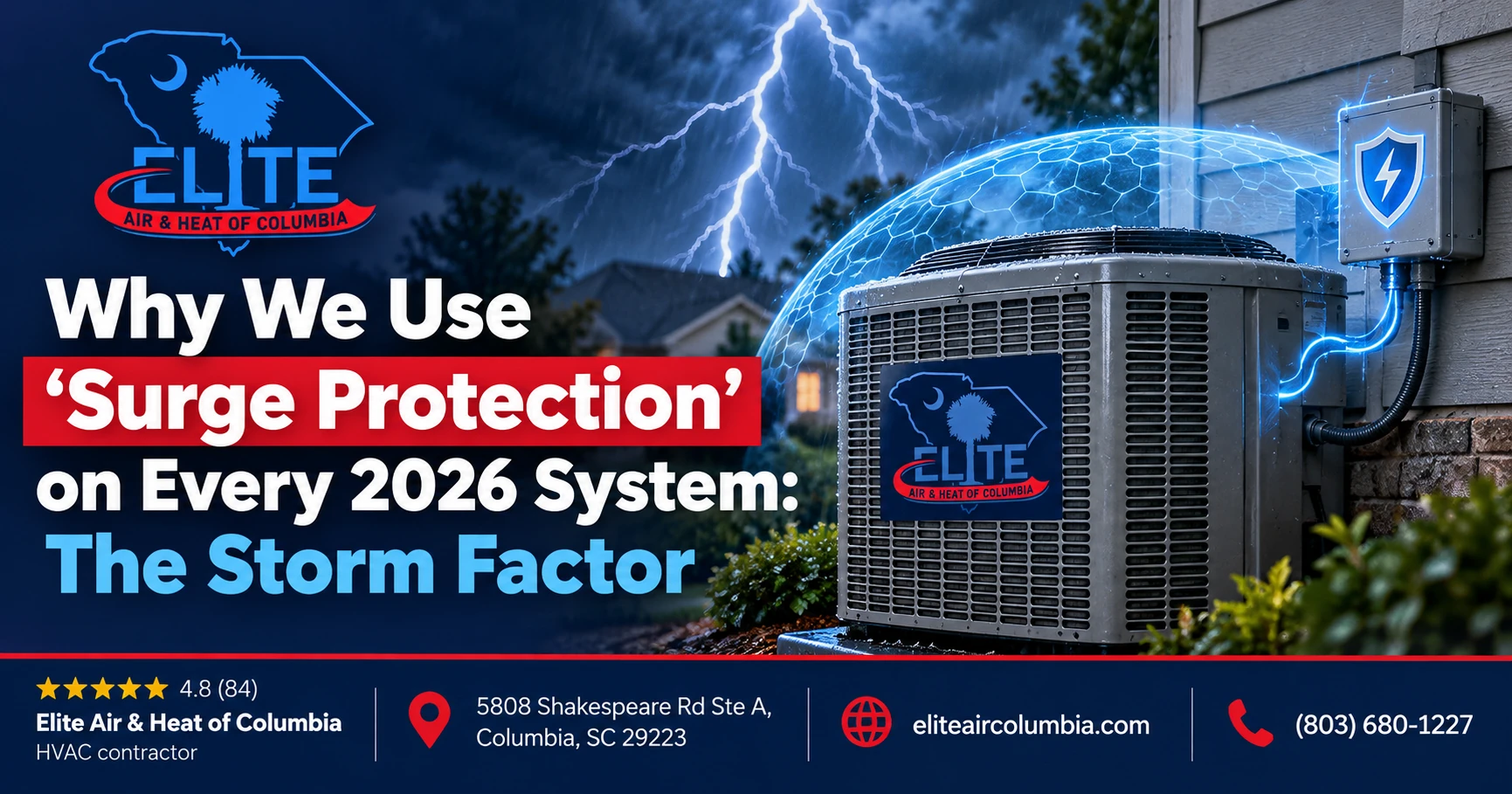

A new HVAC system in 2026 contains far more electronics than the air conditioners many Columbia homeowners grew up with. Variable-speed compressors, inverter drives, communicating thermostats, electronic control boards, sensors, and advanced blower motors can make today’s systems quieter and more efficient. They also give us more valuable electronic components to protect when South Carolina’s storm season arrives.
That is why at Elite Air & Heat of Columbia, we consider surge protection an important part of protecting a new 2026 HVAC investment.
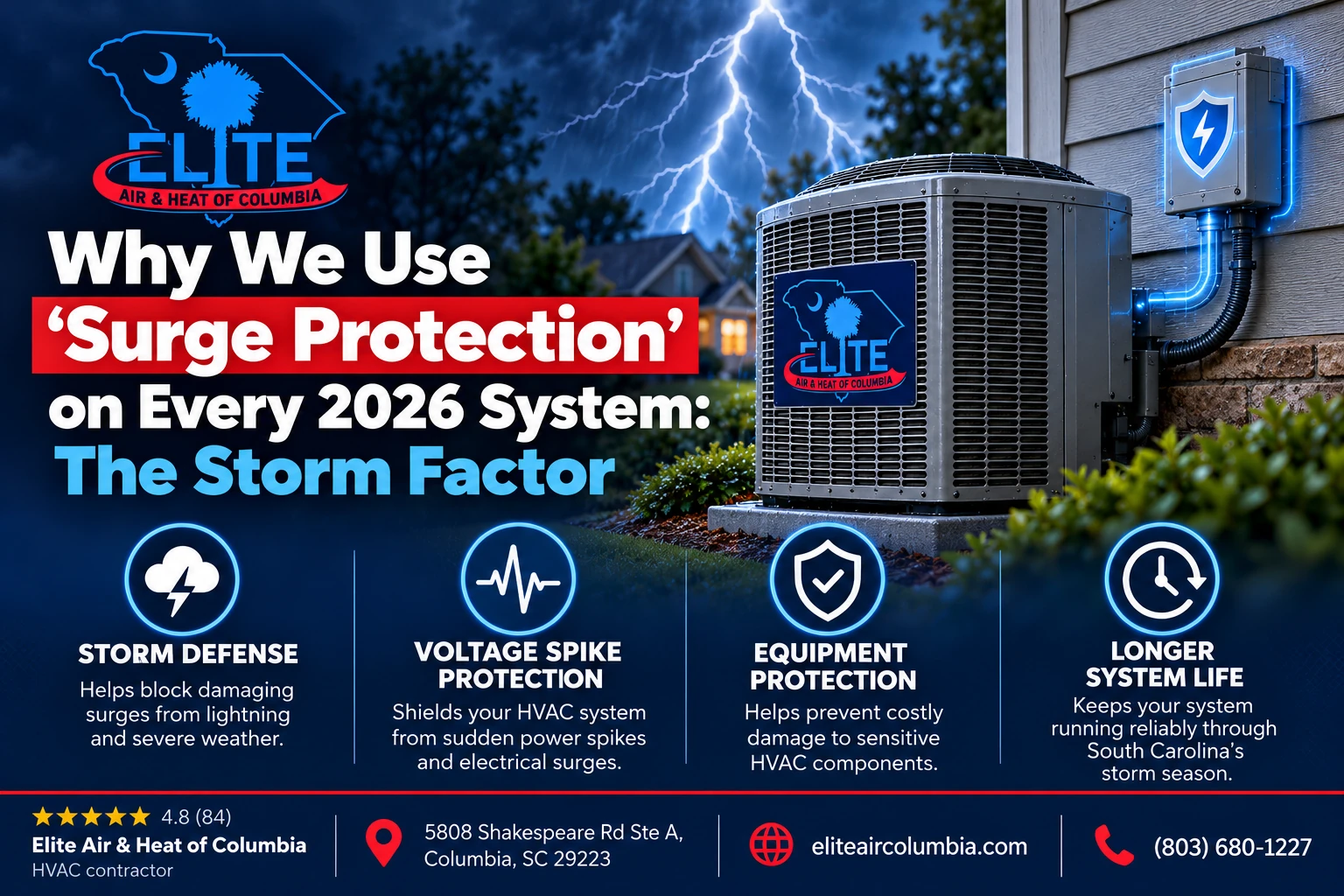
South Carolina experiences roughly 40 to 50 thunderstorm days each year, according to the National Weather Service. Lightning is one obvious concern, but HVAC-damaging voltage disturbances can also occur when utility power flickers, comes back after an outage, or electrical equipment switches on and off.
A surge protector cannot make an air conditioner immune to every lightning strike or electrical event. What it can do is provide another layer of protection between abnormal voltage and some of the most expensive electronics in your heating and cooling system.
Here is why we take that protection seriously on the systems we install in 2026.
Protect Your HVAC System Before the Next Storm!
Power surges can damage expensive equipment. Call now for professional surge protection installation!
Why Modern HVAC Systems Need More Electrical Protection
Air conditioners have always required electricity.
What has changed is how much electronic control is built into the equipment.
Older basic HVAC systems relied heavily on relatively simple electromechanical components.
Today’s higher-efficiency systems may contain:
- Electronic control boards
- Variable-speed blower controls
- Inverter compressor electronics
- Communicating controls
- Electronic expansion controls
- Pressure and temperature sensors
- Smart thermostats
- Indoor and outdoor control modules
Elite’s own HVAC component guidance describes the circuit board as the control center coordinating components such as the compressor, blower, fans, and safety systems.
When everything works correctly, these electronics allow the HVAC system to operate with far greater precision.
But electronic controls do not benefit from being exposed to abnormal voltage.
That is why protecting a $10,000, $15,000, or higher HVAC investment with surge protection makes much more sense to us than treating the electrical side of the installation as an afterthought.
What Exactly Is a Power Surge?
A power surge is a temporary increase in electrical voltage.
Some surges are dramatic.
Others happen so quickly that you may never notice them.
Homeowners commonly associate surges with lightning, but the National Institute of Standards and Technology notes that electrical systems can experience surges from multiple sources, including lightning and switching events.
Potential causes include:
- Lightning activity
- Utility switching
- Power interruptions
- Electricity being restored after an outage
- Electrical equipment switching
- Problems elsewhere in the electrical distribution system
That means you do not necessarily need to see lightning hit the transformer outside your house for electrical equipment to experience a voltage disturbance.
Your lights may simply flicker.
The television may briefly turn off.
The clocks may reset.
Meanwhile, the HVAC system outside is connected directly to the home’s electrical supply.
Why Columbia’s Storm Season Changes the Equation
We do not install HVAC systems in a laboratory.
We install them in South Carolina.
The National Weather Service says thunderstorms can occur in South Carolina throughout the year, although they are most frequent during spring and summer. The state averages approximately 40 to 50 thunderstorm days annually.
Those are also months when your air conditioner may be running the hardest.
That combination matters.
A July thunderstorm can bring:
- Lightning
- Strong wind
- Falling branches
- Heavy rain
- Brief outages
- Flickering utility power
- Rapid power restoration
Your outdoor condenser may already have been operating continuously when the electrical disturbance happens.
This is one reason our storm preparation advice for Columbia homeowners includes paying attention not only to physical debris and flooding but also to electrical surge damage.
What Can a Surge Damage Inside an HVAC System?
The exact damage depends on the equipment and the electrical event.
Potentially affected components can include:
Control Boards
Circuit boards tell different parts of the HVAC system when and how to operate.
If a board fails, the equipment may stop completely or begin behaving unpredictably.
You might see:
- No cooling
- No heating
- Fan problems
- Communication errors
- Intermittent operation
- Error codes
Replacing electronic controls can be considerably more involved than replacing a simple fuse.
Inverter Electronics
Variable-capacity HVAC systems frequently use inverter technology to change compressor speed.
That is one of the features that makes modern equipment so effective at matching output to the home’s cooling demand.
The same technology involves sophisticated power electronics.
Protecting that investment is particularly important because inverter assemblies and variable-speed components can be expensive compared with the basic contactors and capacitors found in simpler systems.
Thermostats and Communicating Controls
Modern thermostats may communicate continuously with indoor and outdoor equipment.
A problem with one control component can potentially affect the operation of the entire system.
Motors and Motor Controls
Variable-speed and electronically commutated motors use electronic controls to regulate operation.
Those components can also be affected by electrical problems.
This does not mean every voltage surge destroys all of these parts.
It means today’s HVAC system has more electronically controlled components worth protecting.
Isn’t the Circuit Breaker Supposed to Protect the AC?
This is one of the most common misunderstandings we hear.
A circuit breaker and a surge protector have different jobs.
Your breaker is primarily designed to protect the electrical circuit against excessive current, such as conditions associated with overloads or short circuits.
A surge protective device is designed to limit transient voltage reaching connected equipment.
That difference matters because a damaging surge can happen extremely quickly.
The breaker may never trip.
That is why plugging a new HVAC system into a properly sized circuit does not provide the same protection as installing a surge protective device.
You want both systems doing the jobs they were designed to do.
How Does an HVAC Surge Protector Work?
In simplified terms, a surge protective device reacts when voltage rises above an acceptable level.
It provides a path for excess surge energy and limits the voltage passed downstream toward the protected equipment.
NIST describes surge protectors in terms of their ability to limit voltage and handle surge current, with characteristics such as clamping voltage and maximum surge current helping describe their performance.
The process happens extremely quickly.
You usually will not know the protector did anything.
The AC simply continues operating.
That quiet operation is exactly the point.
A surge protector is not supposed to make the storm more noticeable. It is supposed to help keep abnormal electrical energy from reaching sensitive components at full strength.
Is an HVAC Surge Protector the Same as a Power Strip?
No.
You would not plug an outdoor air conditioner into the same type of surge strip used behind a television.
HVAC surge protective devices are designed for permanently connected heating and cooling equipment and must be correctly matched and installed.
Trane specifically recommends using surge protection designed for HVAC applications and notes that these devices need to withstand conditions such as repeated surges, outdoor temperature extremes, and humidity.
That environmental factor is important in Columbia.
The surge protector installed beside an outdoor heat pump may spend years exposed to:
- Summer heat
- Humidity
- Rain
- Winter temperatures
- Pollen
- Outdoor contaminants
The protection itself needs to be appropriate for that environment.
Why Whole-Home Surge Protection May Not Be the Whole Story
Some homes already have surge protection installed at the main electrical panel.
That is a good thing.
In fact, the National Electrical Code has increasingly incorporated service-level surge protection into residential electrical safety requirements. The 2020 NEC introduced a requirement for Type 1 or Type 2 surge protection at services supplying dwelling units.
But protection is best thought about in layers.
A service-level device can help reduce surges entering through the home’s electrical system.
Dedicated protection at expensive equipment provides another point of defense closer to the HVAC components themselves.
NIST has studied the way multiple surge protective devices interact within electrical systems, illustrating why surge mitigation is more complicated than simply assuming one device makes every connected appliance invulnerable.
Whether a home needs both approaches should be evaluated based on the electrical system and equipment.
But when we are installing sophisticated new HVAC equipment, we do not want electrical protection to be an afterthought.
Does Surge Protection Stop a Direct Lightning Strike?
No surge protector should be marketed as a magic shield against every possible lightning event.
A direct or extremely severe lightning strike can involve enormous energy.
NIST research into direct lightning events shows that surge protective devices can themselves become overwhelmed under extreme conditions.
That means surge protection is about risk reduction, not a guarantee.
Think about a seat belt.
Wearing one significantly improves protection, but nobody would claim it makes every possible collision harmless.
We take a similar view of HVAC surge protection.
The fact that no device can stop every conceivable electrical event is not an argument for leaving expensive electronics completely exposed.
What About Smaller Surges You Never Notice?
These may actually be more relevant to everyday equipment protection than homeowners realize.
Not every electrical disturbance produces a dramatic lightning flash.
Small transient surges can occur because of switching events within an electrical system.
NIST’s surge-protection guidance discusses both lightning-related and switching-related transients as part of the residential electrical environment.
A homeowner may never know a minor event occurred.
The concern is that electronics can potentially be damaged immediately or stressed over time depending on the event and the equipment involved.
This is why we do not look at surge protection solely as something for major thunderstorms.
Storms make the risk easier to understand.
They are not the only reason electrical protection matters.
Why Variable-Speed HVAC Makes Surge Protection More Important to Us
Variable-speed HVAC is one of the biggest developments in residential comfort.
Instead of running at 100% capacity every time the thermostat calls, these systems can adjust output.
That can help provide:
- Better humidity management
- Quieter operation
- More consistent temperatures
- Longer low-capacity cycles
- Improved part-load efficiency
But that capability requires electronics.
The outdoor unit may include an inverter that converts and controls electrical power so the compressor can operate at different speeds.
The blower may use electronic speed controls.
Indoor and outdoor boards may communicate continuously.
When we install equipment with this level of sophistication, adding surge protection is simply a logical part of thinking about the entire system rather than just the compressor and coil.
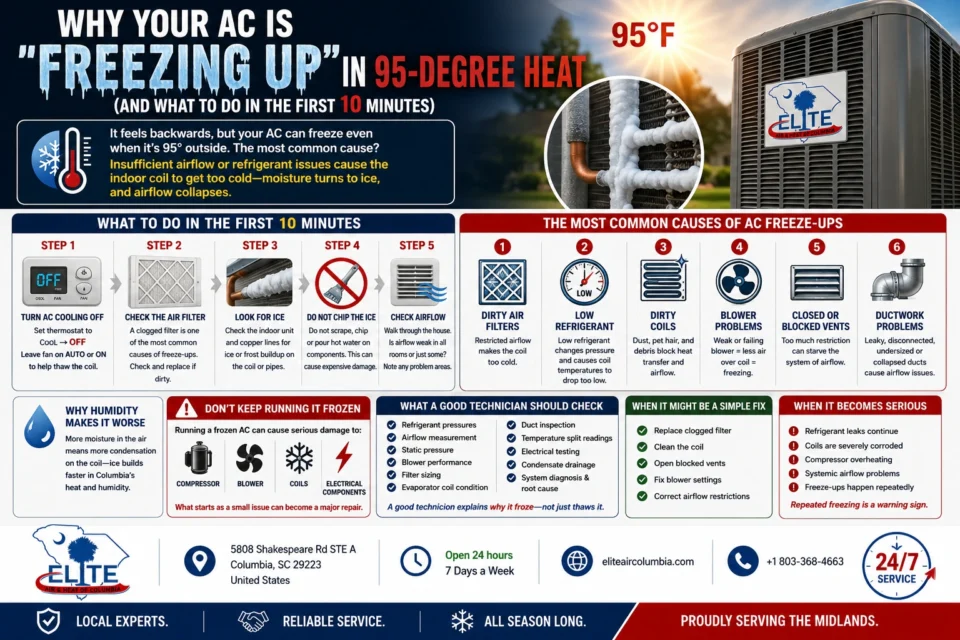
Why Your AC Is “Freezing Up” in 95-Degree Heat (And What to Do in the First 10 Minutes)
It feels backwards, but one of the most common summer AC problems in Columbia is an air conditioner literally freezing…
Why Turning Off the AC Before a Major Storm Still Matters
Installing surge protection does not mean homeowners should completely ignore severe-weather precautions.
If a significant storm is approaching and it is safe to do so, shutting HVAC equipment down can provide additional protection.
Trane recommends turning off power to the outdoor system during major storm conditions when appropriate because a surge may exceed what a protective device can safely handle.
Safety comes first.
Do not go outside in lightning to shut down equipment.
Do not work inside an electrical panel unless you know exactly what you are doing.
If you have advance warning of severe weather, the thermostat can generally be turned off before the storm arrives.
Homeowners may also choose to pre-cool the house before a forecast outage or severe storm, then turn the system off while the worst weather moves through.
What Should You Do After the Power Comes Back On?
One common mistake is repeatedly forcing an HVAC system to restart immediately after an electrical interruption.
Modern thermostats and HVAC controls often include built-in restart delays.
Let those protections work.
After utility power is restored:
- Check whether the rest of the house has stable power.
- Give the HVAC system time to complete any built-in restart delay.
- Listen for unusual buzzing or humming.
- Confirm that the outdoor fan starts normally.
- Check whether conditioned air returns from the vents.
- Look for error messages at the thermostat.
Call for service if the system:
- Does not restart
- Trips a breaker
- Makes an unusual electrical noise
- Produces a burning smell
- Starts but does not cool
- Shows a fault code
- Repeatedly turns on and off
Elite provides 24/7 HVAC service for Columbia and surrounding communities when storm-related problems cannot wait.
Can You Tell If a Surge Protector Has Been Used Up?
Surge protectors are not necessarily lifetime devices.
Depending on the design, repeated surge events or one severe event can degrade the protective components.
Many devices have indicator lights that show whether protection is still active.
NIST has specifically discussed the importance of clear status indication because a surge protective device can potentially fail while connected equipment continues receiving power.
In other words:
Power on does not necessarily mean protection on.
That is why surge protection should be visually checked during routine HVAC maintenance.
If the device indicates that its protection is no longer active, it may need replacement.
Surge Protection Does Not Replace Proper Grounding
Another important distinction is grounding.
A surge protective device needs a properly installed electrical system around it.
It is not a substitute for:
- Correct grounding
- Proper bonding
- Correct breaker sizing
- Sound wiring
- Tight electrical connections
- Code-compliant installation
NIST’s residential surge guidance emphasizes the relationship between surge protection and appropriate grounding practices.
If a home’s electrical system has an underlying problem, adding an HVAC surge protector does not magically correct it.
That is why electrical concerns discovered during installation may need to be addressed separately.
Why We Think About Surge Protection During Installation, Not After the First Storm
The best time to protect a new HVAC system is when it is installed.
Waiting until a control board fails during a thunderstorm defeats the purpose.
When we replace a system, we already have technicians working with:
- Electrical connections
- Disconnects
- Indoor controls
- Outdoor equipment
- System commissioning
That gives us an opportunity to think about electrical protection as part of the installation itself.
For 2026 equipment, especially inverter-driven and variable-speed systems, that approach makes sense to us.
You are already investing in technology designed to improve efficiency and comfort.
Protecting the electronics behind those features should be part of protecting that investment.
Isn’t This Just Another HVAC Add-On?
Homeowners are right to question add-ons.
Not every accessory belongs on every house.
That is why we think contractors should be able to explain what an accessory actually does instead of simply putting it on an invoice.
Surge protection has a straightforward purpose:
It helps limit abnormal transient voltage before that electrical energy reaches sensitive HVAC components.
It does not:
- Make the AC more efficient
- Lower indoor humidity
- Fix bad ductwork
- Prevent mechanical compressor wear
- Guarantee protection from a direct lightning strike
- Eliminate every possible electrical failure
It addresses one particular risk.
In South Carolina, with dozens of thunderstorm days in a typical year and increasingly electronic HVAC equipment, we believe that risk deserves attention.
Is Surge Protection Worth It on a Basic HVAC System?
We still see value in it.
A single-stage system may contain fewer sophisticated electronics than a top-of-the-line communicating inverter system, but it still has electrical components.
Depending on the system, these may include:
- Control boards
- Contactors
- Capacitors
- Motors
- Thermostat electronics
- Furnace or air-handler boards
The potential financial exposure grows as the equipment becomes more advanced, but electrical disturbances are not exclusive to premium systems.
That is why we prefer treating surge protection as a normal part of protecting new equipment rather than reserving it only for the most expensive model.
The Storm May Pass in 30 Minutes. The Damage Can Last Much Longer.
A typical Midlands summer storm can move through quickly.
Your house loses power.
The lights flicker.
Rain pounds the roof for half an hour.
Then the sky clears and everything seems normal.
Until the AC does not come back on.
That is the part homeowners remember.
An electrical problem after a storm can mean replacing a relatively simple component, but it can also mean diagnosing a control board, variable-speed motor, inverter assembly, or other electronic part.
And during a major heat wave, you may not be the only homeowner calling for help.
This is why prevention has value beyond the price of a repair.
It can also reduce the chance of losing cooling when Columbia weather is least forgiving.
Why Elite Uses Surge Protection on 2026 HVAC Systems
The HVAC industry is moving toward more electronic equipment.
South Carolina is not moving away from thunderstorms.
Those two facts are enough for us to take electrical protection seriously.
At Elite Air & Heat of Columbia, we view surge protection as part of installing a modern system responsibly, especially as variable-speed, inverter-driven, and communicating HVAC equipment becomes more common.
Our goal is not to tell homeowners that a surge protector can stop every lightning strike.
It cannot.
Our goal is to reduce an avoidable risk to expensive equipment.
For us, that makes surge protection a sensible part of a 2026 installation.
Protect Your New HVAC Investment Before the Next Midlands Storm
If you are replacing your air conditioner, heat pump, or complete HVAC system in Columbia, ask how the equipment will be protected electrically.
Do not wait until the first summer storm to think about it.
At Elite Air & Heat of Columbia, we install and replace HVAC systems throughout Columbia and the surrounding Midlands, and we take the electrical side of modern equipment seriously. Our team can explain the system’s controls, electrical requirements, surge-protection options, and other installation details before the new equipment starts its first cooling cycle.
Already have a newer system without dedicated surge protection? We can also evaluate the existing installation and determine what options make sense.
Call Elite Air & Heat of Columbia at (803) 368-4663 or schedule service online. Protecting a modern HVAC system is about more than changing filters and cleaning coils. In the Midlands, preparing for what comes through the power lines during storm season belongs on the list, too.
Don't Let a Power Surge Ruin Your System!
Keep your HVAC system protected during storms. Schedule professional surge protection today!