


If you live in Columbia, choosing a smart thermostat based only on Wi-Fi features misses one of the biggest comfort issues in the Midlands: humidity.
A house can be 72°F and still feel sticky when indoor humidity is too high. That is why, at Elite Air & Heat of Columbia, we look beyond whether a thermostat lets you change the temperature from your phone. We want to know how well it works with the actual HVAC system, whether it can respond intelligently to humidity, how much control it gives the homeowner, and whether spending another $50 or $100 actually buys something useful.
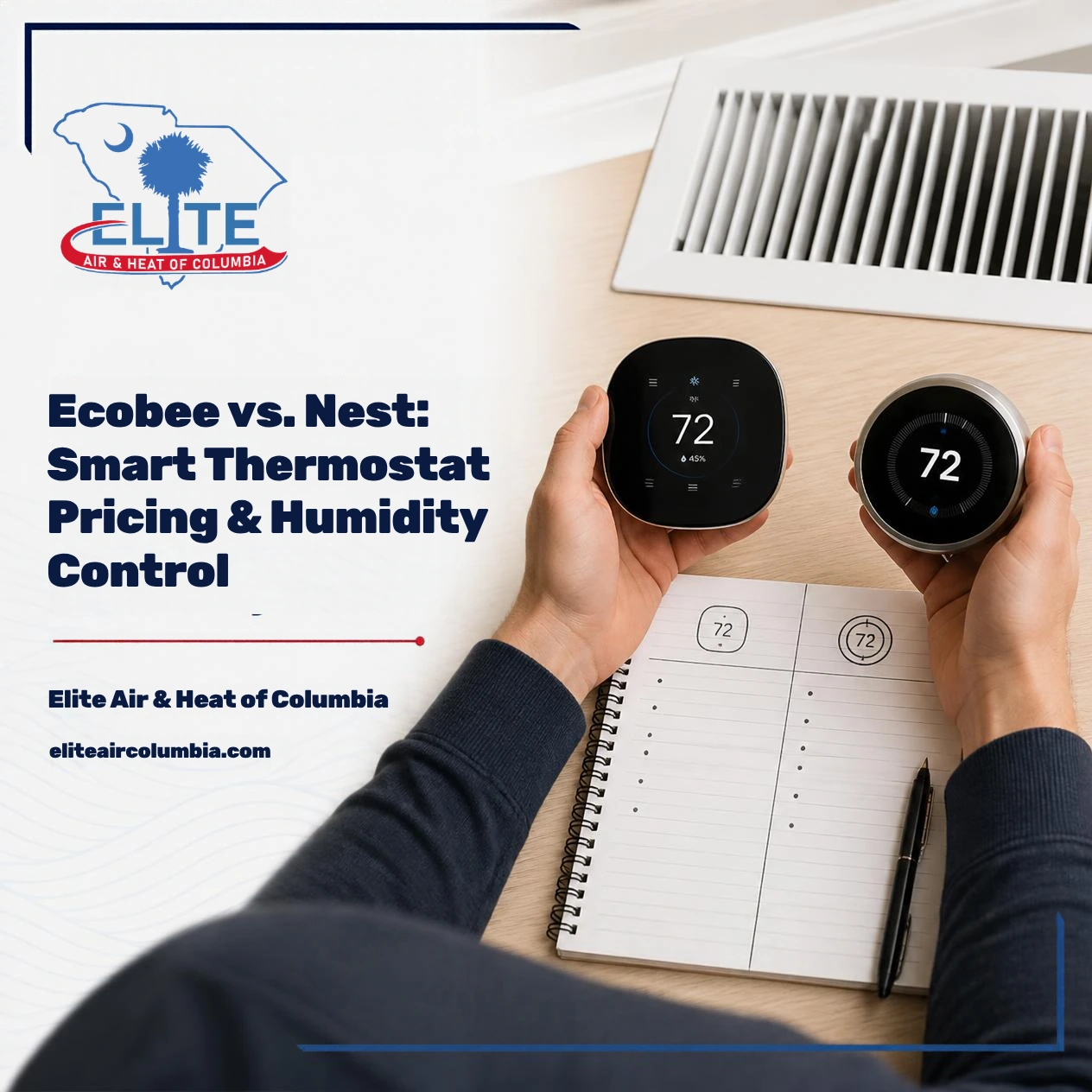
Two of the biggest names are ecobee and Google Nest.
As of September 2026, ecobee’s main U.S. lineup starts at $139.99 for the Smart Thermostat Essential, $199.99 for the Enhanced, and $259.99 for the Premium. Google’s 4th-generation Nest Learning Thermostat carries a regular Google Store price of $279.99, although Google was advertising it for $239.99 at the time of writing.
Which one makes the most sense for a humid Columbia home?
It depends on whether you value more hands-on humidity control or more automated comfort management.
Ready to Upgrade Your Thermostat?
Get professional Ecobee or Nest installation for better comfort and humidity control in Columbia. Call now!
Why Humidity Matters So Much in Columbia
When homeowners talk about comfort, they usually talk about temperature.
Humidity can be just as important.
Your air conditioner removes both heat and moisture from indoor air. Warm air passes across the cold evaporator coil, moisture condenses on the coil, and that water drains away.
The longer the AC operates under appropriate conditions, the more opportunity it generally has to remove moisture.
Problems begin when the system:
- Is oversized
- Short-cycles
- Has incorrect airflow
- Has duct leakage
- Has refrigerant problems
- Runs the fan improperly
- Cannot keep up with moisture entering the home
A smart thermostat can help manage some of these conditions.
It cannot fix all of them.
That distinction is essential when comparing ecobee and Nest.
ecobee Pricing in 2026
Ecobee currently offers three main thermostat levels.
ecobee Smart Thermostat Essential: $139.99
This is ecobee’s lower-cost option.
It still includes smart scheduling, app control, occupancy-related features, and an especially useful function for South Carolina homeowners: AC Overcool to Dehumidify.
Ecobee says this feature can allow the air conditioner to continue cooling beyond the normal temperature setpoint when indoor humidity is high.
For homeowners mainly interested in scheduling, app control, and basic humidity assistance, the Essential deserves consideration.
ecobee Smart Thermostat Enhanced: $199.99
The Enhanced adds more advanced occupancy sensing, broader HVAC compatibility, and the ability to control one compatible HVAC accessory.
Ecobee currently says the Enhanced works with more than 90% of HVAC systems and includes its Power Extender Kit for homes without a conventional C-wire arrangement.
For many Columbia homes, we see this as the interesting middle ground.
You are getting most of the HVAC-control capability without paying for every premium smart-home feature.
ecobee Smart Thermostat Premium: $259.99
The Premium is currently ecobee’s flagship thermostat.
In addition to temperature and humidity functions, it includes:
- SmartSensor in the box
- Built-in occupancy sensing
- Indoor air-quality monitoring
- Smart-home integrations
- HVAC accessory support
- Three-year limited warranty
It can control one compatible accessory such as a whole-home humidifier, dehumidifier, HRV, or ERV.
For a Columbia homeowner already considering a whole-home dehumidifier, that accessory support can matter much more than the premium display.
Nest Learning Thermostat Pricing in 2026
Google’s current premium option is the Nest Learning Thermostat, 4th generation.
Its regular Google Store price is $279.99, although the Store was showing a discounted $239.99 price when we checked in September 2026. Temporary promotions can change, so we would compare the current checkout price rather than assuming that sale will always be available.
The 4th-gen Nest includes sensors for:
- Temperature
- Humidity
- Motion
- Ambient light
It also supports up to three stages of heating and cooling on compatible systems, heat pumps with auxiliary or emergency heat, and dedicated connections for humidification, dehumidification, or ventilation equipment.
So from a pure HVAC capability standpoint, the latest Nest is much more than a pretty thermostat.
ecobee’s Big Humidity Feature: AC Overcool Max
For Midlands homeowners, one of ecobee’s most useful features is AC Overcool Max.
Here is the basic idea.
Suppose you normally keep the thermostat at 74°F.
Indoor humidity becomes uncomfortable.
Instead of shutting the AC off immediately when the house reaches 74°F, ecobee can allow the equipment to continue cooling slightly below that temperature in an attempt to remove more moisture.
The homeowner chooses how much overcooling is acceptable.
Ecobee’s documentation explains that the thermostat can stop once either the desired humidity level is reached or the permitted overcooling limit is reached.
That gives ecobee a very practical advantage for homeowners who like to fine-tune their system.
Instead of simply telling the thermostat:
“Cool to 74.”
you are effectively telling it:
“Aim for 74, but if humidity is still too high, I am comfortable allowing a little extra cooling.”
ecobee Can Also Use an Actual Humidity Setpoint
This is where ecobee becomes particularly interesting for Columbia.
Its Dehumidify Using AC settings can be configured around a desired relative-humidity level.
Ecobee’s documentation shows homeowners selecting a specific humidity target and combining it with an allowed overcool amount.
That gives homeowners fairly direct control.
For someone who regularly watches indoor humidity and thinks in terms of:
“I want to keep this house around 50% to 55% RH,”
ecobee’s approach makes sense.
But there is a limit.
Overcooling with the AC is not a substitute for a properly sized whole-home dehumidifier when the home has a serious moisture problem.
ecobee Also Adjusts Comfort Based on Humidity
Another feature, called Adjust Temperature for Humidity, considers the way humidity changes how temperature feels.
Ecobee says the feature uses a “feels-like” temperature to adjust HVAC operation rather than reacting only to the dry-bulb temperature on the thermostat.
That is useful in Columbia because 74°F at moderate humidity can feel completely different from 74°F at very high humidity.
This is one reason we prefer homeowners to stop treating temperature as the only comfort measurement.
Nest’s Answer: Cool to Dry
Google Nest approaches the same problem with its Cool to Dry feature.
When humidity becomes excessive, Nest can use a compatible air conditioner or heat pump to provide additional cooling and moisture removal.
Google says Cool to Dry can operate even with an AC that does not have a dedicated dehumidification mode. If the HVAC system does have built-in dehumidification capability, Nest can integrate with that too.
The thermostat may allow the house to cool somewhat below its normal temperature setting to remove additional moisture.
Sound familiar?
The broad strategy is similar to ecobee’s.
Keep the cooling system running longer when humidity requires it.
Nest’s Newer Humidity Helper Adds More Control
The 4th-generation Nest Learning Thermostat goes considerably further than older Nest models.
Google’s current Humidity Helper includes:
- Smart Humidity
- Cool to Dry
- Humidifier control
- Dehumidifier control
- Quiet Time scheduling
The 4th-gen thermostat has dedicated support for compatible whole-home humidification and dehumidification systems.
Homeowners can also adjust advanced Cool to Dry settings including:
- Overcooling limit
- Humidity threshold
- Minimum indoor temperature
That closes part of the control gap between modern Nest and ecobee.
Nest Also Has Adaptive Comfort
One of the more interesting 4th-gen Nest features is Adaptive Comfort.
Instead of simply looking at the thermostat’s temperature reading, Adaptive Comfort can consider:
- Indoor humidity
- Forecast weather
- Characteristics Nest has learned about the home
For example, Google says the thermostat may slightly lower the cooling temperature during particularly humid conditions to maintain a more consistent perceived level of comfort.
That approach is very Nest.
The system attempts to make the decision for you.
Ecobee generally gives technically inclined homeowners more obvious controls.
Nest leans more heavily into automation.

Why Your AC Is “Freezing Up” in 95-Degree Heat (And What to Do in the First 10 Minutes)
It feels backwards, but one of the most common summer AC problems in Columbia is an air conditioner literally freezing…
ecobee vs. Nest: Which Has Better Humidity Control?
For manual humidity tuning, we would give ecobee the advantage.
Features such as AC Overcool Max and the ability to work around a desired humidity target make the control strategy fairly transparent.
You can see what the thermostat is trying to accomplish and set boundaries.
For automatic humidity-aware comfort, the 4th-gen Nest has become much more competitive.
Humidity Helper, Cool to Dry, and Adaptive Comfort allow Google to incorporate moisture into the overall comfort strategy without requiring the homeowner to think constantly about every setting.
So the question becomes:
Do you want more control, or do you want more automation?
What About Remote Temperature Sensors?
Both ecosystems offer room-sensor strategies.
This is important in two-story Columbia homes where upstairs bedrooms can be several degrees warmer than the hallway where the thermostat is mounted.
The ecobee Premium includes a SmartSensor in the box. Ecobee sensors can help the thermostat consider temperatures and occupancy in other rooms rather than relying entirely on the thermostat location.
The 4th-generation Nest Learning Thermostat also supports Nest Temperature Sensors, and Google includes a sensor with the current 4th-gen setup.
This does not create true HVAC zoning.
If you have one central system serving the whole house, the thermostat cannot magically send cold air only to the upstairs bedroom unless the HVAC system itself has zoning capability.
But remote sensors can help the control system make better decisions about where comfort matters.
Does ecobee Premium’s Air-Quality Monitor Help With Humidity?
Indirectly.
The Premium’s built-in indoor air-quality monitor is one feature that separates it from the Enhanced.
That can be useful for households interested in a broader picture of indoor conditions.
But do not confuse air-quality monitoring with humidity control.
You do not need the Premium solely to know that Columbia is humid.
If your primary goal is HVAC scheduling and humidity management, the Enhanced may provide the better value depending on equipment compatibility.
The Premium makes more sense when you also value:
- Included SmartSensor
- Indoor air-quality monitoring
- Higher-end smart-home features
The Price Comparison
At current list pricing, the comparison looks roughly like this:
| Thermostat | Current Price* | Best Fit |
| ecobee Essential | $139.99 | Budget smart control with basic humidity assistance |
| ecobee Enhanced | $199.99 | Strong HVAC and humidity value |
| ecobee Premium | $259.99 | Humidity control plus sensor and IAQ features |
| Nest Learning Thermostat 4th Gen | $279.99 MSRP | Advanced automation, humidity features, Google ecosystem |
*Prices checked in September 2026 and subject to change. Google was also advertising the 4th-gen Nest at $239.99 when checked.
That means the hardware-price difference between ecobee Premium and Nest 4th gen is relatively small at regular pricing.
The more interesting comparison may actually be:
ecobee Enhanced at $199.99 vs. Nest Learning 4th Gen at $279.99 MSRP.
If the Enhanced supports everything your particular HVAC system needs, that roughly $80 difference may be difficult to justify solely for humidity control.
Check Dominion Energy Rebates Before Paying Full Price
Columbia-area homeowners served by Dominion Energy South Carolina should also check current utility incentives before buying.
Dominion’s current smart-thermostat program advertises rebates of up to $50 per qualifying ENERGY STAR-certified thermostat, subject to eligibility and its qualified-model requirements. Customers can receive qualifying incentives through its marketplace, participating retailers, or an after-purchase rebate process.
Programs and qualifying models can change.
Check the current rebate before choosing the thermostat rather than assuming every Wi-Fi thermostat qualifies.
A $50 incentive can make the effective difference between two models much smaller.
Don’t Buy a Thermostat Until You Check HVAC Compatibility
This is where we see homeowners get into trouble.
A thermostat may look compatible because the old thermostat has similar wires.
That does not guarantee it can properly control every HVAC feature.
Your system may have:
- Two-stage cooling
- Variable-speed operation
- Heat pump
- Auxiliary heat
- Dual fuel
- Whole-home dehumidifier
- Whole-home humidifier
- Ventilator
- Communicating controls
The Nest Learning Thermostat 4th gen can currently support up to three stages of heating and cooling on compatible systems and has dedicated functionality for certain humidity and ventilation accessories.
Ecobee Premium supports one HVAC accessory and is optimized for conventional and multistage equipment, including compatible heat pumps.
But neither thermostat is universally compatible with every proprietary communicating HVAC system.
That needs to be checked before purchase.
A Smart Thermostat Cannot Fix an Oversized AC
This is probably the most important Columbia humidity point in this entire comparison.
Suppose your AC is oversized.
It blasts the house down to 72°F in a few minutes and shuts off.
Temperature looks great.
Humidity stays high because the system does not run long enough to remove enough moisture.
Ecobee can attempt some additional overcooling.
Nest can use Cool to Dry.
But neither thermostat changes the fact that the HVAC equipment may be too large for the home’s cooling load.
The same applies to:
- Duct leakage
- Incorrect airflow
- Dirty evaporator coil
- Refrigerant problems
- Poor insulation
- Excessive outdoor-air infiltration
Do not spend $280 on a thermostat expecting it to solve a mechanical or building-envelope problem.
When You Actually Need a Whole-Home Dehumidifier
If indoor humidity routinely remains high even when the AC is operating properly, a dedicated dehumidifier may deserve consideration.
This becomes particularly relevant during mild but humid weather.
The house may have plenty of moisture but not enough sensible heat to trigger long cooling cycles.
A thermostat cannot force the AC to run indefinitely without eventually making the house too cold.
That is where a dedicated dehumidifier has an advantage.
Both the ecobee Premium and Nest Learning Thermostat 4th gen can work with compatible humidity-control accessories when properly configured.
Which Would We Choose for a Columbia Home?
For a homeowner primarily focused on humidity control and HVAC tuning, we like the control philosophy of ecobee.
The Smart Thermostat Enhanced is especially compelling because it costs less than both premium options while still delivering strong HVAC-management capability.
The ecobee Premium makes more sense when the included sensor, air-quality monitoring, and broader smart-home functions matter to you.
The Nest Learning Thermostat 4th gen is an excellent alternative for someone who prefers the Google Home ecosystem and wants automation features such as Adaptive Comfort, Smart Schedule, and Humidity Helper doing more of the decision-making automatically.
We would not choose based on the logo.
We would choose based on the HVAC system behind the wall.
Let Elite Match the Thermostat to Your HVAC System
At Elite Air & Heat of Columbia, we install and troubleshoot smart and programmable thermostats throughout Columbia and the surrounding Midlands. Our thermostat services focus on more than connecting Wi-Fi. The thermostat needs to work correctly with the equipment, staging, heat-pump controls, airflow strategy, and humidity goals of the house.
If Columbia humidity is your main concern, we can determine whether an ecobee or Nest upgrade is likely to help or whether the real issue is somewhere deeper in the HVAC system.
Maybe you need better thermostat settings.
Maybe you need longer cooling cycles.
Maybe the blower configuration needs adjustment.
Maybe you need a dedicated dehumidifier.
Or maybe the system is simply oversized.
Call Elite Air & Heat of Columbia at (803) 368-4663 or schedule thermostat and HVAC service online. We can help you choose a thermostat based on what your home actually needs rather than paying for features your HVAC system cannot use.
Take Control of Indoor Humidity!
Keep your Columbia home comfortable with a smart thermostat. Call today for expert installation!